Fresh allegations to the U.N. intensify a regional shadow war as evidence mounts of foreign fighters and weapon flows—claims Abu Dhabi strongly denies

PORT SUDAN/NAIROBI — Sudan’s military authorities have escalated their diplomatic offensive, accusing the United Arab Emirates of sponsoring and ferrying Colombian mercenaries to fight alongside the paramilitary Rapid Support Forces (RSF). The charge, delivered in letters to the United Nations in recent weeks and reiterated by army-aligned officials, could redraw the contours of an already internationalized war—and sharpen scrutiny on the role of private military recruiters operating across borders.
The Emirati government rejects the allegations as fabricated, portraying itself as a major humanitarian donor to Sudan’s civilians. But Sudanese officials insist they have gathered testimonies, travel documents and flight data pointing to a pipeline of former Colombian soldiers, hired through private security firms with links to the Gulf, flown through staging points in North Africa and then onward to RSF-controlled territory. Independent investigators and open-source analysts have, since late 2024, documented the presence of hundreds of Latin American fighters in Darfur—lending weight to claims that the conflict has become a magnet for foreign guns.
What’s new is Khartoum’s effort to frame the phenomenon as state-enabled. In filings and public statements, officials cite flight manifests and cargo operations allegedly chartered from Emirati airports, as well as testimony from captured fighters who say they were promised oil-facility guard jobs in the Gulf, only to find themselves moving overland from Libya into Sudan. Some recruits describe a recruitment chain that began on WhatsApp or via small Colombian agencies offering security work abroad; others say they signed contracts they did not fully understand. Most are ex-soldiers in their 30s and 40s, trained during Colombia’s decades-long internal war and prized for their discipline and battlefield experience.
Analysts say the mercenary pipeline sits atop a broader web of regional interference. Since Sudan’s war erupted in April 2023, the RSF—born from the Janjaweed militias—has leveraged cross-border logistics, commerce, and weapons smuggling to sustain its campaign across Darfur and the capital region. The Sudanese Armed Forces (SAF), for their part, have turned to their own external partners and procurement channels. Each side accuses the other of importing drones, armored vehicles and ammunition in defiance of U.N. restrictions. U.N. experts this year noted the presence of foreign fighters in Darfur, including Colombians, and documented new weapons streams into the theater.
In early August, the army-aligned administration publicly alleged that an Emirati aircraft ferrying fighters was destroyed on the tarmac in Nyala, killing dozens—an account that could not be independently verified and that the UAE dismissed. Days later, Khartoum’s diplomats signaled the matter would be raised at the U.N. General Assembly and Security Council, alongside a call for tighter enforcement of the Darfur arms embargo and fresh sanctions against entities alleged to be recruiting or transporting foreign combatants. The International Criminal Court has already expanded its inquiries into atrocities in Darfur, while rights groups argue that new evidence of outside sponsorship heightens the need to curb illicit supply lines.
For Abu Dhabi, the stakes are reputational and strategic. The UAE has cultivated a profile as a logistics hub and an aid super-donor, while also projecting influence across the Red Sea corridor. Emirati officials say that any claims of state sponsorship of mercenaries are baseless and politically motivated, and that the country is focused on diplomacy and relief operations. Privately, regional diplomats warn that proving direct government control over private recruiters will be difficult; nonetheless, aviation routes, cargo leasing patterns, and the scale of deployments alleged by Sudanese officials imply at least tacit approval somewhere along the chain. Whether that crosses the line into legal responsibility could become a central question in coming proceedings.
Colombia’s angle reflects a global industry. For more than a decade, retired Colombian soldiers have been tapped for private security and war-zone contracts from Yemen to the Sahel—drawn by pay scales that can dwarf pensions back home. Investigations by Latin American and African media since late 2024 identified networks that advertised ‘protection’ or ‘infrastructure security’ jobs, sometimes routing recruits through third countries. Families in Bogotá and Medellín say they lost contact with loved ones after they crossed into Libya; others recount frantic voice notes from men who realized too late that they had been diverted to Sudan. Colombia’s government has faced pressure to disrupt recruitment rings and assist return efforts.
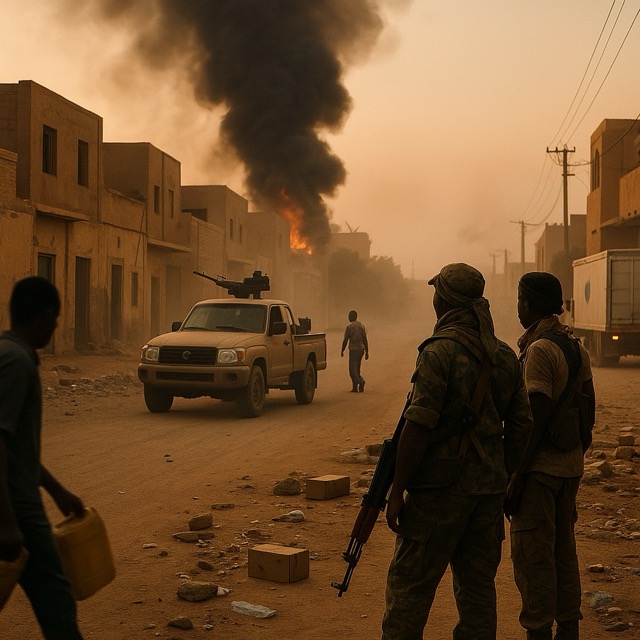
Inside Sudan, the impact of foreign fighters is felt in the RSF’s siege-and-starve tactics as well as in pitched battles for urban centers. In North Darfur’s capital El Fasher, months of RSF encirclement have cut road access and strangled humanitarian delivery—contributing to confirmed famine in parts of the region and pushing families into catastrophic hunger. Aid agencies say the lines between front-line logistics and smuggling routes are porous: the same tracks that bring in ammunition also tax or block the convoys that carry grain and medicine. Meanwhile, the SAF has intensified airstrikes and counteroffensives, displacing more civilians even as it touts gains on the battlefield.
By most metrics, the war has become the world’s largest displacement crisis. U.N. agencies and humanitarian groups estimate that roughly 12 to 13 million people have fled their homes since April 2023, including millions within Sudan and others spilling into Chad, South Sudan, and Egypt. Researchers warn that official death counts—often cited around the tens of thousands—likely understate the toll, given limited access and the collapse of civil registries. With famine deepening, aid officials argue that constraining external arms and fighter flows is inseparable from restoring humanitarian access.
The mercenary story matters because it intersects with accountability. If states are found to have enabled the deployment of foreign fighters—directly or through controlled intermediaries—pressure will mount for embargo expansions, targeted sanctions, and possibly reparations claims. Rights monitors have already urged countries to suspend arms exports to governments credibly accused of re-transferring weapons into Sudan. A growing chorus in Western legislatures has called for inquiries into whether commercial partners—and the banks and insurers behind them—are facilitating violations of international law.
For now, the evidence chain is still being built. Sudanese officials say they are compiling testimonies and travel traces; open-source researchers are matching faces to passports and mapping routings through regional airfields; and families in Colombia are piecing together the recruitment web. The UAE’s denials will be tested as these dossiers land in courtrooms and at the U.N. If confirmations multiply—of chartered flights, of payrolls, of command links—the war’s profile could shift from a domestic power struggle to a proxy contest with clearer lines of responsibility. That, in turn, could open pathways to curb the flow of guns and men into Sudan—and, more importantly, to save lives.
What to watch in coming weeks: whether new U.N. reporting corroborates the scale of foreign-fighter deployments alleged by Sudan; if Colombia announces prosecutions targeting recruiters; whether Emirati authorities open formal investigations into private security contractors; and if any state moves to widen the arms embargo beyond Darfur to all of Sudan. The answers will determine not just the credibility of Khartoum’s accusations, but the trajectory of a war whose epicenter lies in Sudan—and whose supply lines, increasingly, do not.