Europe lines up strategic guarantees for Kyiv, but Putin’s red lines — and Trump’s energy ultimatum — narrow the path
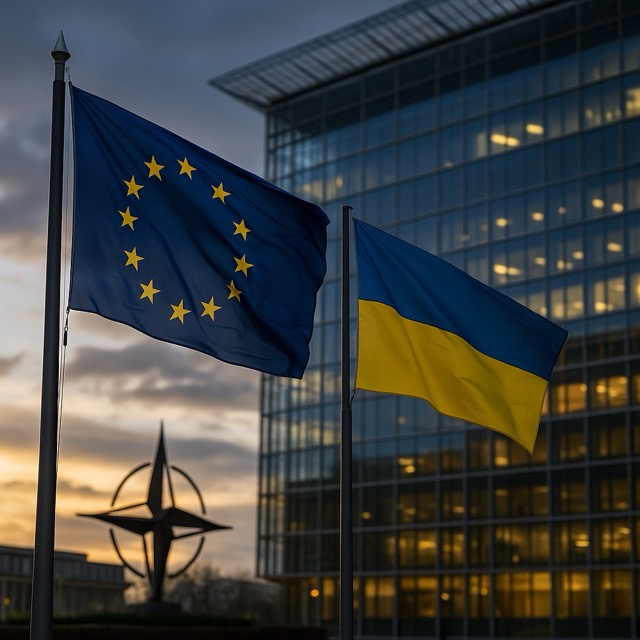
BRUSSELS – European governments say they are ready to anchor Ukraine’s security for the long haul. In Paris this month, leaders from across the continent rallied behind a plan to provide postwar guarantees “on land, at sea and in the air,” with France proclaiming that twenty‑six allied states are prepared to act the day the guns fall silent. The promise, a European answer to years of debate over NATO membership for Kyiv, is meant to deter a future attack by locking in military aid, training and a standing multinational presence that would make any renewed assault vastly more costly.
The architecture is still on the drawing board—and so are the risks. Vladimir Putin continues to sketch his own “red lines,” from warnings against any Western troop presence in Ukraine to threats over long‑range strikes into Russian territory. Moscow’s updated nuclear doctrine and periodic escalatory rhetoric have not stopped Europe from arming Kyiv, but they have shaped every decision about pace and posture. The result is a strategy that is both more muscular than in 2022 and still deliberately calibrated to avoid a direct NATO‑Russia clash.
The new European framework builds atop dozens of bilateral security agreements signed since last year and the G7’s long‑term pledge. What makes September’s initiative different is scope and sequencing: a coalition of the willing would assemble a deterrent package that switches on immediately after a ceasefire or peace deal—ranging from air‑defense coverage and maritime security to training missions and sustained funding lines. Several capitals, notably Paris and London, have left open the possibility of a limited troop presence in Ukraine once active hostilities end, while others prefer “outside‑in” support from neighboring NATO territory.
The effort is also a message to Washington. One day before the Paris pledge, President Donald Trump said the United States is “ready” to slap new sanctions on Moscow—if, and only if, all NATO members stop buying Russian oil and adopt similar measures. He paired the challenge with a call for 50% to 100% tariffs on China as leverage against what he described as Beijing’s economic lifeline for the Kremlin. The ultimatum thrilled some hawks in Eastern Europe and irritated others who heard a familiar refrain: American pressure conditioned on allied unanimity that does not yet exist.
Energy flows make Trump’s condition a hard needle to thread. The European Union’s 2022 ban on seaborne Russian crude slashed imports by roughly nine‑tenths, but pipeline oil still reaches Hungarian and Slovak refineries under exemptions, and Russian liquefied natural gas keeps docking at ports in France, Spain and Belgium. Turkey, a NATO member outside the EU, remains a large buyer of Russian oil. Brussels now says the bloc can phase out Russian gas by 2028—and perhaps faster under U.S. pressure—but for now around one‑eighth of Europe’s gas supply still comes from Russia, directly or as LNG resold through hubs.
This energy patchwork feeds the politics of caution. Leaders who remember the price spikes of 2022 are leery of fresh shocks, and the Kremlin knows it. When shelling and drone strikes temporarily shut the Druzhba pipeline to Central Europe in August, ministers scrambled to reassure markets. The episode underlined how a single disruption can ripple through a continent that is stronger than it was two years ago but not yet insulated from energy coercion.
Security risks are no less immediate. In recent days Polish air defenses intercepted Russian drones that strayed into NATO airspace, prompting urgent consultations in Brussels. The incident did not trigger Article 5, but it did intensify debate over how close Europe is willing to press its advantage. Ukraine’s battlefield needs have pushed allies to green‑light longer‑range weapons and more permissive rules of engagement; each step has come after weeks of argument about where “red lines” actually lie—and what Moscow would really do if they were crossed.
For all the talk of limits, Moscow’s red lines have been elastic. The Kremlin has repeatedly declared that Western tanks, then F‑16s, then long‑range missiles would cross thresholds—with dire consequences. Each arrival has brought new threats but little beyond intensified strikes and mobilization at home. That does not mean Russia is bluffing about everything. Putin’s most consistent warning is against NATO troops fighting in Ukraine. European planners assume that line will hold throughout the war—and build their postwar guarantees around it.
Inside the EU, the center of gravity has shifted east and north—to states that never tire of reminding their partners that deterrence is about the enemy’s perceptions, not our intentions. The Baltics and Poland champion hard timelines for air‑defense cover and ammunition production; the Nordics push maritime security in the Baltic and the High North; the Netherlands, Italy and Spain argue for a sustained naval presence in the Black Sea to keep grain routes open under a Ukrainian flag. France frames the whole effort as a sovereign European project that complements NATO and signals staying power, not strategic autonomy at America’s expense.
Money remains the hinge. Kyiv’s defense now rests on predictable shells, interceptors and spare parts more than on any single silver‑bullet system. Europe’s defense industry has ramped up output since 2023 but still struggles with multiyear contracts and fragmented procurement. The European Commission is proposing to tie Ukraine support to a longer‑term industrial plan—guaranteed orders for air defense, joint training pipelines for F‑16s, and a permanent munitions consortium that keeps factories loaded even if annual budgets wobble.
None of this answers the ultimate question: What security promise can deter a Kremlin that talks about red lines one day and redraws them the next? In late summer, Russian officials again floated peace terms that would carve up Ukraine and forbid Western troops on its soil; European leaders dismissed the overture as coerced capitulation. The emerging consensus is to lock in long‑range support for Kyiv while keeping escalation management front and center—arming Ukraine to defend itself, accelerating air defense and precision strike, and preparing, visibly, for quick reinforcement the day a ceasefire takes hold.
That is the paradox of the willing. Europe is bolder than at any point since 2022, yet it is still navigating a narrow channel—between an American president who conditions pressure on unity that does not yet exist, and a Russian president who weaponizes ambiguity. The next months will test whether the coalition’s thousand moving parts can assemble into a credible shield. If they do, it will be because Europe learned to turn its caution into staying power—and to make guarantees that matter even when margins are tight.
Sources
• Reuters, Sept. 4, 2025: “26 nations vow to give Ukraine postwar security guarantees, Macron says.”
• IRIS (Paris), Sept. 2025: “War in Ukraine: New Western Security Guarantees?”
• Foreign Affairs, Sept. 2025: “A Better Way for Europe to Guarantee Ukraine’s Security.”
• Atlantic Council, Sept. 4, 2025: “Twenty-six European countries have committed to help defend Ukraine after the war.”
• EUISS Commentary, Sept. 2025: “Europe should be willing to take more risks.”
• Reuters, Sept. 13, 2025 & AP, Sept. 13, 2025: Trump urges NATO allies to halt Russian oil purchases; says U.S. ‘ready’ for sanctions if allies comply.
• The Guardian & Sky News, Sept. 13, 2025: Coverage of Trump’s oil ultimatum and tariff threat on China.
• Reuters, Sept. 5 & 10, 2025: EU plans to phase out Russian oil and gas by 2028; imports cut ~90% for seaborne crude; gas share ~13% this year.
• IEEFA & CREA, 2024–2025: Europe’s Russian LNG flows concentrated in France/Spain/Belgium; July 2025 fossil‑fuel import estimates.
• Reuters, Aug. 18–22, 2025: Druzhba pipeline disruptions and resumption after strikes.
• Reuters, Sept. 27, 2024 & Feb. 27, 2024: Putin’s nuclear ‘red line’ statements; Kremlin warnings on NATO troops in Ukraine.
• Reuters, Aug. 21, 2025: Reported Russian demands in exploratory talks (Donbas, no NATO, no Western troops).


 The Tower Post