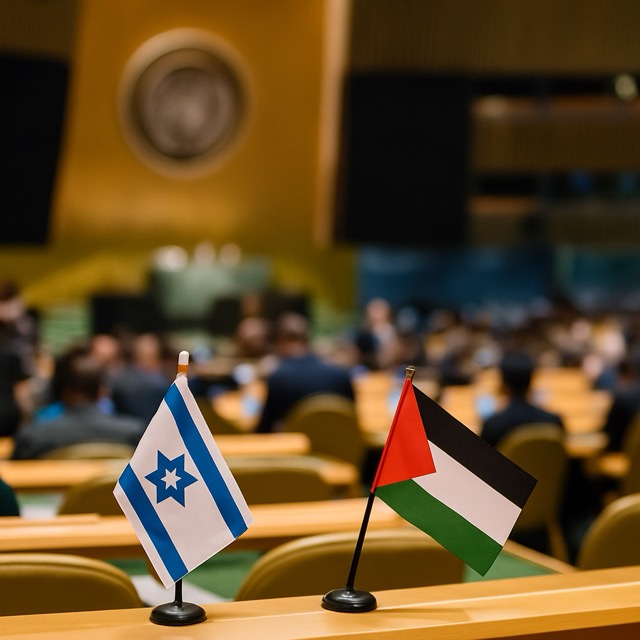
General Assembly condemns the Oct. 7 attacks, urges the release of hostages and a transfer of Gaza’s governance to the Palestinian Authority. Italy votes yes to the ‘New York Declaration’.

NEW YORK – The United Nations General Assembly on Friday overwhelmingly endorsed a roadmap to a two-state solution that explicitly excludes Hamas from governance, condemns the group’s Oct. 7, 2023 attacks on Israel and calls for the immediate release of all hostages. The nonbinding resolution—formally adopting the ‘New York Declaration’ drafted by France and Saudi Arabia—passed by 142 votes to 10, with 12 abstentions, after days of fraught diplomacy at Turtle Bay.
The declaration lays out time‑bound, “irreversible steps” for Israelis and Palestinians to reach a negotiated peace, while envisaging a temporary international stabilization presence in Gaza and the West Bank. It calls for Hamas to disarm and for administrative and security responsibilities in the Gaza Strip to be transferred to the Palestinian Authority (PA), with international backing, as part of a sequence intended to restore basic services, protect civilians and restart political talks.
Israel blasted the vote as “disgraceful,” arguing it rewards Hamas and undermines efforts to free the captives still held in Gaza. “This declaration detaches diplomacy from reality,” an Israeli official said, pointing to ongoing rocket fire and cross‑border skirmishes. The United States also opposed the measure, warning it could complicate sensitive negotiations. Most European Union members backed the text; Italy voted in favor and said it helped shape the language, calling it a necessary step to revive a credible peace track.
The resolution carries moral and political weight even if it does not impose legal obligations. Supporters say it fills a vacuum left by the Security Council, where divisions have hardened, by setting an international baseline: a permanent ceasefire tied to the release of all hostages; the withdrawal of armed groups from population centers; the return of displaced Palestinians; and a phased reopening of Gaza’s borders under coordinated international supervision.
For many diplomats, the text’s most consequential innovation is its clarity that Hamas cannot be part of Gaza’s future government. That formula—long discussed in European and Arab capitals—was rarely written so starkly into a UN document. The sponsors argue that removing Hamas from the equation is a prerequisite to reunifying Palestinian institutions under the PA and to re‑establishing a single legitimate counterpart for Israel across the West Bank and Gaza.
At the same time, the declaration shies away from unqualified endorsement of either side’s conduct since the war erupted nearly two years ago. It condemns Hamas’s massacre and kidnappings on Oct. 7 and demands the hostages’ release, while also decrying the scale of Israel’s military response and the humanitarian toll in Gaza. UN officials and aid agencies report widespread devastation, strained hospitals and interrupted food supplies. Donor states are preparing a stepped‑up logistics surge—fuel, field hospitals, shelter and de‑mining—should a ceasefire take hold.
The mechanics of the envisaged stabilization mission remain deliberately open. Diplomats are debating a light‑footprint security presence authorized by the UN but staffed predominantly by willing regional contributors, alongside robust civilian components to restore water, electricity and schooling. Several capitals stress that any presence must be invited by and work through the PA, to avoid perceptions of imposed trusteeship.
Reaction across capitals tracked familiar lines. France and Saudi Arabia hailed a “landmark” that holds perpetrators of the Oct. 7 atrocities to account while giving international cover to recognize a Palestinian state. Several countries—including the United Kingdom, Canada, Australia and Belgium—signaled they are prepared to move on recognition during high‑level week at the UN later this month, a step supporters say could lock in momentum toward final‑status talks.
Jerusalem, meanwhile, is bracing for diplomatic and legal headwinds. Prime Minister Benjamin Netanyahu has repeatedly rejected any path that, in his view, risks a hostile state on Israel’s borders. Israeli officials insist lasting security must precede statehood talks and have pressed for Arab partners to shoulder more responsibility for border security and reconstruction, particularly along the Rafah and Kerem Shalom crossings. They also argue that the PA must undertake deep governance reforms to be a credible alternative to Hamas.
Within the Palestinian arena, the declaration adds urgency to a long‑stalled reconciliation agenda. PA officials welcomed the vote as a mandate to re‑establish their authority in Gaza, but they face daunting tasks: rebuilding battered institutions; integrating civil servants; reviving a collapsed economy; and preparing for elections that could refresh a leadership without broad democratic legitimacy. Beyond Gaza, rising settler‑Palestinian violence and continued settlement expansion in the West Bank have further poisoned the atmosphere for talks.
For Rome, the vote capped months of coordination with Paris, Riyadh and Washington. Italy’s foreign ministry said the declaration reflects key European priorities: a hostage deal as part of a durable ceasefire; a credible path to Palestinian statehood within a secure regional architecture; and a clear rejection of terrorist actors in any future governance. Italian officials also back tight oversight of reconstruction funds to ensure they strengthen reformed Palestinian institutions rather than armed factions.
Whether the General Assembly’s signal changes facts on the ground will depend on actors far from the marble halls of New York. The war has splintered Gaza’s neighborhoods and displaced families across the strip and into the Sinai border zone, while northern Israel remains on edge amid exchanges with Hezbollah. U.S., Egyptian and Qatari mediators continue to shuttle between capitals, seeking a sequencing that trades a sustained halt to fighting for hostage releases, prisoner exchanges and phased Israeli withdrawals.
Even critics acknowledge the declaration forces overdue choices. If Hamas refuses to disarm and relinquish control, it risks greater isolation not only in Western capitals but in parts of the Arab world that have shown impatience with maximalist rhetoric. If Israel rejects the international consensus outright, it faces the prospect of diplomatic isolation of its own and growing pressure from traditional partners to articulate an alternative that leads to separation and security for both peoples.
For now, the vote gives diplomats a new reference point: a timeline, post‑conflict governance principles and a sketch of what a monitored calm could look like. But like every UN blueprint in this conflict, its success will be measured not by lopsided vote tallies but by whether Israeli and Palestinian civilians see tangible relief—and whether leaders on all sides are willing to convert the Assembly’s words into a workable deal on the ground.
Sources (selected):
— United Nations General Assembly vote adopting the ‘New York Declaration’, Sept. 12, 2025; reporting by Reuters, AP, the Guardian and Al Jazeera.
— Italian Ministry of Foreign Affairs statement confirming Italy’s ‘Yes’ vote and support for the text.