Herzi Halevi’s admission aligns with Gaza casualty data while an intelligence rift over strikes in Qatar rattles ceasefire diplomacy
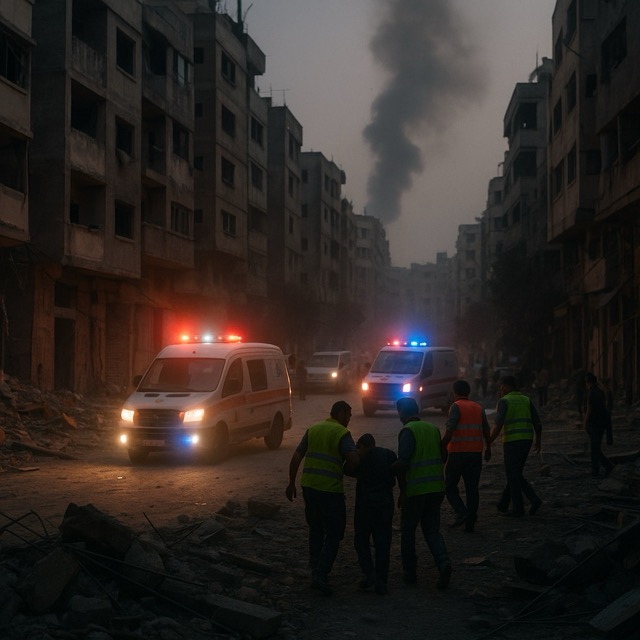
TEL AVIV / DOHA / GAZA CITY – In a candid exchange with residents of a southern Israeli farming community this week, Israel’s former chief of staff Herzi Halevi acknowledged that the war in Gaza has killed or injured “more than 200,000” Palestinians since October 2023—roughly a tenth of the enclave’s prewar population. The disclosure, captured in a recording published by Israeli outlet Ynet and reported internationally, marks one of the first times a top Israeli commander has publicly echoed the overall casualty picture long cited by authorities in Gaza.
Halevi, who led the Israel Defense Forces (IDF) through the first 17 months of the conflict before stepping down in March, also described a campaign in which, as he put it, the army “took the gloves off from the first minute.” He said operational decisions under his tenure were never halted by legal advice—a claim that underscores the enduring debate over how Israel interpreted the laws of war as bombardment, evacuations and urban fighting reshaped the strip.
The former commander’s tally sits close to the latest figures released by Gaza’s health authorities, which list more than 64,000 dead and nearly 165,000 wounded. Israel has often questioned the ministry’s credibility, noting Hamas’s control of civil institutions in the territory, but the overall scale of destruction and injury described by Halevi lines up with what humanitarian agencies have recorded across months of strikes and ground incursions.
Halevi’s remarks come as the conflict threatens to metastasize beyond Gaza’s borders. On Tuesday, Israel launched a high‑risk strike in Doha targeting senior Hamas officials based in Qatar, an action that rattled the mediation track hosted there and drew condemnation from governments across the region. Qatari officials said several Hamas members were killed along with a Qatari internal security officer. Top negotiators survived. Israel has not detailed the operation publicly.
Multiple media accounts, citing U.S. and Israeli officials, say the raid was preceded by intense debate within Israel’s security establishment. The Mossad intelligence service—deeply involved in hostage and ceasefire talks via Doha—reportedly opposed carrying out a planned ground operation on Qatari soil, warning it would wreck the channel and jeopardize captives. With a ground option off the table, Israel ultimately executed an airstrike.
Further reporting indicates the strike involved air‑launched ballistic missiles fired from warplanes over the Red Sea—an unusual tactic that allowed Israel to hit a target more than a thousand kilometers away without publicly overflying several Arab states. Satellite imagery of the blast site shows a leveled villa compound on the outskirts of Doha.
Diplomatic blowback was immediate. Qatar summoned allied leaders and convened an Arab‑Islamic summit in its capital. Russia called the strike a violation of the U.N. charter. In Washington, the Trump administration signaled displeasure, and Secretary of State Marco Rubio shuttled to the region for consultations, even as the United States reaffirmed its commitment to Israel’s security and to the release of hostages.
Inside Israel, the episode sharpened a running argument over whether hitting Hamas leaders abroad helps or hurts ceasefire talks. Prime Minister Benjamin Netanyahu has argued the Doha‑based leadership remains the chief obstacle to a deal and that eliminating them would hasten the end of the war. Critics counter that the strike disrupted delicate negotiations and risks further regional escalation.
Halevi’s casualty estimate is significant as the war approaches its second anniversary next month. It tacitly acknowledges that the offensive’s human cost is not far off what Gaza’s authorities have claimed—numbers that, while not distinguishing between combatants and civilians, have been broadly consistent with assessments by international monitors. A report in the British press, citing leaked Israeli military data, suggested that a large majority of those killed by May were civilians.
The former chief has walked a public tightrope since January, when he tendered his resignation over the security failures of October 7 and the subsequent handling of the war. In recent days he told residents near the strip that the catastrophe of the Hamas assault was a “terrible failure” for which he bore responsibility. Yet his comments this week also implicitly defend the military’s latitude to act, framing legal oversight as a tool to justify operations internationally rather than to constrain them.
On the ground, the fighting has continued in Gaza City’s north and in the south around Rafah and Khan Younis, with fresh evacuation orders emptying neighborhoods for the second or third time. Aid agencies report mounting malnutrition and disease while reconstruction remains impossible amid the pace of strikes. The IDF says it is targeting Hamas’s remaining battalions and tunnel networks; Palestinian factions fire rockets sporadically toward Israel and conduct ambushes that continue to kill and wound Israeli troops.
The Doha operation, meanwhile, has injected new uncertainty into a diplomatic process already hobbled by maximalist demands. Hamas insists on a full Israeli withdrawal and a path to statehood; Israel insists on the release of all hostages and the group’s disarmament. With Doha shaken, Egypt and the U.N. are exploring whether talks can be re‑anchored elsewhere or whether Qatar can still serve as host with enhanced security guarantees.
For many Israelis, Halevi’s comments will be read against a broader reckoning over accountability. As protests continue in Tel Aviv and Jerusalem, critics say that operational bravado—“gloves off”—delivered neither decisive victory nor the return of all hostages, while exacting extraordinary costs on Palestinians and deepening Israel’s isolation. Supporters reply that the scale of Hamas’s October 7 atrocities left the army no ethical or strategic alternative but to dismantle the group by force, however long it takes.
What Halevi did make clear is the scale of the war’s human ledger: more than 200,000 dead and wounded in Gaza. Coupled with the choice to strike in Doha despite the risks, the admission lays bare a conflict increasingly fought on two fronts—one measured in neighborhoods reduced to rubble, the other in covert operations and diplomatic spats that can redraw the map of mediation. As the second year of the war looms, both fronts are converging in ways that will shape any eventual endgame.
Reporting based on: The Guardian; Reuters; The Wall Street Journal; Ynet; Times of Israel; Jerusalem Post; Associated Press.



 The Tower Post