As Erika Kirk vows her husband’s movement “will not die,” President Donald Trump confirms he’ll attend a stadium-scale memorial while White House aide Stephen Miller pledges the left “will live in exile.” Grief and politics now converge on Arizona.

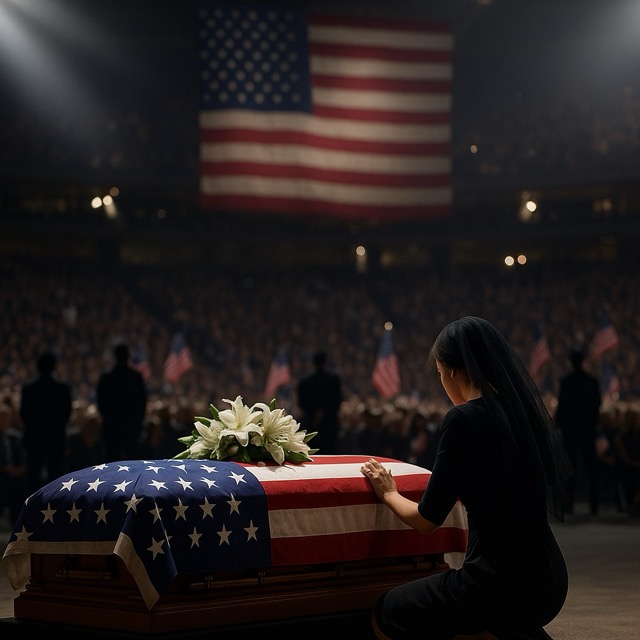
The pews were replaced by bleachers and the hush of sanctuaries by the acoustics of an NFL stadium, but the grief was unmistakably intimate. In a series of images and statements that ricocheted across social media over the weekend, Erika Frantzve Kirk was seen weeping over the open casket of her husband, conservative activist Charlie Kirk, and vowing to carry his mission forward. “You have no idea what you have unleashed within this wife,” she wrote, a message that landed like a vow and a warning to admirers and adversaries alike.
Four days after the 31-year-old Turning Point USA founder was fatally shot while speaking at Utah Valley University, preparations for a public farewell have accelerated. A memorial is being organized for Sunday, Sept. 21, at State Farm Stadium in Glendale, Arizona, where tens of thousands are expected to gather for a program that will blend personal remembrance with unmistakable political muscle. Former President Donald Trump has said he will attend. Vice President JD Vance—who helped escort Kirk’s casket onto Air Force Two for its flight back to Arizona—has joined the family in public moments of mourning.
In her first extended remarks since the killing, Erika told supporters she would ensure “the movement my husband built will not die.” At a brief appearance carried by conservative media, she thanked first responders and praised Trump and Vance for their support, then spoke directly to a jittery conservative base: “The cries of this widow will echo around the world like a battle cry.”
The assassination has already jolted the country’s political nervous system. Utah officials say the suspected gunman, 22-year-old Tyler Robinson, fired a single round from a rooftop roughly 200 yards from the student event where Kirk was taking questions. Investigators recovered a bolt‑action rifle and are analyzing ammunition that, according to state authorities, carried bizarre internet in‑jokes etched into the metal. Robinson is in custody and expected to be arraigned next week on aggravated‑murder and related charges. Officials have not announced a coherent motive.
The killing unfolded in the glare of smartphones and livestreams, and the aftermath—angry posts, vigil clips, and calls for justice—has been just as public. President Trump condemned the shooting and urged supporters to avoid retaliation even as he framed the atmosphere that produced it as the product of “radical left political violence.” The White House signaled a hard line: senior aide Stephen Miller said the administration would move to “dismantle” organizations he claims foment extremism and declared of those “spreading this evil hate,” “you will live in exile.” Critics called the comments authoritarian chest‑thumping, a dangerous escalation cloaked in the language of public safety.
Those competing narratives—aggrieved movement vs. alarmed opposition—are now flowing directly into the choreography of Kirk’s farewell. Stadium funerals are, by definition, stagecraft as well as sacrament. Organizers close to Turning Point USA are promising a “celebration of life” on a scale rarely seen for a political activist, with a program that will likely include faith‑inflected tributes, testimonials from young organizers he mentored, and extended footage from Kirk’s campus tours. The family is said to be considering ways for a national audience to participate remotely, an acknowledgment that Kirk’s influence, and the fury around his death, stretch far beyond Arizona.
Security planning is extensive. Local authorities and federal protective teams are expected to coordinate perimeter control, magnetometers, and aerial surveillance typical of national‑level events that feature current and former top officials. Supporters are organizing prayer vigils and motorcades, while college chapters tied to Turning Point USA have scheduled campus memorials in the days leading up to the stadium service. Vendors in Phoenix report surging orders for candles, flags, and commemorative pins.
For those who knew Kirk, the spectacle is consistent with the man they describe: a relentless media entrepreneur who turned a college‑speaker hustle into a youth‑movement empire with an AM‑radio cadence and a TikTok tempo. His fans saw him as a cultural first responder; his critics as a pugnacious amplifier of grievance. Either way, Kirk understood how to fill rooms—and feeds. His death, captured in shaky videos and stitched into countless reels, has now filled a country’s conscience, at least for a moment, with a terrible question: where does this all go next?
One answer will play out on the stadium floor. Trump’s presence—along with party luminaries and conservative media figures—will assure the event doubles as a rallying point for a movement that has increasingly blurred the lines between devotional, political, and entertainment spaces. Advisers say Trump is likely to frame Kirk as a martyr and to call for unity among conservatives while promising consequences for those who “stoke violence.” Expect the crowd to hear an update on the investigation, a promise of federal resources, and—if recent statements are a guide—sweeping rhetoric about rooting out ideological enemies.
Democrats and civil‑liberties advocates warn that the response already risks criminalizing dissent. Miller’s language about “exile,” they note, came days after separate comments labeling the Democratic Party a “domestic extremist organization.” The administration’s musings about visa bans or other penalties for foreigners who applaud political violence have raised fresh questions about where speech ends and public safety begins. To Kirk’s supporters, however, such measures sound like overdue accountability in a climate they view as permissive toward threats and doxxing campaigns aimed at conservatives.
Beyond the politics, a young family now inhabits the void left by the killing. Friends say Erika and the couple’s two small children have spent the past days split between private grieving and highly public rituals: greeting flag‑waving crowds as the motorcade moved through Phoenix; standing with second lady Usha Vance by the casket’s side; meeting with law enforcement leaders who promised a swift case. In an anecdote that resonated widely online, Erika said she told their three‑year‑old that “Daddy is on a work trip with Jesus,” a line of maternal triage that captured both the couple’s faith and the irreducible cruelty of explaining political violence to a child.
Back in Utah, officials have pleaded for patience as forensic work continues. Investigators are tracing the rifle’s provenance, mapping the suspect’s movements, and poring over social‑media evidence and tips from the public—thousands of them within 72 hours, according to state officials. The FBI and local police are examining whether the suspect acted alone and what, if any, ideological network may have encouraged or animated him. Amid the manhunt and then the arrest, Utah Democrats reported receiving a flurry of threatening voicemails blaming them for Kirk’s death, a reminder that even grief can be weaponized in the nation’s feedback loops.
The upcoming memorial will test whether a movement powered by friction can create a shared moment of solemnity. It will also test whether a polarized nation can honor the dead without rehearsing its worst arguments. Turning Point organizers insist the emphasis will be on Kirk’s faith, his family, and his insistence that youthful energy belongs in politics. Yet few doubt the cameras will linger on Trump, on rows of elected officials, on the choreography of Secret Service agents, and on a widow who has found within her mourning a voice that rallies millions.
“Charlie always said he wanted to be remembered for his courage and for his faith,” Erika told supporters. The courage now required is of a different kind: to grieve without vengeance, to seek accountability without erasing liberty, and to build something gentler out of the jagged shards of a national trauma. Whether the stadium offers catharsis or merely a louder echo will depend on what happens when the speeches end and the lights come up—when the cameras pull back and a family returns home to a nursery, a folded flag, and a silence that politics cannot fill.