A tussle over protected status for basmati rice is straining India–Pakistan ties and threatens to complicate New Delhi’s push for a far‑reaching EU trade agreement.
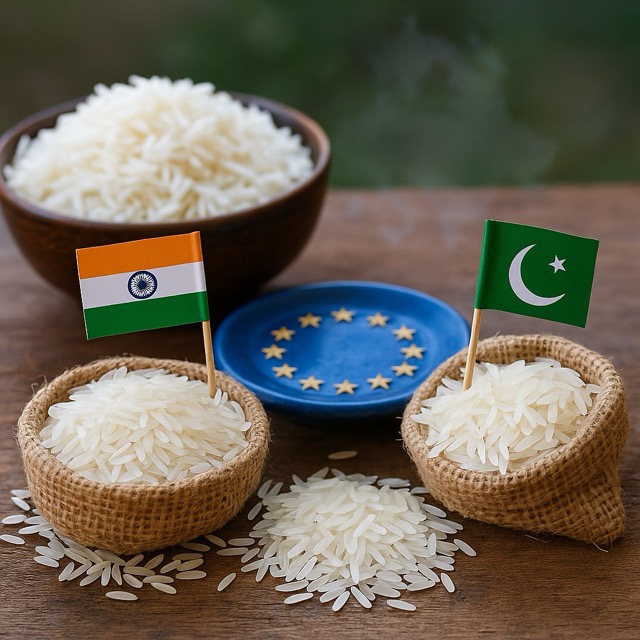
NEW DELHI/BRUSSELS — Europe’s tortuous trade talks with India have run into an unlikely snag: a slender, fragrant grain.
At the center is “basmati,” the aromatic long‑grain rice cherished in biryanis and pilafs from Lahore to Lucknow. India and Pakistan — the two dominant producers — both want the European Union to protect the name with a geographic label that would allow their exporters to command a premium and keep rivals from marketing look‑alikes as the real thing. What would normally be a technical question for food regulators has become a diplomatic tripwire, with the risk of complicating a free‑trade agreement that negotiators hope to conclude by late 2025.
The European Commission is weighing two competing applications for Protected Geographical Indication (PGI) status: India’s, which the EU published in September 2020, and Pakistan’s, published in April 2024 after Islamabad filed its claim the previous summer. Officials in Brussels say both files are being handled with unusual care. The sensitivity is easy to grasp. Pakistan’s submission lists districts in Pakistan‑administered Kashmir; India, which claims the territory, argues basmati is inextricably tied to its own agrarian heritage. Any EU decision, however narrowly framed, risks being read as a political judgment.
A premium name — and a premium price
For traders, the word “basmati” is money. Industry estimates suggest it can fetch about $200–$300 more per tonne than comparable long‑grain rice. That margin multiplies quickly across millions of tonnes sold around the world each year. In Europe, demand for specialty rice has grown alongside diaspora populations and a lockdown‑era surge in home cooking. Italy’s millers, who pivoted more toward basmati after Brexit reshaped regional trade flows, are now entrenched in a segment where Pakistan and India have jostled for share.
That premium is precisely why both countries are determined to lock down EU recognition. India argues that basmati’s reputation is rooted in soils and traditions linked to the Indo‑Gangetic plains, mostly within India. Pakistan counters that the grain’s cradle straddles the Punjab on both sides of the frontier and says any EU label must reflect that shared origin rather than hand exclusive rights to New Delhi.
A needle to thread for Brussels
Behind closed doors, EU negotiators say the basmati fight is unlikely to sink the wider deal on its own. But it does complicate the choreography. Along with the main market‑access pact, the EU and India are negotiating a stand‑alone agreement on geographical indications. Progress on one influences the other. And any move the Commission makes on basmati will reverberate not only in Delhi and Islamabad but also in the European Parliament, where protections for traditional foods are politically salient.
People familiar with the discussions say India has pressed hard for an outcome that would secure exclusive use of “basmati” in the EU market. Pakistan, newly assertive after filing its PGI application, has mobilised its rice industry and diplomats to resist. Commission lawyers, mindful of precedent, must ensure that whatever definition is adopted can be defended in court and policed at Europe’s borders.
Politics at the waterline
The history is fraught. Two decades ago, India and Pakistan briefly cooperated to help overturn a controversial U.S. patent related to basmati strains — a rare alignment that soon dissolved. After the 2008 Mumbai attacks, the broader relationship frayed and trade became collateral. Today, domestic politics in both countries magnify the symbolism of culinary heritage. In India, basmati sits alongside tea and spices as a soft‑power icon; in Pakistan, it is one of the few premium agricultural exports with a ready global market.
The legal filings have heightened the stakes. Pakistan’s application defines its basmati zone to include parts of the region it administers in Kashmir — a red rag to Delhi. Even if Brussels frames any recognition purely as a matter of product specification, diplomats say the cartography will be scrutinised for geopolitical meaning.
Trade talks on a clock
The timing is awkward. After restarting in 2022, EU–India negotiations accelerated this year, with an eleventh round in May and both sides publicly targeting a conclusion by late 2025. Another round is scheduled for early October in Brussels as teams work to narrow gaps on tariffs for cars, wine, dairy and medical devices, as well as rules on digital trade and sustainability. The EU remains India’s largest trading partner in goods, and officials on both sides say lighter‑touch customs procedures and clearer standards could lift investment and trade.
Agriculture and food labelling are often among the last pieces to click. The EU’s GI chapter is highly visible at home; for India, concessions on sensitive sectors are easier to sell if New Delhi can point to victories on products it prizes. That is why basmati looms larger than its tonnage might suggest.
What’s at stake for farmers and diners
On the ground, the calculus is simple. If India were to secure exclusive EU protection, Pakistani exporters fear they would have to market their rice under a different name — losing the price premium and supermarket recognition that “basmati” carries. Indian traders, for their part, say exclusive rights would curb misleading look‑alikes and reward farmers who have invested in quality upgrades and stricter pesticide‑residue controls to meet EU standards.
Consumers could feel it too. Heavy rains and early‑September flooding drenched key basmati‑growing districts in both India and Pakistan, threatening yields just as the harvest approaches and nudging prices higher. If the EU’s labelling decision disrupts established supply chains or triggers tit‑for‑tat restrictions, shoppers could see further bumps for their favourite rice — though much will depend on how importers and retailers manage stocks through the autumn.
Possible landing zones
There are paths out of the impasse. Trade lawyers and industry groups sketch three plausible outcomes: exclusive protection for one party (clean to administer but combustible politically); a shared or co‑existence model that recognises designated zones in both countries under a common name; or a narrower compromise in which “basmati” is protected with mandatory country qualifiers — for example, “Indian basmati” and “Pakistani basmati” — each tied to its own product specification. None is painless; all would demand careful drafting and credible enforcement.
For now, officials insist no decision is imminent. Formal objection periods and technical consultations mean any ruling would likely trail the political negotiations, not lead them.
Europe’s choice
The EU has long marketed its GI regime as a way to protect authenticity and rural livelihoods. That mission now collides with the realities of a contested border 6,000 kilometres away. Move too fast, and Brussels risks being dragged into South Asia’s quarrels. Wait too long, and a marquee trade deal with a pivotal partner could slip behind schedule.
As the next round of talks approaches, negotiators in Delhi and Brussels will keep a close eye on a dossier that, at first glance, reads like a culinary footnote. In 2025’s geopolitics, even a grain of rice can tip the scales.
Sources
• Financial Times, “India’s push for EU trade deal hit by basmati rice dispute,” September 15, 2025.
• European Commission eAmbrosia register: India PGI application for ‘Basmati’ (published September 11, 2020); Pakistan PGI application (application dated August 24, 2023; published April 30, 2024).
• Reuters, reports on EU–India trade talks (September 12, 2025) and basmati price pressures amid flooding (September 8, 2025).
• European Parliament Legislative Train, update on EU–India FTA rounds (May 2025).
• FratiniVergano Trade Perspectives, January 29, 2024 (EU rice market dynamics; Italy’s basmati imports).


 The Tower Post