Bucharest tracks intruder for about 50 minutes; Poland’s incursion days earlier forces the Alliance to bolster its eastern flank

BUCHAREST / WARSAW – Romania accused Russia of violating NATO airspace after a Russian-made drone crossed into Romanian territory on Saturday and was tracked by the air force for nearly an hour before exiting, Defence Minister Ionuț Moșteanu said on Sunday. The breach, the second incursion into NATO territory in less than a week after a major drone incident in Poland, prompted sharper allied deterrence measures and fresh diplomatic protests.
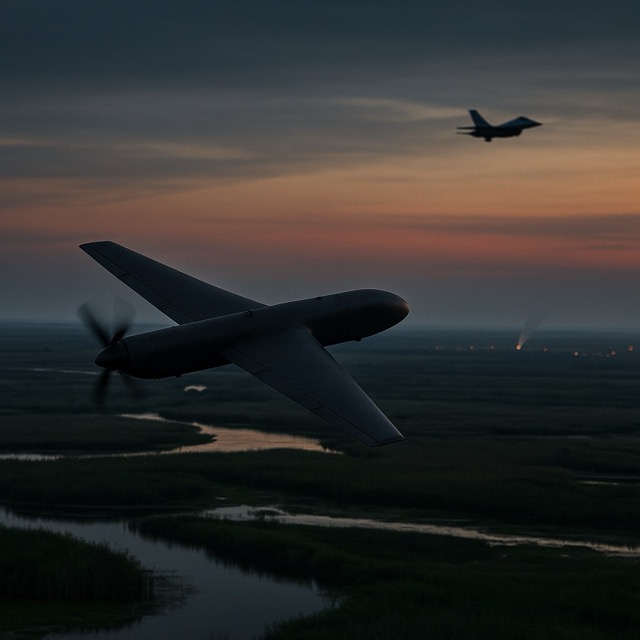
Romania’s defence ministry said it scrambled two F‑16s, later joined by two Eurofighters taking part in Germany’s air-policing mission, after radar detected an inbound unmanned aircraft during a Russian strike on nearby Ukrainian infrastructure. Pilots followed the drone at very low altitude until it dropped from radar roughly 20 kilometres southwest of the Danube Delta village of Chilia Veche, near the Ukrainian border. Moșteanu told Antena 3 television that crews came close to shooting the aircraft down but held fire due to the risk of collateral damage over sparsely populated wetlands and farmland.
Ukrainian President Volodymyr Zelensky said data shared with Romania indicated the drone penetrated about ten kilometres into Romanian territory and loitered in NATO airspace for around 50 minutes. Romanian authorities issued shelter warnings in Tulcea County, the southeastern region most exposed to spillover from Russia’s war, before lifting them once the aircraft was confirmed to have returned toward Ukraine.
The intrusion rattled border communities that have already endured repeated discoveries of drone debris since 2023, but Romanian officials noted this was the first time a hostile unmanned aircraft was tracked for an extended period inside the country’s airspace. Parliament approved a law this year giving the military clearer authority to engage drones that illegally enter national airspace during peacetime, though parts of the implementing rules are still being finalized.
Saturday’s breach came days after the largest known drone incursion into Poland’s airspace since Russia’s full‑scale invasion of Ukraine. On Wednesday, Polish authorities said 19 objects crossed from the east during a large‑scale Russian attack on Ukraine; Polish and allied NATO aircraft engaged, shooting down several drones in the first instance of a NATO member firing on airborne threats linked to the war. Warsaw framed the episode as a deliberate provocation designed to probe allied red lines and activated Article 4 of the North Atlantic Treaty to trigger formal consultations.
The Polish incidents reverberated through the weekend. On Saturday, with fresh threats reported along the border, Poland deployed additional aircraft and temporarily closed the regional airport in Lublin as a precaution, before later resuming operations. No casualties were reported, though minor damage was recorded in one locality.
NATO’s response came swiftly. On Friday, Secretary‑General Mark Rutte announced the launch of a new defensive operation, code‑named “Eastern Sentry,” to reinforce the Alliance’s eastern flank after the Polish airspace breach. The operation is designed as a flexible, integrated posture stretching from the Baltic to the Black Sea, and will rotate assets according to threat. Initial contributions include Danish F‑16 fighters and a frigate, three French Rafales, and four German Eurofighters; additional deployments from other allies are expected as the operation matures. U.S. Air Force General Alexus G. Grynkewich, NATO’s Supreme Allied Commander Europe, said the aim is to keep adversaries off balance while reassuring frontline populations.
Allied capitals condemned the Romanian and Polish incursions as unacceptable violations of sovereignty. The United Kingdom summoned Russia’s ambassador; Sweden’s foreign minister called the breach of Romanian airspace “another unacceptable violation of NATO airspace,” and other European leaders warned of calibrated attempts by Moscow to stress allied air‑defense networks without triggering a direct confrontation.
Moscow has denied targeting NATO members and suggested drones straying over borders were incidental to strikes on Ukraine—claims rejected by Warsaw and met with skepticism in Bucharest. The incidents are the latest iteration of what security officials describe as a ‘gray‑zone’ playbook: low‑cost, expendable drones probing air defenses, forcing costly scrambles and decision‑making under tight timelines, while keeping the intensity below thresholds that might automatically invoke collective defence.
Analysts say the Romanian episode underscores the operational dilemmas of drone warfare along NATO’s borderlands. Small, low‑flying unmanned aircraft are difficult to detect and track, especially amid cluttered terrain like the Danube Delta. Intercepting them safely requires not only fast‑jet patrols but also layered ground‑based air defenses, counter‑UAS sensors, and electronic‑warfare tools—capabilities that many European air forces have expanded since 2022 but are still fielding at scale. The risk calculus is equally complex: firing on a drone over civilian areas can cause more harm than letting it pass, yet letting it pass can normalize increasingly brazen incursions.
For Romania, the episode validates years of investment in air policing and the recent arrival of additional Eurofighters under NATO auspices. Officials said the immediate priority is to tighten detection ranges near the border, harden critical infrastructure, and finalize rules of engagement that prioritize public safety while deterring future breaches. Bucharest has also moved to improve cross‑border data sharing with Ukraine’s air‑defense network, which tracks and triangulates inbound munitions across the Black Sea and the lower Danube.
Poland, meanwhile, has accelerated the creation of dedicated counter‑drone teams and training pipelines, drawing on Ukrainian combat experience in interdicting unmanned systems. Officials in Warsaw argue that the September incursion was a Kremlin test of allied resolve and that only a visibly stronger posture—more patrols, more sensors, and quicker decision loops—will deter repeats.
Eastern Sentry is meant to provide that posture. But the operation’s opening inventory—while politically potent—remains modest in absolute numbers. NATO commanders stress that the innovation lies less in raw totals and more in agility: mixing air patrols, ground‑based defenses, maritime sensors and intelligence assets as patterns of activity shift from the Baltic states to the Black Sea. Allied diplomats also point to the signaling effect: a named, standing operation that can surge forces quickly across borders may make gray‑zone tactics less attractive by increasing the chance of rapid attribution and response.
The question now is one of thresholds. Repeated airspace violations heighten the risk of miscalculation—whether from a drone crash near civilians, a retaliatory strike gone awry, or a radar picture misread under pressure. For that reason, officials in Brussels and national capitals are trying to balance firmness with restraint. They say defensive shots will be taken when necessary, but procedures will emphasize verification and de‑escalation. Diplomatic channels remain open, even as sanctions debates re‑ignite in several EU states.
Along the Danube on Sunday, the mood was a mix of fatigue and fatalism. Residents in Tulcea County have grown accustomed to late‑night alerts and the distant thud of explosions across the water. Local authorities say public‑education campaigns—urging people to take shelter promptly and report debris—have improved compliance and cut down on risky curiosity. But the economic toll of repeated disruptions, especially on agriculture and river shipping, is mounting.
As September wears on, the Alliance’s eastern flank is settling into a new rhythm: more patrols, more sensors, more drills—and a wider canvas of uncertainty shaped by unmanned systems. If the weekend’s events are any guide, the line between war and peace in Europe’s skies will continue to be drawn by small aircraft flying low and slow, and by the split‑second decisions of the pilots and commanders sent to meet them.
Reporting for this article draws on official statements from Romania’s defence ministry and NATO, and on contemporaneous reporting by Reuters, as well as other accredited news agencies and public broadcasters.