Export bans and permit bottlenecks throttle a metal vital to Western defence optics, triggering panic buying and a scramble for non‑Chinese supply

The price of germanium—a silvery metalloid used to make the thermal-imaging and night‑vision optics that give modern militaries their edge—has leapt to nearly $5,000 per kilogram this month, the highest level in data going back at least to 2011. Traders describe a market in triage mode: bids pile up, offers vanish, and customers in the United States and Europe scramble to secure grams, let alone kilos, of material.
At the heart of the squeeze are Chinese export restrictions. Beijing first required licences for gallium and germanium shipments in 2023; by December 2024 it banned exports of the materials to the United States altogether, and by late 2024 and into 2025 deliveries to Western buyers were drying up. That shift has now metastasised into a full‑blown supply crunch, according to traders, defence contractors and price‑reporting agencies.
“It’s desperate out there,” says one European trader, paraphrasing widespread sentiment across the minor‑metals market. Buyers that once ordered by the tonne now plead for a few kilograms to keep production lines running. Another dealer at a UK trading house says the spot market has ‘ceased to function’ because sellers are unwilling—or unable—to quote firm offers for immediate delivery.
The near‑vertical rally this September caps two years of tightening. Price‑reporting agency Fastmarkets, cited by multiple market outlets, puts germanium near $5,000/kg—around five times the level at the start of 2023. China’s controls have also coincided with state stockpiling and a steep drop in reported exports, amplifying scarcity even for buyers outside the United States who are not covered by the outright ban.
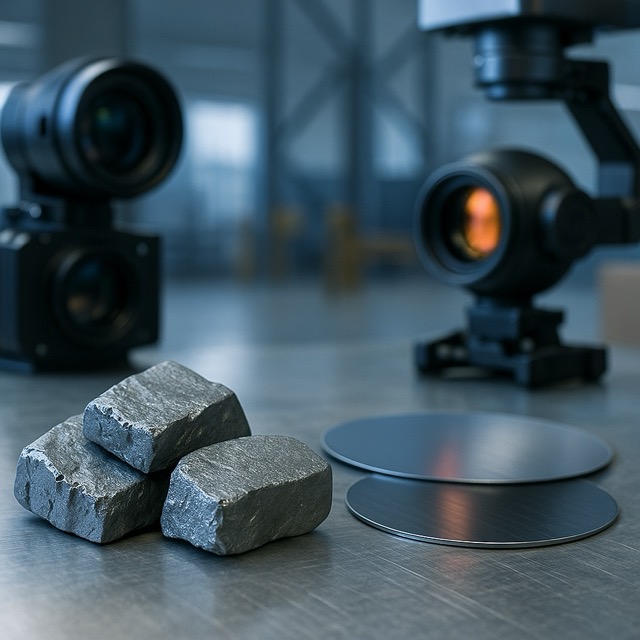
For defence manufacturers, the shortage bites in sensitive places. Germanium’s high refractive index and transparency in the long‑wave infrared make it a workhorse of military electro‑optics—from forward‑looking infrared (FLIR) cameras and rifle sights to missile seekers and drone sensors. It is also used in fibre‑optic networks, high‑efficiency satellite solar cells and radiation detectors. With little strategic stockpiling in the West and production concentrated in China, procurement officers have been forced into a juggling act: rationing existing inventories, re‑sequencing assembly schedules and seeking qualified alternative suppliers.
The structural challenge is geological and industrial as much as geopolitical. Germanium is almost never mined on its own; it is typically recovered as a by‑product of zinc smelting or from certain coal ash, which means supply cannot be dialled up quickly without new refining capacity or different feedstocks. China dominates refining and exports, with additional volumes coming from Canada and Europe. In 2024, the U.S. Geological Survey noted that China remained the leading global producer and, in December of that year, formally banned exports of germanium to the United States.
Those realities have turned supply chains inside out. In August, Lockheed Martin signed a memorandum of understanding with Korea Zinc to establish a ‘China‑free’ germanium supply for the U.S. defence major, a signal that prime contractors are moving upstream to lock in materials years ahead. North of the border, Teck Resources—already one of the world’s larger integrated germanium producers through its Trail Operations in British Columbia—has said it is evaluating ways to lift output.
Europe, too, is on the hunt. An Umicore‑backed project in the Democratic Republic of Congo began shipping germanium‑bearing concentrates to Belgium in late 2024, recovering the element from historic tailings near Lubumbashi. The initiative, supported by the Minerals Security Partnership, points to one of the few scalable near‑term levers available to Western buyers: squeeze more germanium out of existing zinc and copper flows and reprocess what past generations left behind.
Yet even with new feed, bottlenecks remain. Germanium recovery requires specialised circuits at smelters, and commissioning such units takes capital, permits and time. In the United States, Nyrstar has floated plans for a germanium and gallium recovery facility at its Clarksville, Tennessee, zinc plant, and policymakers have debated lifelines for ageing smelters in allied countries because without base‑metal refineries, by‑products like germanium do not get recovered.
The crackle of geopolitics complicates everything. Washington’s chip‑export controls, followed by Beijing’s riposte on critical minerals, have turned materials once known only to lens‑makers into instruments of statecraft. In December 2024, China’s commerce ministry announced an immediate ban on exports of gallium, germanium and antimony to the United States, tightening earlier licensing rules and placing further scrutiny on graphite. While some American buyers have reportedly found lawful ways to source Chinese‑origin material via third countries, such channels are narrow, risky and, in a panic market, expensive.
As prices spike, substitution chatter has returned. Chalcogenide glasses can replace germanium in some infrared optics, and silicon or gallium arsenide suffice in certain semiconductor uses. But for many long‑wave IR applications, especially where ruggedness and precision matter, germanium remains the material of choice. Engineers warn that qualifying substitutes takes years and often degrades performance—hardly a trivial trade‑off for weapon systems meant to operate in the most demanding conditions.
The Pentagon has started to react. In April 2024 the U.S. Department of Defense awarded funding to expand germanium wafer capacity in Utah, an incremental but symbolically important step. Meanwhile, European ministries have asked primes for materials ‘heat maps’ and contingency plans, and NATO officials have quietly raised the subject in supply‑chain working groups. It is a striking reminder that the most advanced kit in the world can be hobbled by a few grams of a metal few people could pick out of a line‑up.
Industrial buyers describe a triage system that favours national‑security end‑uses. One European distributor says defence and space orders are being prioritised over commercial optics and photonics, with lead times for the latter stretching out months. That rationing risks collateral damage: medical‑device makers and telecom suppliers compete for the same inputs, and abrupt price moves can render multi‑year fixed‑price contracts uneconomic overnight.
The stakes are not just higher prices but system fragility. Germanium’s role as a by‑product ties its availability to the economics of zinc. If smelters in Europe or Australia curtail output because of power prices or weak margins, germanium recovery falls as well—precisely when policymakers are pleading for more. Several governments are weighing targeted support for zinc and lead smelters on national‑interest grounds that explicitly include by‑product recovery of critical minerals.
For traders, the near‑term outlook depends on China. If export permitting remains tight and the U.S. ban effective, Western prices are likely to stay elevated through year‑end. Any signs of additional state stockpiling in China, or stricter enforcement against re‑exports via intermediaries, could push prices higher still. Conversely, a loosening of licences, a surge of material from non‑Chinese projects, or an economic slowdown that crimps demand for optics and electronics could cool the rally.
Either way, the world will emerge with a reshaped supply chain. Defence primes are cutting upstream deals. Smelters are reconsidering by‑product circuits. And governments are dusting off once‑sleepy stockpile programmes. For a metal that lives in the shadows of bigger markets, germanium has become a bright test case of how the ‘de‑risking’ era collides with the physics of extraction and the chemistry of optics.
Sources
• Financial Times, “China’s curbs on metal germanium create ‘desperate’ supply squeeze,” September 15, 2025. (Fastmarkets price near $5,000/kg; quotes from traders)
• U.S. Geological Survey, Mineral Commodity Summaries 2025: Germanium (January 2025). (End uses; China’s December 2024 ban on exports to the U.S.; market statistics)
• Reuters, “China bans exports of gallium, germanium and antimony to the U.S.,” December 3, 2024. (Scope and timing of the ban; graphite scrutiny)
• Reuters, “How U.S. buyers of critical minerals bypass China’s export ban,” July 9, 2025. (Third‑country sourcing dynamics)
• Optics.org, “Lockheed Martin aims to source germanium from Korean metals producer,” August 26, 2025. (MOU with Korea Zinc to secure China‑free supply)
• Reuters, “Teck Resources eyes output boost for chipmaking‑metal germanium,” June 20, 2025. (Potential capacity expansion at Trail Operations)
• Umicore / STL (Gécamines) announcements and reporting, May–October 2024. (Start‑up of germanium recovery from Lubumbashi tailings; shipments to Belgium)