Universities tighten security while vowing to widen the range of viewpoints — testing whether safety and free speech can coexist.

OREM, Utah — The fatal shooting of conservative activist Charlie Kirk during a Sept. 10 outdoor event at Utah Valley University has rippled far beyond one campus quad. In the days since, university leaders across the United States have launched urgent reviews of their speaker protocols, promising that students will continue to encounter a wide range of viewpoints — but with new layers of protection in place.
Investigators say the gunman fired a single round from a rooftop overlooking the amphitheater-style space, striking Kirk as he took questions from the crowd. Authorities have arrested a 22‑year‑old suspect, and federal officials said forensic evidence — including DNA — links him to items recovered near the suspected rifle. As of Monday, the motive remains unclear, and formal charges are pending.
The brazen, long‑distance attack — carried out in broad daylight at a campus event that drew thousands — has become a stress test for two foundational campus commitments: keeping people safe and keeping the marketplace of ideas open. “This is a police chief’s nightmare,” Utah Valley University’s top campus police official said after the shooting, as outside security experts questioned why bags were not checked and magnetometers were not used at the entrance to the crowded venue.
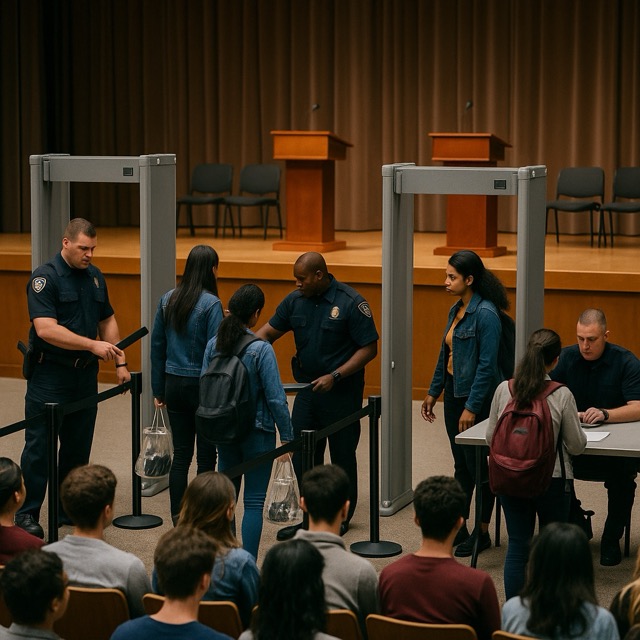
In response, institutions from large state flagships to small private colleges are re‑examining everything from event locations to the division of responsibilities between campus police and visiting speakers’ security teams. Some are moving high‑profile appearances indoors, where perimeters are easier to control, and adding pre‑registration, ID checks, clear‑bag policies, and magnetometers for marquee visits. Others have begun conducting rooftop sweeps and deploying overwatch positions when outdoor settings are unavoidable.
Technologists and consultants say the playbook is evolving, too. Drone patrols to scan nearby rooftops, geofenced camera alerts tied to campus dispatch, and faster interops with city police are gaining favor among chiefs who warn that open‑air stages — once prized for their informality — now present unacceptable sightlines. The shift is already rippling into speaker logistics: more hardened back‑of‑house corridors, timed arrivals, and controlled Q&A formats that balance spontaneity with threat management.
But the drive to harden events is colliding with equally strong cautions not to chill speech. Civil liberties advocates, student groups across the spectrum, and nonpartisan watchdogs argue that security concerns must not become a pretext to cancel controversial talks or to transfer steep security fees to student hosts — practices that risk turning the loudest heckler or the vaguest threat into a veto.
One prominent campus free‑speech nonprofit urged administrators to ‘redouble their efforts to protect both safety and expressive rights,’ warning against cost‑shifting and blanket cancellations. Conservative and progressive student leaders alike say the point of campus is to meet arguments head‑on. “We will never stop debating,” a College Republicans leader said, urging universities to partner closely with local public safety while ensuring students can still bring in the speakers they choose.
The investigation itself is unfolding in a fevered media climate. Federal authorities said over the weekend that their labs tied DNA to items near the suspected weapon and described a destroyed note recovered during searches, even as critics accused them of speaking too freely while the case is active. State officials have said only that the suspect’s ideology is under review and that investigators are interviewing relatives and acquaintances to establish a timeline. Memorials have been set for later this month.
Meanwhile, campuses are grappling with secondary effects. Law enforcement agencies report a surge in threats and hoax emergency calls — so‑called ‘swatting’ — that have sent officers racing to dorms, student centers, and administrative buildings in recent days, including at historically Black colleges and universities. Police chiefs describe the strain of chasing false alarms while also hardening real‑world events.
Policy debates are intensifying, too, particularly in states that recently loosened firearms rules on campus. In Utah, a change enacted this summer expanded how permitted gun owners may carry on university grounds, sparking renewed scrutiny after the shooting. Security experts interviewed by several outlets stressed that no policy can fully eliminate the risk posed by a distant attacker with a high‑powered rifle, but many argued that layered measures — better venue selection, covered approaches, and dedicated rooftop patrols — can reduce exposure.
Inside student affairs offices, the philosophical work is proceeding alongside the tactical. A number of colleges are accelerating programs that teach constructive dialogue and viewpoint diversity through residence‑hall workshops and classroom modules. The impulse is both pragmatic and aspirational: lower the temperature so that disagreements do not escalate into disorder, and equip students to argue well across differences.
At the same time, administrators concede that some changes will be uncomfortable. Magnetometers and bag checks can lengthen lines and dampen the spontaneity of campus life. Stricter credentialing for press and outside guests raises transparency questions. Students have voiced concerns that a heavier police footprint could fall unevenly on marginalized groups, while faculty warn that surveillance tools can have a chilling effect on research and activism. “If the cure is to make free expression feel like an airport screening, we risk losing the very spirit we’re trying to save,” said one Northeastern dean, who asked not to be named to speak frankly about internal deliberations.
University risk managers say they are updating threat‑assessment rubrics that determine when an event triggers heightened precautions. Key factors include the speaker’s profile and recent threats; the venue’s lines of sight; rooftop and window exposure; expected crowd size; and whether the event is advertised widely on social media, which can turbocharge both turnout and the risk of disruptions. Several police chiefs described a simple rule of thumb now circulating among their peers: if a sniper can see the stage, the stage can’t be there.
Some student groups have paused or relocated events this week out of sensitivity to grieving communities and to give security teams time to recalibrate. Others have pressed ahead. Candlelight vigils honoring Kirk drew crowds in multiple states, even as university HR offices disciplined and, in some cases, dismissed employees who posted celebratory remarks about the killing online — a reminder that institutions are navigating real‑time pressures from all directions.
On Capitol Hill and in statehouses, lawmakers are seeking answers. A legislative panel in one state has called university police chiefs to testify about their preparedness and the wave of hoax threats. In another, budget writers are asking whether campuses should receive dedicated funds for temporary magnetometers and drone programs, or whether outside campaigns and student organizations should be required to shoulder those costs — a proposal critics say would amount to a speech tax.
For students, the return to class has whiplash. Many watched the killing unfold in short, viral clips that ricocheted across their phones. In interviews this weekend, some said they are newly anxious about attending outdoor rallies or even lining up to ask questions at a microphone; others insisted that the only answer to violence is more debate, not less. At one campus, organizers moved a planned conservative speaker from a lawn to a theater and added a moderated Q&A; across town, a progressive coalition pledged to attend and challenge the ideas rather than demand a cancellation.
If there is a through‑line in the messiness, it is that the promise of college — to encounter ideas you dislike and people you disagree with — is not going away, even as the logistics get tougher. The urgent work for administrators is to design events that are both safe and genuinely open: to prevent a lone gunman from controlling who gets heard, and to make sure security does not become the new gatekeeper of acceptable speech.
There will be missteps. Security theater will waste time and erode trust; genuine threats will be missed. But the early choices matter. Transparency about risk assessments, clear lines between safety measures and content‑based decisions, and support for student sponsors across the political spectrum can help restore confidence that campuses remain the country’s most vital — and yes, safest — places to argue.
As the investigation proceeds and memorials are held, the fall speaking season will offer a visible test. If universities can protect both their people and their principles, the microphone will remain open. If not, the lesson students absorb this semester will be a darker one: that fear can do what argument never should — end the conversation.