At 38, the game’s greatest champion becomes an unlikely protest symbol—embracing the calm of age as he challenges Belgrade’s power.
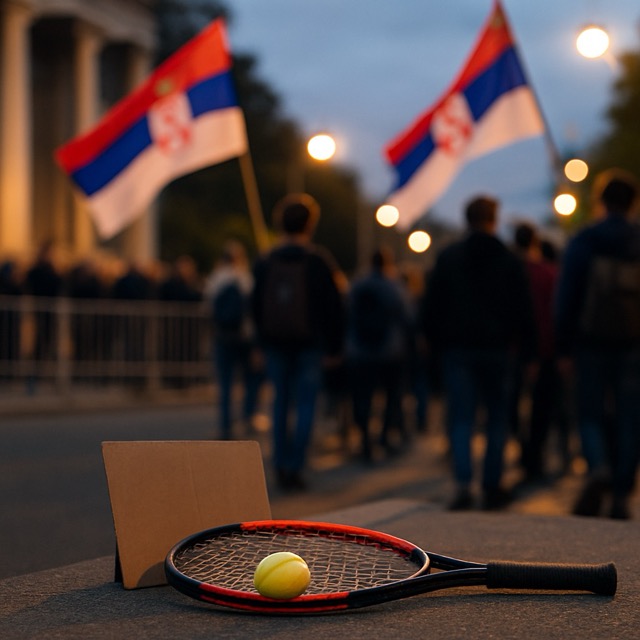
ATHENS/BELGRADE
Novak Djokovic has spent two decades building a legend that seemed to float above politics. This September, Serbia’s most famous son chose a side. In a country convulsed by student-led protests over corruption and abuse of power, the 24-time Grand Slam champion has aligned himself with the young. The price has been immediate: a ferocious campaign by pro-government media, whispered accusations of treachery, and a decision—by all credible accounts—to move his family from Belgrade to Athens.
The shift is more than a change of address. It redefines a public figure who, for years, carried a nation’s hopes without directly confronting its rulers. Djokovic’s Instagram posts in support of students; the viral images of him in a hoodie emblazoned with a message of solidarity at a Belgrade basketball derby; the decision to lend his name, platform, and money to a youth movement demanding accountability—all have turned the most scrutinized athlete in the Balkans into a political protagonist.
Context matters. The protests began last winter after a concrete canopy at Novi Sad’s railway station collapsed, killing 16 people and crystallizing allegations of graft and cronyism tied to a marquee infrastructure project. Demonstrations spread from campuses to city centers. Civil society rallied; police cracked down. Tear gas hung over university quadrangles; hundreds were detained in Belgrade, Novi Sad, Niš and beyond. The government of President Aleksandar Vučić denounced the crowds as foreign-backed malcontents, even as professors were dismissed and riot police massed around parliament.
Into that standoff walked Djokovic—the national hero with the polarizing charisma of an anti-hero. He wrote of believing in the power of youth and the need to hear their voices. He dedicated victories to injured students. He posted crowd shots from marches he called “historic.” In the Serbian mediasphere, where loyalties can resemble the tribal ferocity of a derby day, the backlash was swift. Commentators close to the ruling party labeled him a traitor. A star once embraced by the state was recast as an enemy.
The personal consequences have mounted. Reportedly, Djokovic and his wife, Jelena, enrolled their children in an Athens school at the start of September. He has trained in the Greek capital and explored opening an academy there. In a striking tennis-side ripple, the ATP 250 event long run by the Djokovic family in Belgrade has been moved to Athens for the week of November 2–8, to be staged on indoor hard courts at the OAKA complex. It is, in effect, an exodus of an institution as much as a family.
For Serbia, the symbolism is enormous. Djokovic has been the nation’s most resonant export since the end of the Yugoslav wars—a polyglot champion who strapped a flag to his shoulders and told the world that Serbia could be something other than its darkest headlines. To see him break with the government, explicitly or implicitly, says as much about the country’s political temperature as it does about his evolution as a public figure.
On court, too, an evolution is underway. At 38, Djokovic has entered the period athletes euphemistically call “managing the calendar.” In New York on September 5, he fell to Carlos Alcaraz in straight sets in the U.S. Open semifinals, the first season since 2017 in which he failed to reach a major final. He spoke with disarming candor about the strain of the tour and whether he would play a full Grand Slam slate next year. There was no melodrama; just a stoic recognition that even the greatest must choose their battles.
That stoicism—more Seneca than swagger—has marked Djokovic’s public tone through the crisis at home. Asked why a megastar would risk alienating a government, sponsors, or a segment of his fan base, confidants point to something disarmingly simple: he listened to students. The movement’s core demands—snap elections, independent institutions, an end to police impunity—are not radical in a European democracy. What is radical is that Serbia’s most famous citizen is willing to say so, and to endure the consequences.
The consequences are real. Serbian state-aligned outlets have turned their spotlight on a man they once praised as the “greatest ambassador of Serbia.” Online smears have flourished. A chorus of loyalist influencers suggests he has been captured by “foreign agendas”—the same trope used to discredit students and journalists. Yet the attempt to shrink him runs up against the one metric politics cannot touch: sport. Djokovic remains, on the evidence of a generation, the best to ever pick up a racket.
That is why this turn matters beyond Belgrade. Balkan politics, like sport, is a game of symbols. When a champion who has built his brand on discipline and control uses his platform for civic resistance, it grants the movement a legitimacy the state cannot easily erase. It also complicates the West’s cautious posture. Brussels and Washington have scolded Vučić over democratic backsliding while courting him on regional stability; they now face a Serbia where batons meet textbooks and the country’s most famous face is standing with the latter.
In Athens, Djokovic appears to have found a measure of calm—training with his son, exchanging pleasantries in local shops, contemplating an academy that might become both refuge and seedbed. None of this means he is abandoning Serbia. If anything, it suggests a new phase: less omnipresent, more intentional; less about proving immortality, more about using influence. He may still chase majors in 2026. But the shot that will echo longest this year will not be a forehand winner. It will be the decision to take a stand.
Djokovic has always played the long rally. In siding with students who want a cleaner, fairer Serbia, he has placed a ball deep in the government’s court and invited a reckoning. The scoreboard will not settle quickly. But it is already clear who served: a champion who, at the dusk of dominance, has chosen to be something larger than a tally of titles.


 The Tower Post