Israel masses armor for a new ground push; at least 300,000 residents flee after full-city evacuation orders amid warnings of a ‘mighty hurricane.’
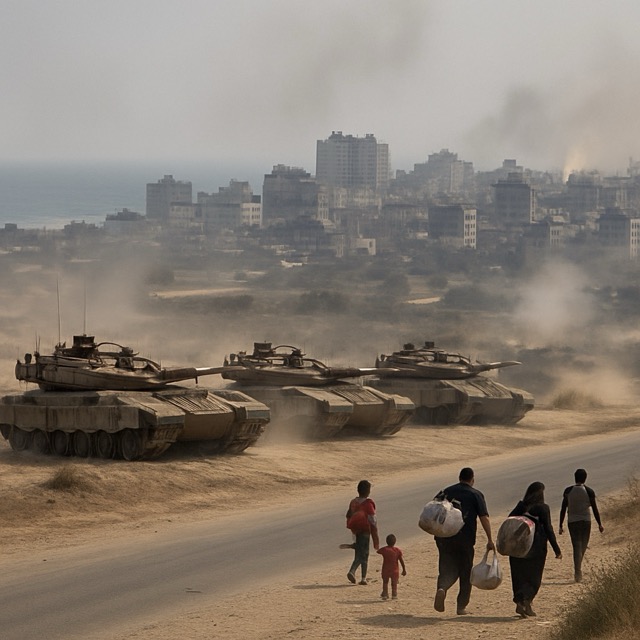
GAZA CITY/JERUSALEM — Columns of Israeli armor have fanned out along the northern rim of Gaza this week, as the Israel Defense Forces signaled a new phase of operations aimed at seizing control of Gaza City from Hamas. After ordering the full evacuation of the city on September 9, Israeli forces have stepped up air and artillery strikes and pushed tanks into several neighborhoods, prompting a fast‑rising exodus and fears of a catastrophic urban battle in the coming days.
The IDF says it is preparing for an expanded ground offensive, while Prime Minister Benjamin Netanyahu has renewed vows to “eliminate” Hamas. Defense Minister Israel Katz warned of a “mighty hurricane” if the group does not surrender and release the remaining hostages. U.S. Secretary of State Marco Rubio arrived in Israel over the weekend, expressing support for Israel’s campaign while focusing on the fate of captives and on post‑war planning that would eventually rebuild the shattered enclave.
The evacuation order — Gaza City’s first full‑city directive since the war began — sparked panic. Leaflets dropped over shattered districts and text messages urged residents to move south toward the coastal strip of al‑Mawasi, designated by Israel as a humanitarian zone. Aid agencies say al‑Mawasi is already overcrowded and under fire; many residents lack transport or money to flee, and some who left have returned after finding no safety or services in the south.
By Sunday, Israeli and international reports estimated that around 300,000 people had left Gaza City in recent days, even as hundreds of thousands more remained in place. The IDF says it has advanced into areas including Sheikh Radwan and the city’s western approaches, supported by armor and combat engineers. On the northern periphery, Israeli media and security analysts reported that “hundreds of tanks, armored personnel carriers and bulldozers” have been assembled for the next push — an assessment echoed across Israeli media and defense research outlets, even as the army maintains tight operational secrecy about precise numbers.
Inside the city, strikes have leveled residential towers and flattened blocks already scarred by nearly two years of war. Health authorities in Gaza, which is governed by Hamas, report dozens killed daily; footage from the weekend showed high‑rises in Tal al‑Hawa erupting into fireballs after warnings to evacuate. The United Nations says famine and disease are spreading, and that a mass evacuation “cannot be done in a safe and dignified manner” under current conditions.
Israel argues that Gaza City remains the “center of gravity” for Hamas, whose fighters have reconstituted units in dense urban terrain and continue to fire rockets and improvised explosive devices at troops. Over the last two weeks, Israeli units have detonated explosive‑laden vehicles remotely and used heavy armor to probe deeper into contested districts, often at night. The military says it controls significant swathes of the urban area, though it has stopped short of declaring full control, and it asserts that Hamas embeds forces and munitions within civilian infrastructure.
Complicating the picture are reports — circulated by Israel’s COGAT unit and amplified by local media — that some Hamas officials and civil administrators are seeking to slip out of the Strip even as the group urges civilians to stay put. Those claims could not be independently verified, but they feed into Israel’s narrative that Hamas is using residents as human shields while preparing fallback positions. Hamas says it is resisting occupation and accuses Israel of targeting civilians and essential infrastructure.
Diplomatic fallout is intensifying. Rubio’s visit comes amid a rift with Qatar after an Israeli strike in Doha that Israel said targeted senior Hamas figures — a move that jolted mediation efforts and drew a sharp response from Gulf states. European governments are split over whether to escalate pressure on Israel; rights groups assert that mass displacement orders and the pattern of strikes violate international law, while Israel’s allies emphasize Hamas’s October 2023 massacre and ongoing hostage‑taking.
Numbers underscore the scale of the crisis. The death toll in Gaza has surpassed 64,000 since 2023, according to figures cited by multiple international agencies, with hundreds of thousands repeatedly displaced. UNRWA says it has been forced to suspend operations in parts of the north due to insecurity. Hospitals operate on fumes, fuel is scarce, and aid convoys remain sporadic. The International Committee of the Red Cross warns that the citywide evacuation order risks triggering a humanitarian catastrophe.
For residents, choices are narrowing by the hour. Those who can move queue along the coastal road with bundles of bedding strapped to pickup trucks, pushing handcarts and wheelchairs; others dig through rubble for valuables or huddle in stairwells when jets roar overhead. Internet blackouts are frequent; families lose contact as they try to coordinate safe passage past checkpoints or shell‑damaged intersections. Many have already been displaced several times since 2023 and now face yet another wrenching uprooting.
The battlefield remains fluid. Hamas has adapted to Israel’s technological edge with low‑cost tactics — tunnels, booby‑trapped buildings, and antitank ambushes. Israeli commanders are trying to mitigate losses with overwhelming firepower, armored breaching, and systematic demolitions to carve lanes for advance. Analysts say the coming phase will test whether Israel can isolate and dismantle entrenched Hamas battalions without razing what remains of the city — or whether the operation will devolve into a grinding war of attrition.
What happens next hinges on two clocks: humanitarian collapse and political patience. In Israel, families of hostages press the government to prioritize a deal before tanks roll deeper into dense districts where captives may be held. Abroad, Washington is trying to keep Arab partners engaged while blunting calls for sanctions and embargoes. In Gaza, where communication is intermittent and the economy has flatlined, daily calculations are more primal: survive the night, find water, charge a phone, decide whether to risk the road south or shelter in place.
On Sunday night, fresh evacuation messages pulsed across Gaza City as artillery thudded on the outskirts. By dawn, more families were on the move — a few taxis still running, bicycles stacked with mattresses wobbling south. The armor on the horizon has yet to surge in full, but the sense on both sides of the front is that it soon will.
—
Sources used in reporting: Reuters dispatches from Sept. 1–15; ABC News and PBS reports on the Sept. 9 evacuation order; The Wall Street Journal on Israel’s intent to expand the ground offensive; U.N. OCHA humanitarian updates; statements by Israel’s COGAT unit reported by Israeli media; Al Jazeera and international wire photos documenting recent strikes in Gaza City.




 The Tower Post