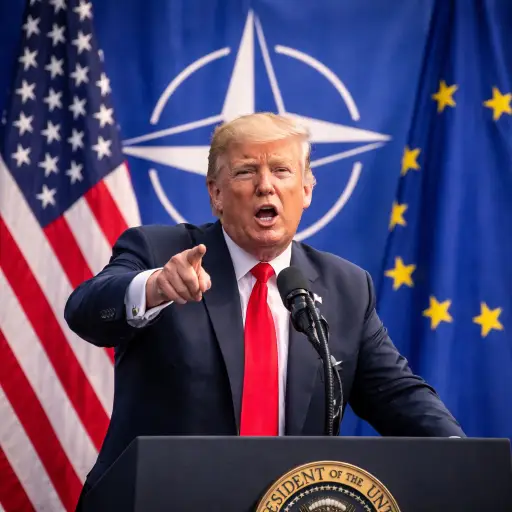
With tariffs up, NATO targets reset and Ukraine aid tied to allied cash, former UK ambassador Peter Westmacott asks whether London should bargain as hard as Washington does — and what that would look like.

Lede
As U.S. President Donald Trump begins an unprecedented second state visit to Britain, the pomp has been matched by hard-edged policy. The two governments on Tuesday trumpeted a multibillion-pound ‘Tech Prosperity’ package anchored in artificial intelligence and civil nuclear cooperation — even as a long-trailed fix to U.S. steel tariffs slipped out of reach at the last minute. It is the latest reminder that, for Washington, relationships are instruments not heirlooms. For London, argues former ambassador to the U.S. Sir Peter Westmacott, that lesson is long overdue.
Nutgraf
In a column this week, Westmacott urged British policymakers to ditch the rhetorical comfort blanket of the ‘special relationship’ and think in transactions: What leverage do we have? What do we want in return? Where can we say no? The timing is apt. In 2025 the United States has raised a baseline 10% tariff on imports and tied exemptions to deals; NATO allies have endorsed a steep new defence-spending target under U.S. pressure; and the White House is linking military aid to Ukraine to greater allied burden-sharing. The gameboard has moved — and the case for a more clear-eyed British approach is stronger than at any point in decades.
What Trump Wants
First, the Trump administration has re-wired trade policy around reciprocity and leverage. A nationwide 10% tariff now applies to most imports, with reciprocal rates rising higher for countries that Washington deems restrictive — a system that can be tightened or relaxed by executive order. Carve-outs exist, but they are earned rather than assumed. Even close partners such as the UK have found that sectoral fixes — like the repeatedly promised relief on steel and aluminium — can be paused or re-scoped at short notice.
Second, the President’s insistence that allies ‘pay up’ has shifted the NATO centre of gravity. This summer, alliance leaders endorsed a far more ambitious multi-year spending trajectory, answering Washington’s demand for Europeans to shoulder a larger share of collective defence. The UK, for its part, has pledged to lift spending to 2.5% of GDP by 2027, with an ambition to reach 3% thereafter — a costly but credible signal of seriousness. With Russia’s war against Ukraine grinding on and a recent drone incursion testing NATO’s air defences over Poland, the politics of deterrence have become as transactional as trade.
Third, the administration has reframed assistance to Kyiv. Rather than open-ended U.S. grants, new packages are being structured around a pooled mechanism in which allies finance weapons drawn from U.S. stockpiles. Europe can still get what it needs — Patriots, air-defence munitions, long-range fires — but only if it underwrites the bill. This is transactional statecraft by design: set a price, extract a concession, move on.
What London Can Trade
If Trumpism is proudly transactional, should Britain be, too? Westmacott thinks so, and there is a pragmatic case for it. The UK’s most bankable currencies are not ceremonial flattery or sweeping promises; they are concrete capabilities and market access. A short list includes world-class intelligence sharing through Five Eyes, high-end defence manufacturing, basing and training facilities, a deep capital market for tech investment, and — crucially — an ability to corral European partners behind realistic compromises.
Intelligence and bases are harder to price, but not impossible to leverage. Britain could, for example, make explicit the link between expanded data and cyber co-operation and priority access to U.S. export-controlled technologies under the AUKUS umbrella. On defence industry, London can fast-track co-production and maintenance lines for U.S. kit in Britain — from air defences to munitions — in exchange for written exemptions from baseline tariffs and mutually recognized security-of-supply guarantees.
On trade, a fully-fledged free-trade agreement remains politically remote on both sides. But the White House has now created an incentives framework in which sectoral reciprocity earns relief. That is an invitation to bargain issue-by-issue. London should bring a menu to Washington: remove tariffs (or agree predictable quotas) on UK steel and clean-tech inputs; expand mutual recognition on professional services and digital trade; coordinate on critical minerals so that British-made EVs qualify for U.S. consumer subsidies.
Each line item should carry a corresponding UK offer — from energy-security deals that reduce dependence on Russian hydrocarbons, to procurement that deepens allied supply chains in semiconductors and civil nuclear.
Proof of Concept
The headline investments unveiled this week — cloud capacity, AI compute, and nuclear cooperation — are a start. They show that when the UK aligns its regulatory posture with U.S. preferences and clears planning hurdles, American capital moves. But they also underscore a reality: investment announcements are not market access, and ribbon-cuttings do not lower tariffs. To turn photo-ops into durable advantages, London will need to anchor each press release to a binding policy exchange and a measurable gain for British firms.
Risks and Limits
There are hazards. A purely transactional posture can erode the trust that makes intelligence ties and military integration work. Britain also has European equities to protect. Overplaying a bilateral bargain with Washington — for example, by seeking carve-outs that undercut EU firms — risks regulatory retaliation from Brussels just as the UK is trying to rebuild a stable working relationship with the bloc. And treating everything as a chip to be traded risks sending the wrong signal to adversaries about allied resolve on first-order security commitments.
Nor should ‘transactional’ be confused with performative toughness. The most effective negotiators in Trump’s Washington are those who arrive with numbers, not adjectives. If London wants tariff relief, it should quantify how a given exemption increases U.S. content in UK supply chains, or how a steel quota swap helps Washington achieve its China-containment aims without domestic price spikes. If Britain wants the United States to prioritise air defences for Ukraine, it should put cash on the table — and line up European co-financing — to move British firms into the production slots that unlock U.S. deliveries.
A Playbook for the Next 12 Months
• Put defence on a contract. Lock in a U.S.–UK Defence Industrial Security-of-Supply Arrangement that guarantees no-export-license lanes for critical munitions and components within AUKUS, in return for British commitments on capacity expansion and long-term orders.
• Trade for tech. Convert the AI-and-nuclear press statements into binding mutual-recognition agreements on safety standards and cloud security, paired with targeted tariff or quota relief on British inputs to U.S. growth sectors.
• Ukraine burden-sharing, visibly. Announce a joint UK–U.S.–Europe procurement plan that purchases specified quantities of air-defence interceptors and artillery shells from U.S.
inventories for transfer to Ukraine, with London corralling at least three EU capitals into the financing round.
• Steel, then services. Use any steel compromise as the opening bid for a services mini-deal: digital trade baselines, lawyer/accountancy mobility, and a privacy bridge that reduces data-friction for SMEs.
• Price the intangibles. Tie expanded intelligence and cyber cooperation to an explicit U.S. commitment to seek reciprocal tariff exemptions where statutory authority allows — and to use executive discretion where it does not.
The Westmacott Test
The former ambassador’s provocation is not to junk the history or shared values that made the alliance special; it is to stop pretending those sentiments are self-executing. Britain’s goal should be a relationship that is special because it works — because each side gets something it needs and both can show their voters why that matters. If that sounds transactional, that is because, in 2025, it is.
Editors’ Note on Sources
This article draws on public statements and reporting in September 2025 on U.S. tariff policy, NATO spending decisions, UK defence spending plans, the structure of new Ukraine aid mechanisms and this week’s U.S.–UK announcements on technology and civil nuclear cooperation, as well as Peter Westmacott’s published argument for a more transactional approach.
References
[1] Peter Westmacott, “Forget the ‘special relationship’ — Britain needs to be more transactional,” Financial Times, Sept. 16–17, 2025.
[2] Reuters, “UK and US agree £31bn ($42bn) ‘Tech Prosperity’ pact as Trump begins UK state visit,” Sept. 16, 2025.
[3] The Guardian/FT, reports on the pause/shelving of a UK–US steel tariff fix ahead of the visit, Sept. 16–17, 2025.
[4] The White House, Fact Sheets and Executive Orders establishing a baseline 10% import tariff and reciprocal rates, April–July 2025.
[5] Reuters and NATO communiqués on allies endorsing a higher multi‑year defence‑spending goal under U.S. pressure, June 2025.
[6] HM Government and House of Commons Library papers on the UK plan to reach 2.5% of GDP on defence by 2027, with an ambition toward 3%, Feb.–June 2025.
[7] Reuters reporting on the new Ukraine aid mechanism financed by allies (PURL), Sept. 16, 2025.
[8] UK Parliament oral evidence referencing caution about the term ‘special relationship,’ March 2025.
[9] U.S. administration orders providing targeted tariff exemptions to countries with trade deals, Sept. 5, 2025.