After a spate of incursions and GPS jamming, the EU races to stitch together a layered shield along its eastern flank—with Ukrainian know‑how at its core.
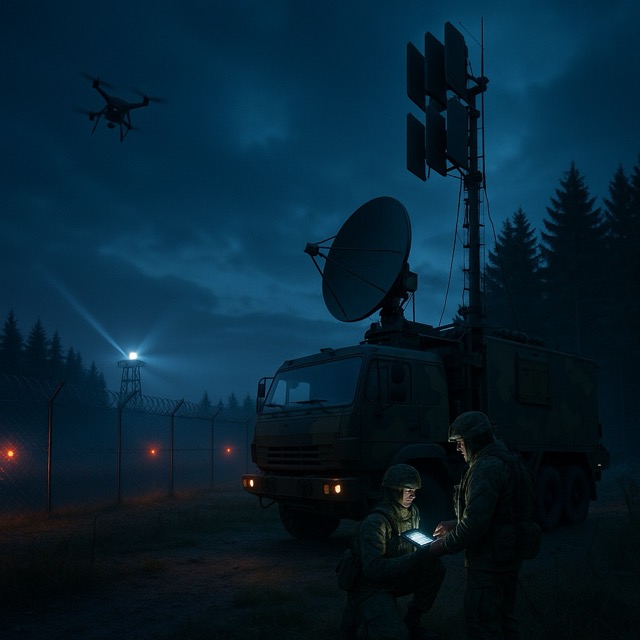
BRUSSELS – The European Union is racing to harden its air defenses with a so‑called “drone wall,” a fast‑expanding lattice of sensors, jammers and mobile interceptor teams designed to keep cheap, low‑flying unmanned aircraft out of NATO airspace. The push has accelerated after a flurry of Russian incursions into Poland and Romania this month and a run of GPS jamming incidents that rattled civil aviation—most notably one affecting the aircraft of European Commission President Ursula von der Leyen during an approach to Bulgaria. Together, the episodes have become a clarifying moment for Europe’s security establishment: the continent needs a layered, affordable counter‑drone architecture yesterday, not tomorrow.
Unlike early‑war debates about tanks and fighter jets, this sprint is not just about headline platforms. It is about stitching together thousands of relatively inexpensive devices—acoustic arrays, passive RF sensors, compact 3D radars, electronic‑warfare kits and gun‑based interceptors—into a single, interoperable network that can spot, classify and defeat slow, small targets before they cross a border or menace a runway. Lessons lifted directly from Ukraine are central: disperse the sensors, cue mobile teams with tablet‑based command software, and meet a €20,000 drone with a €2,000 effect, not a €2 million missile.
The money is finally moving at scale. Brussels’ new Security Action for Europe (SAFE) facility—part of a broader Readiness 2030 push—opens up as much as €150 billion in defence loans for EU governments, with frontline states expected to draw heavily for counter‑UAS buys and infrastructure. The separate European Defence Fund’s 2025 work programme channels just over €1 billion into collaborative R&D, with a marked emphasis on air defence and unmanned systems. And in a shift that underscores how the frontline has become the laboratory, the Commission has unveiled a €6 billion EU‑Ukraine “drone alliance” to co‑develop and industrialise battlefield‑proven counter‑drone technologies.
The immediate spur was kinetic. In the most serious breach of the war to date for the alliance, Poland reported nearly two dozen Russian drones crossing into its airspace during a mass strike on Ukraine and, with support from NATO aircraft, shot down several intruders—an unprecedented engagement. Romania has also reported repeated border‑area incidents. Separately, a surge in satellite‑navigation interference across the Baltic‑Black Sea arc has forced commercial pilots to dust off ground‑based procedures and detour around hotspots. European officials blame Moscow for the jamming and say the saturation tactics are designed to test responses, sow doubt and raise costs.
This is the cost curve problem in miniature. A €500 quadcopter modified to carry explosives or a €20,000 loitering munition can compel a defender to launch a €1 million missile—or shut an airport for hours. To win that math, Europe’s “drone wall” blends layers: low‑power RF detectors and acoustic mics to catch propeller signatures; portable jammers to sever links or spoof positioning; 35‑ to 40‑mm gun systems like the continent’s Skyranger/Skynex class with airburst rounds; and, increasingly, software that fuses feeds from many nations’ systems into a shared picture. Directed‑energy prototypes are maturing, but commanders say what matters in the next 18 months is volume—fielding thousands of cheap sensors and hundreds of mobile teams rather than waiting for a silver bullet.
Procurement is following the threat. Poland is building out a networked counter‑UAS backbone along its Eastern Shield while encouraging domestic‑foreign partnerships—such as tie‑ups between local radar makers and Nordic air‑defence primes—to scale production. The Baltics and Finland are extending the concept that their interior ministers sketched last year: a continuous belt of detection and interdiction nodes along the EU’s border with Russia and Belarus. Germany is expanding orders of mobile gun‑and‑sensor vehicles to protect brigades and critical infrastructure, and several air forces are tasking fighter squadrons and GBAD units to train shoulder‑to‑shoulder with police aviation and civil airport authorities.
Institutionally, NATO is tightening standards and training. The alliance’s tech and communications agency has run live trials to make sure national jammers and radars don’t trip over one another. European border agency Frontex, meanwhile, is stress‑testing off‑the‑shelf and bespoke systems in live operational trials this fall, with an eye toward rapidly deployable kits for crossing points and energy facilities. The goal is a minimum common denominator: that a Lithuanian RF sensor can cue a Polish interceptor and a Romanian airport jammer without a translator—or a lawyer—getting in the way.
The politics of money and market access could still slow things down. Paris has pushed for tighter rules on how much non‑EU content can ride on EU‑funded projects, risking friction with London at the very moment the UK and EU are rebuilding security ties. Washington’s role is also in flux, as Europe weighs how much to source inside the single market and how much to buy from U.S. suppliers. For capitals on the eastern flank, however, such debates are a luxury. Their priority is getting kit to the border before the next mass strike or another night of drones—this time flying deeper, faster, and lower.
Civil aviation is an equally urgent driver. Air‑traffic managers and pilots report that the spike in GNSS interference from the High North to the Black Sea is not a thought experiment but a daily operational headache. Airlines are revising risk models for routes over Poland and the Baltic, while regulators consider mandating hardened navigation receivers and contingency procedures. A two‑page defence memo circulated in several EU capitals this month argues that protecting airports and approach corridors should be treated as a “critical‑infrastructure sprint” for winter 2025–26, with deployable counter‑drone kits pre‑positioned at regional hubs and joint police‑military cells on call.
There are real constraints. Electronic attack authorities remain patchy across the union, with some countries still lacking clear, rapid‑response legal frameworks for jamming in dense urban airspace. Spectrum management, export controls and data‑sharing rules can delay cross‑border deployments. And Europe’s defence industry—for all its wartime growth—still faces bottlenecks in optics, microelectronics and energetics that slow production of sensors and programmable ammunition. Officials say SAFE loans can pull forward investment, but warn that standardising interfaces and opening back‑end data will be just as decisive as writing cheques.
The strategic picture is blunt. Russia has learned that the grey zone between peace and war rewards persistence and deniability. Small drones and spoofers can humiliate a state without triggering Article 5—until they do. Europe’s answer is to make that grey zone expensive, risky and unproductive for an adversary. The “drone wall” is not a single line of concrete and barbed wire; it is a fabric that sees farther, thinks faster and responds cheaper than the threat. If member states keep the pace—funding the low end of air defence with the same urgency as big‑ticket systems—the next time an unmanned aircraft flirts with NATO airspace, it will meet a net, not a gap.




 The Tower Post