As the world watches Gaza, Israel accelerates land seizures, settlement growth and camp demolitions across the West Bank—eroding three decades of fragile governance and the prospect of Palestinian statehood.
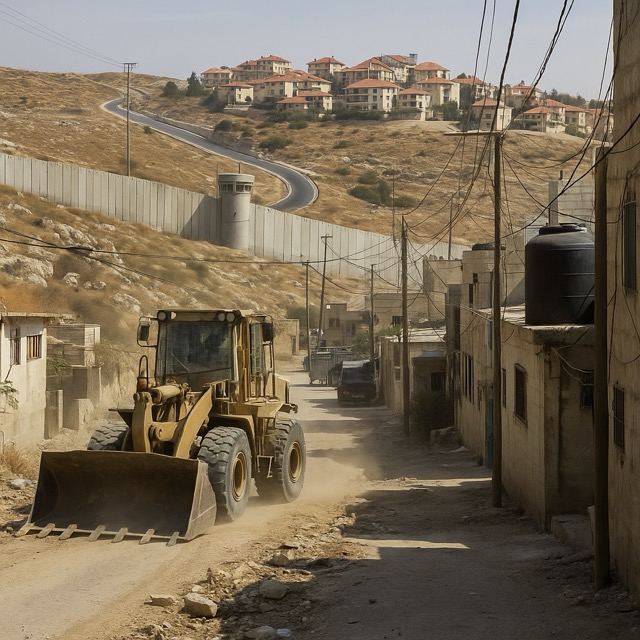
JERUSALEM/RAMALLAH — For nearly a year, the world’s gaze has been locked on Gaza’s catastrophe. Yet just over the Green Line, a different map is being redrawn in real time. Across the occupied West Bank, Israeli authorities have moved to cement control through stepped‑up land seizures, the rapid expansion of settlements, the extension of walls and segregated road networks, and a deepening military presence in refugee camps and cities. Together, these steps have begun to dissolve the delicate—and always incomplete—architecture of Palestinian self‑rule erected since the Oslo Accords, replacing it with an archipelago of enclaves increasingly cut off from each other and from East Jerusalem.
The shift is not subtle. In August, Finance Minister Bezalel Smotrich—who also wields sweeping powers over the Civil Administration that governs the West Bank—unveiled a settlement push aimed, in his words, at ‘burying’ the very idea of a Palestinian state by splitting the territory and severing it from its political and economic hub in East Jerusalem (Reuters, Aug. 14, 2025). Days later, the government approved a broader plan to consolidate and legalize dozens of settlements and outposts, triggering warnings from European governments of sanctions and from the United Arab Emirates of a diplomatic downgrading should formal annexation proceed (Reuters, May 30, 2025; Reuters, Aug. 20, 2025; Reuters, Sept. 18, 2025).
Prime Minister Benjamin Netanyahu has since signed off on rules that further accelerate settlement growth while once again rejecting any path to Palestinian statehood (Reuters, Sept. 11, 2025). Analysts describe this phase as a shift from ‘creeping annexation’ to a decisive, overt strategy: transferring powers long held by the military to civilian officials under Smotrich, funding new outposts, and advancing projects like E1 east of Jerusalem that would cleave the West Bank into northern and southern cantons (Peace Now, Feb. 2025; academic commentary, 2025).
On the ground, the map is changing in concrete and asphalt. The barrier—part wall, part fence—continues to snake across hillsides, with new segments and gates complementing a dual road system that channels Israeli and Palestinian traffic on separate arteries. Security‑cabinet approvals revived projects first floated years ago: bypass roads for settlers and controlled corridors for Palestinians, deepening physical separation and tightening Israeli jurisdiction over Area C—the 60 percent of the West Bank that remains under full Israeli control (Jerusalem Story, May 22, 2025). The wall’s legal status has long been criticized by international bodies, including the International Court of Justice and UN agencies, for its route that bites deep into the territory (ICJ/UN assessments summarized by IMEU).
Meanwhile, Israeli raids have become a grim routine across dense refugee camps—Jenin, Tulkarm, Nur Shams, Balata, Aqabat Jabr—where armored bulldozers plow through alleys to expose roadside bombs and tear up infrastructure. In late June and July, UN field reports documented waves of demolitions and damage, including orders against hundreds of structures in Jenin, Tulkarm and Nur Shams, and the destruction of homes and roads during multi‑day incursions (UN OCHA, June 25 & July 9, 2025; UN, July 11, 2025). Residents who rushed back after withdrawals found homes uninhabitable, businesses ransacked and basic services crippled (UN OCHA, Sept. 12, 2025).
The human toll is steadily rising. Between January 1 and July 21 this year, UN OCHA recorded 159 Palestinians killed by Israeli forces in the West Bank, along with a surge in demolitions that displaced families—more than half of them children—in East Jerusalem alone (UN OCHA, July 24, 2025). Settler violence has spiked too, with herding communities in Area C reporting attacks that drive them from grazing lands. Israeli officials say the raids and demolitions are aimed at dismantling armed networks and illegal construction; rights groups counter that the tactics amount to collective punishment that makes civilian life untenable.
Less visible, but just as consequential, are bureaucratic moves that blur the line between occupation and annexation. Since 2023, powers over planning, enforcement and settlement regulation have migrated from the military chain of command to a civilian ‘deputy’ aligned with Smotrich—an institutional redesign that, according to Israeli watchdogs, places strategic levers of land management under a minister whose stated goal is permanent Israeli sovereignty in ‘Judea and Samaria’ (Peace Now, Feb. 2025). The Knesset’s July 2024 vote rejecting a Palestinian state added political ballast; and this month, the security cabinet held an explicit discussion of annexation options, from select settlement blocs to the bulk of Area C (policy analyses, Sept. 2025).
For the Palestinian Authority, the implications are existential. Oslo’s fragile division of the West Bank into Areas A, B and C—meant as an interim arrangement—was supposed to evolve toward greater Palestinian self‑rule. Instead, Area A cities are repeatedly raided, Area B villages are hemmed in, and Area C—where most land reserves lie—has been re‑engineered to privilege settlement growth while pushing Palestinian construction toward denial and demolition. Fiscal pressure compounds the squeeze: Israel’s withholding of Palestinian tax revenues and tight movement controls have created liquidity crises, public‑sector strikes and partial salary payments, fraying what remains of the PA’s legitimacy (Financial Times, Sept. 2025).
Diplomatically, a counter‑current is building. Several Western governments have moved toward recognition of a Palestinian state this year, arguing that facts on the ground cannot be the arbiter of final status. Gulf states warn of consequences if Israel crosses into formal annexation. But even absent a proclamation, the cumulative effect of today’s policies is to pre‑decide tomorrow’s borders. Veteran negotiators describe a ‘race of irreversibilities’: every new outpost authorized, every bypass road poured, every neighborhood in a camp razed without rebuilding shrinks the domain in which a sovereign Palestinian state could realistically function.
Israel’s leaders counter that a demilitarized Palestinian state is an illusion after October 7, and that only sustained Israeli security control can prevent the West Bank from becoming another rocket‑launching front. Yet security maximalism has a territorial logic. Once security becomes permanent, the infrastructure that enables it—bases, buffer zones, access‑controlled roads, legal regimes—takes on a permanence of its own. The result is a landscape of ‘temporary’ measures that have outlived the negotiations they were meant to protect.
In conversations across the West Bank this summer, two images recur. The first is a hilltop settlement, red‑roofed homes blooming outward on terraced slopes, connected by fresh asphalt to Jerusalem. The second is a camp alley dredged into mud, its tangle of electric lines drooping over shattered curbs. Between these scenes runs a concrete wall and a web of checkpoints that contour daily life. If maps teach anything, it is that political possibilities are spatial. And the space for a Palestinian state—contiguous, viable, connected to East Jerusalem—has rarely felt narrower.
None of this is inevitable. Just as policy produced today’s fragmentation, policy could still reverse it: halting settlement expansion; repairing infrastructure in camps and cities; returning planning powers to Palestinian institutions; opening corridors that reconnect enclaves to East Jerusalem; and restoring a credible diplomatic horizon that anchors security measures to agreed political ends. Without that pivot, however, the dream fixed in communiqués and conference photographs will continue to recede, replaced by a managed one‑state reality defined by unequal rights and permanent conflict management.
The world’s focus can hold more than one crisis at once. What happens in the West Bank now will determine whether ‘two states’ remains a policy slogan or a future that can still be built.
Sources
• Reuters, Aug. 14, 2025: Smotrich plan to ‘bury’ Palestinian state by dividing West Bank.
• Reuters, Aug. 20, 2025: Government approves settlement plan; international responses.
• Reuters, May 30, 2025: Announcement of 22 new settlements despite sanctions threats.
• Reuters, Sept. 11, 2025: Netanyahu signs settlement expansion plan; rules out Palestinian state.
• UN OCHA, June 25 & July 9, 2025: Large‑scale demolitions in Tulkarm and Nur Shams; camp damage.
• UN (UNISPAL), July 11, 2025: Demolition orders for hundreds of structures in Jenin/Tulkarm/Nur Shams.
• UN OCHA, Sept. 12, 2025: Post‑incursion assessments as residents re‑enter refugee camps.
• UN OCHA, July 24, 2025: 159 Palestinians killed Jan–July 2025; displacement figures.
• Peace Now, Feb. 2025: Transfer of settlement powers to civilian authority under Smotrich.
• Financial Times, Sept. 2025: Strategy to dismantle remnants of Oslo; PA fiscal crisis.
• Jerusalem Story, May 22, 2025: Separate road system approvals; deepened separation.
• IMEU explainer (summarizing ICJ/UN positions): Barrier’s route and legality assessments.




 The Tower Post