Riyadh signals security diversification after Israel’s Doha strike while moving to shutter music lounges amid a conservative backlash
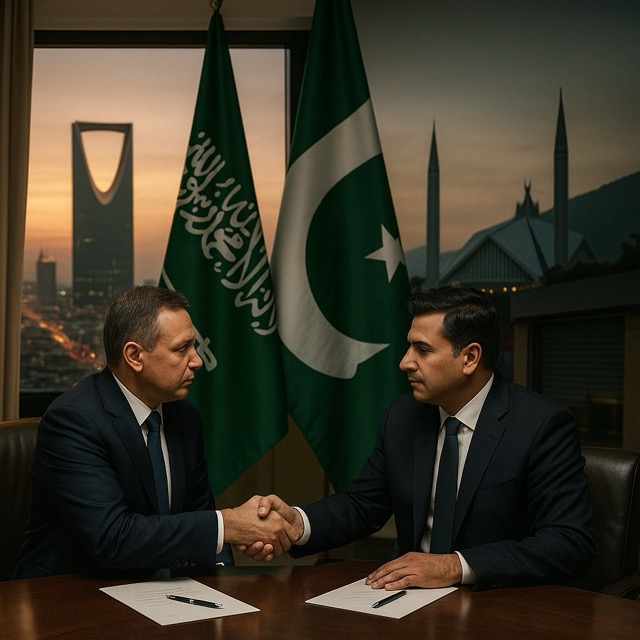
Riyadh — In a week that captured Saudi Arabia’s increasingly complex balancing act, the kingdom on Wednesday, September 17, signed a “strategic mutual defence” pact with nuclear‑armed Pakistan—an agreement that commits each country to treat an attack on the other as an attack on itself. The announcement came days after Israel’s unprecedented strike on Hamas figures in Doha, an operation that jolted the region and paused Qatar’s mediation efforts. Even as Riyadh broadcast a tougher, more autonomous security posture abroad, authorities at home moved to shut down dozens of popular music lounges in Riyadh and Jeddah, citing health and hygiene violations amid a conservative backlash against the kingdom’s expanding entertainment scene.
Taken together, the two stories—seemingly unrelated—illustrate the dual track of Saudi statecraft in 2025: strategic diversification of security partnerships abroad, and a carefully modulated cultural opening at home that advances in spurts and pauses under pressure from traditional constituencies. The result is a kingdom simultaneously projecting deterrence and caution, and reminding allies and critics alike that its reforms are not a straight line.
The defence pact, signed in Riyadh during Pakistani Prime Minister Shehbaz Sharif’s visit, is the most explicit security commitment Saudi Arabia has entered with a nuclear‑armed partner. Officials in both capitals described it as a ‘Strategic Mutual Defense Agreement,’ embedding language that a strike on one would be met as a strike on both. Pakistani Defence Minister Khawaja Asif went further in public comments, suggesting the kingdom would stand by Pakistan in the event of a conflict with India—remarks that will be parsed closely in New Delhi and Washington.
While the full text has not been released, Saudi and Pakistani readouts emphasize joint deterrence, expanded exercises, and deeper defence‑industrial cooperation. For Riyadh, the timing is deliberate: the pact lands one week after Israel’s September 9 strike in Doha that killed several people, including a Qatari security officer, and—critically—infuriated Qatar, a pivotal interlocutor in hostage and ceasefire diplomacy. Doha has since demanded an Israeli apology and assurances before resuming mediation. The episode underscored the volatility of U.S.‑led crisis management and the risks of escalation spilling across borders long considered off‑limits.
By turning to Pakistan, Saudi leaders are doing more than rewarding a historical partner. They are signaling that the kingdom will not rely solely on U.S. guarantees—or any single pillar—for deterrence. Pakistan brings to the table one of the world’s largest armies, a well‑tested ballistic missile program, and, above all, a nuclear deterrent. None of this makes a Saudi nuclear program inevitable; indeed, Riyadh has continued to court U.S. security ties and civilian nuclear cooperation. But in the near term it broadens options and complicates the calculations of adversaries from Yemen to Tehran.
The pact’s ripple effects extend east. India, which has cultivated deep energy and investment ties with the kingdom while managing a frosty relationship with Islamabad, will read the agreement warily. New Delhi does not want any development that emboldens Pakistan or internationalizes South Asian flashpoints. At the same time, India’s burgeoning trade and strategic dialogue with Riyadh give both sides incentives to firewall their cooperation from subcontinental crises. Expect quiet diplomacy to clarify red lines and avoid misperception.
For Washington, the message is familiar but sharper. U.S. officials have long encouraged Gulf partners to assume more of their own security burden without outsourcing it to rivals inimical to American interests. A Saudi‑Pakistan mutual defence clause raises questions about command and control in a crisis, interoperability, and how U.S. assets in the Gulf would be positioned if deterrence failed. The Biden administration—already managing the Gaza war’s spillovers and an election season at home—must now integrate this new axis into its regional planning while keeping pathways open for a broader Saudi‑U.S. security framework.
Then there is Israel. Jerusalem views Pakistan through the lens of nuclear opacity and distance; the two states have no diplomatic relations. Yet the Doha strike’s diplomatic blowback—halting Qatari mediation and isolating Israel further in the Gulf—has given Saudi planners a case study in how quickly assumptions can shift. A Riyadh that diversifies partners is harder for Israel to read, and perhaps less inclined to tie its hands to the preferences of a government that has repeatedly surprised even close allies.
If the defence pact showcased Saudi autonomy abroad, the crackdown on music lounges revealed the limits of cultural disruption at home. Over recent weeks, municipal authorities have closed at least two dozen lounges—venues that offered live music, shisha, and a relaxed atmosphere at accessible prices—particularly in working‑ and middle‑class neighborhoods. Officials cited serious breaches of public health and hygiene codes. Yet many Saudis read the campaign as an institutional response to mounting conservative complaints that such spaces blur gender boundaries and mimic the aesthetics of nightclubs in a country where alcohol remains illegal.
These lounges emerged organically alongside the glitzier, sanctioned entertainment of Vision 2030—Formula 1 races, marquee concerts, and mega‑festivals. They filled a demand for affordable, routine leisure that didn’t require a trek to a mega‑project or a pricey ticket. In that sense their shuttering is not just a morality play; it is a question of urban policy and social equity. When public space and cultural expression expand primarily through top‑down, spectacular events, more quotidian venues can become flashpoints.
Authorities are now attempting to square the circle. The Interior Ministry has established units to combat ‘immoral acts,’ a label broad enough to accommodate both genuine code violations and shifting lines of permissibility. At the same time, officials do not want to torpedo the kingdom’s nascent creative economy or spook international promoters who have invested in the Saudi market. Expect a compliance drive—licensing, inspections, and stricter operating rules—rather than an outright reversal of cultural opening.
What does the week tell us about Saudi Arabia’s trajectory? First, that diversification is as much a doctrine as a tactic: diversify security partnerships, diversify economic inputs, diversify the cultural offer. Second, that diversification does not mean democratization. The state remains the arbiter of pace and scope—accelerating here, decelerating there—based on regime priorities and political risk.
Third, and most practically, Saudi policy is tightly sequenced to regional shocks. The Doha strike both exposed the fragility of existing de‑escalation channels and created political room for Riyadh to underline its autonomy. Closing lounges, meanwhile, alleviates domestic pressure at a moment when the leadership is testing the boundaries of external alignment. Each move buys time and leverage in a volatile environment.
For investors and diplomats, the signal is clear. Saudi Arabia is not retreating from reform or from global engagement. It is refining its instruments. The defence pact with Pakistan is a hedge with teeth; the cultural clampdown is a reminder that reform is curated, not crowdsourced. Those who mistake either move for a permanent turn—to hard alliance on the one hand or cultural retrenchment on the other—will misread a leadership that prizes optionality.
The near‑term watch‑list writes itself. Will Qatar accept an Israeli apology that restores its mediation role? Will Riyadh and Islamabad publish fuller details of the pact, including command arrangements or basing access, that could either reassure or alarm neighbors? Will the lounge closures harden into a ban, or will a regulated model re‑emerge that meets public‑health standards while preserving space for local musicians and social life? Each answer will help define whether this week was an inflection point or simply a particularly vivid snapshot of Saudi Arabia’s ongoing recalibration.
For now, one conclusion stands: Saudi Arabia is moving on two tracks that often intersect. The kingdom is building new guardrails for its external security while renegotiating the boundaries of everyday life at home. The choreography is complicated, sometimes jarring, and, as this week shows, designed to keep Riyadh—rather than its friends or foes—in control of the tempo.
Note on sourcing: This article draws on reporting and official statements from Associated Press, Al Jazeera, Axios, the Financial Times, The Diplomat, and other publicly available materials dated September 9–21, 2025.


 The Tower Post