A post-regional-election sell-off, a frantic defense of the peso, and a surprise pledge from the U.S. Treasury set the stage for October’s midterms
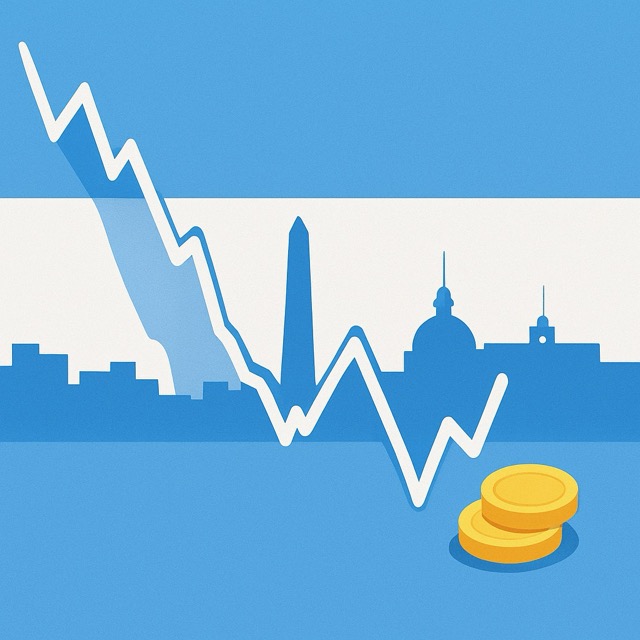
Buenos Aires — Argentina’s assets slumped in early September after President Javier Milei’s party fared worse than expected in a key regional election, triggering a new wave of volatility just weeks before nationwide midterms. The sell-off revived old fears: that a reform agenda built on sweeping deregulation, fiscal consolidation and a lighter state may falter if the coalition cannot broaden its base in Congress.
The market stress quickly migrated from equities to debt and currency markets. As offshore funds and locals sought safety, the central bank stepped hard on the brakes, spending more than $1.1 billion across three sessions to support the peso and keep the official rate inside its managed band, according to people familiar with the operations and local press tallies. The pace of intervention jolted bondholders, who have long worried that Argentina’s scarce liquid reserves could be depleted in a matter of weeks if volatility persists.
Officials framed the action as a necessary circuit breaker to prevent a disorderly move that could reignite pass-through inflation and reignite expectations of a deeper devaluation. But every dollar sold by the monetary authority sharpened an uncomfortable calculus for investors: how much of the buffer can be burned before the exchange regime, or the political will to defend it, cracks.
Then, a plot twist from Washington. U.S. Treasury Secretary Scott Bessent said on Monday that “all options” were on the table to support a critical hemispheric partner—including, he said, potential purchases of pesos or Argentina’s sovereign debt. The comments, paired with the prospect of drawing on the Treasury’s Exchange Stabilization Fund, amounted to the clearest signal yet that the United States is prepared to underwrite stability in South America’s second-largest economy.
Markets snapped back on the headline. The peso rallied, strengthening about 6% on Tuesday, while yields on Argentina’s dollar bonds fell roughly 3.7 percentage points—a sizable single-day move—though spreads remain more than 1,000 basis points above comparable U.S. Treasuries, a reminder of how far confidence still has to climb.
The timing and the politics are inseparable. September’s regional setback raised doubts about whether Milei’s party can expand support in October’s midterms, where control of key committees—and therefore the legislative runway for supply-side changes—hangs in the balance. Governors aligned with the opposition have already flexed their muscles over fiscal transfers and revenue-sharing disputes, and union leaders are testing wage floors in collective bargaining that could reheat price dynamics.
In parallel, the government moved to coax in dollars by temporarily suspending export taxes on major farm products through late October, a gambit aimed at flushing grain stocks and front-loading foreign-exchange inflows. While agribusiness groups welcomed relief from levies that have long distorted incentives, economists warned the measure risks creating a post-election air pocket if sales are merely pulled forward.
For Bessent, the calculus appears partly geopolitical. Stabilizing a G20 economy—and a president closely aligned with the White House—would telegraph U.S. resolve at a moment when the region’s growth engine, Brazil, is cooling and China’s footprint in commodity finance is expanding. The U.S. has multiple levers: direct currency operations, secondary-market purchases of hard-currency bonds, or a repo-like liquidity backstop coordinated with multilateral lenders. Any of those, even if modest in size, could crowd in private capital by reducing tail-risk scenarios.
Skeptics, however, note that Argentina’s problems are less about liquidity than credibility. Years of fiscal dominance over monetary policy, a complex web of capital controls, and weak institutional anchors have produced chronic stop‑go cycles. Without faster progress on trimming the fiscal deficit, normalizing relative prices and rebuilding an independent central bank balance sheet, fresh money—whether from Washington or Wall Street—may only buy time.
What would a durable turning point look like? Three signposts stand out. First, a convincing path to positive real interest rates that can coexist with gradual FX flexibility, limiting one-way bets. Second, a critical mass in Congress for pro‑market legislation on labor, competition and privatizations—enough to change expectations about the economy’s productive frontier rather than just its next quarter. Third, a coherent reserve‑rebuilding plan that marries commodity pre‑export finance, multilateral disbursements, and incremental capital account normalization.
For now, price action is doing the talking. The knee‑jerk rally after Bessent’s remarks underscores how hungry investors are for a backstop. But the pricing still embeds a fat risk premium, and the burden of proof remains on Argentine policymakers to convert external goodwill into internal consensus. October’s vote is less a referendum on Milei’s ideology than on his ability to stitch together a governing majority.
The next month will be a test of sequencing and stamina. If the central bank keeps defending the currency at this clip, it risks eroding the very reserves needed to anchor confidence into the midterms. If it steps back, the peso may find a weaker level that rekindles inflation psychology. That is why Washington’s signal matters: it widens the policy menu at a moment when domestic politics narrow it. Whether it proves a bridge to reform—or just another chapter in Argentina’s long chronicle of near‑misses—will be written at the ballot box.



 The Tower Post