As cameras, trackers and AI shrink in size and price, the power to watch — and to judge — shifts from states and platforms to all of us.
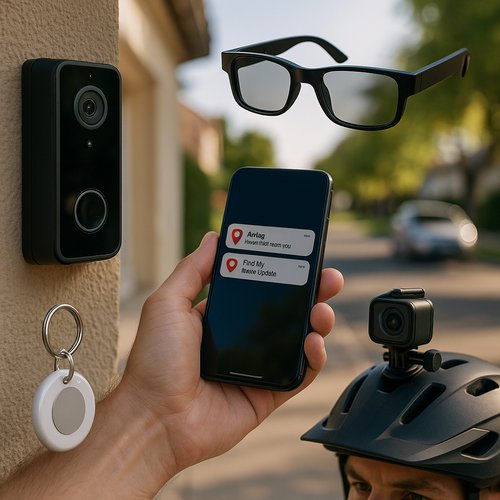
The easiest way to glimpse the future of surveillance is to stand on any street corner and look around. Doorbells blink at head height. Delivery riders wear helmet cameras that record in high definition by default. Smart glasses can now translate, caption and record without drawing a second glance. And key rings, bike saddles and luggage are seeded with Bluetooth trackers that ping vast finding networks built into our phones. Surveillance has not disappeared into the background; it has been socialized. The question is no longer just what Big Brother sees, but what we do to one another. Call it ‘peerveillance’—a Little Brother society where observation flows sideways as much as from the top down.
The term captures a shift technologists and sociologists have been circling for a decade: ordinary people are becoming the primary collectors and arbiters of behavioral data. This year, that trend took a hardware leap. Meta’s new Ray‑Ban Display smart glasses put a camera, microphone and a heads‑up display into everyday eyewear, with live captions and translation on tap, and gesture control via an EMG wristband. They sell for the price of a mid‑range phone. Wearables are maturing from gadgets into garment—clothing that records.
The domestic frontier is even more revealing. The same week a neighbor posts a clip of a fox prowling the sidewalk, another neighbor privately forwards doorbell footage of a teenager cutting across a lawn. In WhatsApp groups, these clips gather comments, interpretations, and occasionally identifications. The practical upside is obvious: stolen packages are recovered; suspicious cars are noted. But the civic downside grows in parallel: the crowd learns to police not just crime, but etiquette. Aesthetic disagreements—about who belongs on a bench, what time music should end, where a skateboard should roll—harden into a digital dossier of small infractions.
What makes 2025 pivotal is that the infrastructure for peerveillance is no longer patchwork. Apple and Google’s cross‑platform anti‑stalking alerts now notify most smartphone users if an unknown tracker is traveling with them. That is a genuine privacy win—but it also confirms how ubiquitous trackers have become, and how fully our devices have been enlisted into a planetary sensor mesh. And as independent tests have shown, these networks are still imperfect; coverage gaps and delays persist, reminding us that protection is uneven and contested.
Meanwhile, the enforcement landscape is playing catch‑up. Europe’s AI Act, in force since August 2024, began phasing in prohibitions and governance in 2025, including guardrails on real‑time remote biometric identification in public spaces. Those limits matter for governments and large retailers. Yet they do little to restrain a neighbor using a consumer camera and a cheap facial‑recognition plug‑in, or a manager who quietly logs keystrokes and webcam snaps from a home‑working laptop. The rules of the public square are tightening just as the private porch—and the private Slack—expands.
A second force accelerates the shift: ambient AI. Microphones tucked into laptops, smart speakers and cameras make it possible to infer more from less. Academic teams have shown that models can reconstruct typed text from the sound of a keyboard with startling accuracy, even in noisy environments. Combine that with shrinking camera modules and on‑device vision models, and the data diet for Little Brother becomes richer by the quarter. The barrier is no longer technical; it is social and legal.
This is not purely dystopian. Peerveillance has saved lives and secured justice. Bystander video has exposed abuses by officials and employers; cyclists’ helmet cams have clarified liability in crashes; phone footage has chronicled war crimes the world might otherwise dispute. Sousveillance—the watching of the powerful by the less powerful—remains a democratic tool. But peerveillance is sousveillance without direction: it turns the lens laterally and everywhere, often detached from due process or context. A viral clip becomes a verdict, a neighborhood chat becomes a tribunal. And because the costs of capturing and sharing are near zero, the supply of judgments is infinite.
The economics are relentless. Hidden cameras that once cost hundreds now ship for under a dinner out, shooting 4K video with day‑night modes. Battery life creeps from hours toward days. Platforms optimize for engagement; engagement rewards outrage; outrage loves video. Even when regulators act—such as the U.S. Federal Trade Commission’s serial cases against stalkerware makers—new vendors pop up with slightly different branding, or offshore hosting. The curve bends toward more devices in more places, owned by more people with more ambiguous motives.
So are we becoming a Little Brother society? In some respects, we already are. The sign is not a panopticon hovering over the town square but a mosaic of small lenses at eye level, stitched together by software and social norms. The danger is not only surveillance but chilling: the subtle inhibition of public life when we expect to be judged by neighbors, colleagues and strangers. Hesitation around a playground conversation. The choice not to dance at a festival. The instinct to self‑censor a joke.
What would it take to course‑correct without losing the real benefits? Three layers stand out:
First, devices that default to dignity. Manufacturers can make capture more conspicuous—stronger recording indicators, audible shutters, and clear‑sighted privacy dashboards—while continuing to ship cross‑platform alerts for unwanted tracking. They should keep compute on‑device by default and minimize retention windows, so that a snatched moment doesn’t metastasize into a permanent record.
Second, laws that match the locus of power. The AI Act’s limits on public‑space biometric identification are a start; similar clarity is needed for private‑space misuse—doorbell dragnetting, face‑tagging at parties, covert workplace monitoring. We do not need to outlaw recording; we need to define where consent ends and harassment begins, and we need remedies that individuals can actually invoke without a class‑action lawyer.
Third, norms that travel faster than hardware. Neighborhood groups and parent chats can publish simple codes: announce when you record; blur kids by default; avoid posting license plates and faces without a safety justification; recognize that a single clip is not the whole story. Journalistic habits—verify before sharing, correct when wrong, grant context—belong in the group chat as much as in the newsroom.
Technologists sometimes argue that social adaptation inevitably soaks up the shocks. There is truth in that; every medium forces manners to evolve. Yet adaptation is not automatic. It is taught and negotiated, and the institutions that teach—schools, companies, city halls—need updated curricula for a world of constant recording. Kids should learn not just to code but to camera: how to handle bystander video ethically, how to respond to misidentification, how to repair reputations.
Above all, we should resist fatalism. Peerveillance is not a natural law; it is an equilibrium we choose through purchases, policies and posts. The same networks that can shame can also shelter—by alerting someone who is being tracked, by routing crisis footage to trusted responders, by adding friction to miscontextualized clips. The test for 2026 will be whether we embed those counterbalances faster than hardware furnishes new angles on our lives.
If Big Brother was a state project, Little Brother is a social one. It is not omniscient and never will be. But it is intimate, ubiquitous, and increasingly automated. Whether it becomes the water we swim in or a tide we manage depends on choices still open to us—in code branches, in legislation drafts, and in the micro‑decisions we make every time a camera lights up.



 The Tower Post