Why Moscow may gradually increase its provocations in the Baltics to test NATO
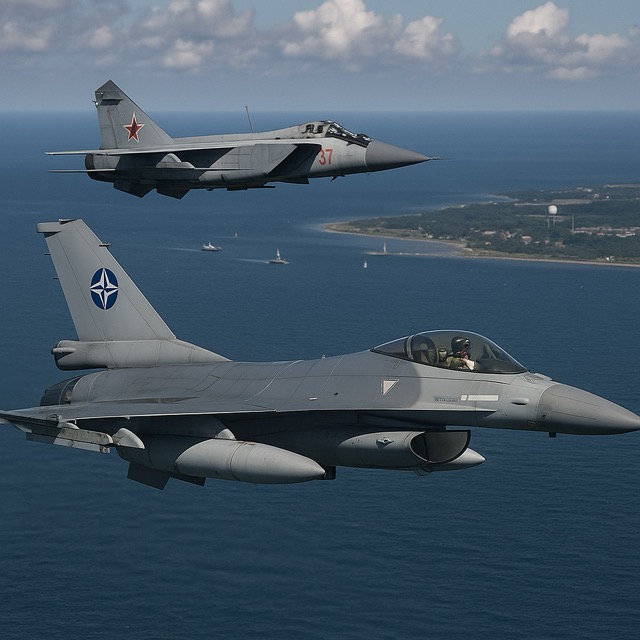
In the Baltic region, deterrence is a daily performance, not a line in a treaty. In recent months, a drip‑drip pattern of incidents — alleged airspace violations near Estonia, GPS jamming across flight corridors over the Baltic Sea, maritime boundary maneuvers around the Gulf of Finland, and probing drones and aircraft near Polish and Lithuanian infrastructure — has revived a sobering question: is the Kremlin deliberately edging up the temperature to test NATO’s cohesion and crisis management?
All the ingredients of a “gray‑zone” playbook are present. Electronic warfare has disrupted satellite navigation for civilian airliners and ships. Border theatrics, such as the removal of navigation buoys on the Narva River that separates Estonia from Russia, blur administrative disputes with political signaling. A June decree in Moscow redrew the legal baselines from which Russia measures territorial waters in parts of the Baltic, a cartographic change with operational implications for foreign vessels. And, at moments, the brinkmanship has been kinetic in all but name: close passes by fighter jets and unmanned systems straying into allied airspace, forcing scrambles and emergency deliberations.
None of these acts, on their own, meets the bright line of an “armed attack” under NATO’s Article 5. That is precisely the point. The aim is to make allied governments argue among themselves about thresholds while acclimating publics to a constant tremor of anxiety. For Russia, this is strategic anesthesia: normalize the abnormal, and you erode the deterrent value of the Alliance without ever firing a shot.
Why now? Three layers of context matter. First, the war in Ukraine has locked Moscow into a long campaign where pressure on NATO’s periphery is a lever to complicate Western logistics, soak up allied attention, and probe for seams. Second, the map of the Baltic has changed: Finland and Sweden’s accession transformed the Baltic Sea into a de facto NATO lake, encircling Russia’s Kaliningrad exclave and narrowing its options. That strategic setback incentivizes the Kremlin to contest the new status quo with tools that are deniable, incremental, and reversible. Third, 2025 is a year of political churn across NATO capitals. Leaders face budget constraints, election pressures, and debates about burden‑sharing — a ripe environment to test how quickly consensus forms under stress.
Consider the electronic warfare front. Aviation authorities and open‑source researchers have tracked persistent GNSS interference radiating from Kaliningrad and the eastern Gulf of Finland, periodically forcing airlines to revert to alternative procedures and divert approaches. Maritime operators report similar disruptions to navigation around busy traffic separation schemes. These are low‑cost, low‑risk acts that create real‑world friction. They also generate ambiguity: was a particular incident a test of a new jammer, an overeager local commander, or a political signal? That fog is a feature, not a bug.
At sea, Moscow’s June decision to redefine maritime baselines in the Gulf of Finland — tightening the geometry of what it considers internal waters — signals the likely next phase: more frequent Russian challenges to allied ships and research vessels on the margins of contested zones, accompanied by legal‑bureaucratic assertions of jurisdiction. In parallel, the Narva buoy episode underscores how the Kremlin blends technical disputes with coercive optics along a NATO frontier. Each move forces Tallinn, Riga, and Vilnius to choose between swallowing a nuisance or escalating a confrontation over objects that, to a casual observer, look trivial. Either response carries a cost.
In the air, the pattern is familiar from the Cold War but now plays out against far less strategic slack. The Baltic states are small; a single incursion can traverse the width of a country in minutes. That compresses warning, decision‑making, and the margin for error. Close passes near Polish offshore platforms in the Baltic and drone incursions over allied territory raise the risk of snap, localized crises in which national commanders must decide — quickly — whether to intercept, jam, or shoot down. Moscow is betting that the fear of “accidental escalation” will bias NATO responses toward restraint, at least at first.
To be sure, deterrence is not one‑sided. NATO has tightened its posture. Germany is anchoring a permanent brigade in Lithuania, with new training areas and prepositioned equipment; Canada is scaling up to brigade strength in Latvia; the United Kingdom has earmarked a brigade for rapid reinforcement of Estonia. Allied air policing has evolved into air defense, with dispersed bases and quick‑turn alert cells integrated with Swedish and Finnish sensors. Under the Alliance’s new regional defense plans, national forces are now wargaming short‑notice reinforcement of the Suwałki Gap — the 96‑kilometer corridor binding Lithuania to Poland and the rest of NATO — with rail timetables, bridge classes, and fuel points planned in detail rather than on PowerPoint. The deterrent message is clear: any grab will meet a layered, multinational response.
Yet posture solves only part of the problem, because Moscow’s most effective moves aim below the threshold of open conflict. The real test is political — how fast and how credibly can allies consult, attribute, and decide on costs to impose after each “salami slice”? Several steps would strengthen the answer.
First, make attribution routine and public. When GNSS jamming spikes or a drone crosses a border, the instinct to classify the evidence for fear of revealing sources is understandable. But excessive secrecy cedes the narrative. With Sweden and Finland now inside the tent, NATO should stand up a Baltic Incident Attribution Cell that fuses allied sensor data, civil aviation reporting, and commercial RF analytics into rapid, releasable assessments. Speed and transparency are their own form of deterrence: they deny the Kremlin the fog it exploits.
Second, codify a menu of automatic, proportionate responses for sub‑Article 5 events. Think of it as an “Article 4.5”: if X happens, then Y follows within days. The responses should be cumulative and visible — rotating an electronic warfare squadron into theater, lighting up an exercise window that was penciled in for later in the year, or activating joint maritime patrols along newly contested baselines with embarked legal advisers. The goal is to make small provocations predictably counterproductive for Moscow without triggering an escalatory spiral.
Third, harden the civil‑military seam. The Baltic states have already invested in resilient communications, reserve mobilization, and total defense concepts. But the vulnerabilities that provocations exploit often sit in civilian systems: port scheduling software, air traffic procedures, energy interconnectors, the rail nodes that would surge transatlantic kit toward the front. Exercises should force‑march through those seams, with airline dispatchers, harbor masters, and grid operators in the same ops rooms as brigade S‑3s and air defense coordinators. The measure of success is not a glossy after‑action report but a shorter, calmer chain of decisions during the next scare.
Fourth, clarify red lines around critical infrastructure. The Balticconnector gas pipeline incident in 2023 and subsequent cases of seabed cable damage in northern waters have already prompted NATO to expand undersea domain awareness. In the Baltic, allies should move from awareness to guardianship: map out the top 20 nodes whose loss would most disrupt reinforcement or civilian life, publish that list to raise the bar for would‑be saboteurs, and quietly assign persistent surveillance — not just ships, but uncrewed systems and seabed sensors that make covert tampering conspicuously risky.
Finally, speak to publics early and often. The Kremlin’s gray‑zone artistry depends on Western self‑deterrence and social fatigue. Clear, consistent communication — that these incidents are designed to make democracies second‑guess themselves; that rules‑based pushback is not escalation but stabilization; that shared costs today prevent far higher costs tomorrow — is not a sideline. It is part of the shield.
Skeptics warn that talking tough about “tests” can become a self‑fulfilling prophecy, trapping policy in a reactive crouch. They have a point. The answer is disciplined proportionality and persistent presence, not loud threats. Credibility, in the Baltic theater, will be measured in prepositioned fuel bladders, deconflicted flight plans, exercised rail spurs, and alerted air defense crews — the unglamorous sinews that turn an alliance from a promise into a plan.
So what does escalation look like if Moscow decides the temperature is still too low? Expect more of the same, but closer and more frequent: drones flown deeper into allied airspace under the guise of “weather balloons,” coast guard standoffs over scientific buoys or crayfish traps, civil airliners forced to wave off approaches to regional airports as nav signals flicker, and maritime “safety notices” that suddenly close off rectangular patches of sea in shipping lanes near the approaches to the Gulf of Finland. Each incident would be calibrated to generate uncertainty and arguments about response, not a firefight.
That calibration is the danger. The more often such incidents occur without predictable consequences, the more a new normal sets in — one in which Russian officers on the Baltic littoral feel licensed to improvise for effect, and NATO’s local commanders become habituated to restraint. The risk is not only miscalculation at the tactical level; it is strategic drift. Over time, the line between a “probe” and a “fait accompli” can blur in a haze of precedent.
The Baltic states themselves understand this better than anyone. Their response has been to invest, integrate, and internationalize: increase national defense spending, align plans with neighbors, and embed foreign forces on their soil. Those choices are not escalatory; they are stabilizing. They raise the cost of adventurism and widen the circle of stakeholders committed to regional peace.
The Kremlin’s wager is that democracies tire before autocracies blink. But the Baltic story of the past two years offers a different lesson: pressure has clarified purpose. If Moscow’s dangerous game aims to test NATO, the prudent reply is not a single retort but a posture — one that is steady, layered, and relentlessly practiced. In deterrence, repetition is reputation. And in the Baltic, reputation may be the most powerful weapon of all.




 The Tower Post