At the UN in New York, the U.S. president distances himself from past both-sides rhetoric and says his rapport with Putin “did not mean anything.”
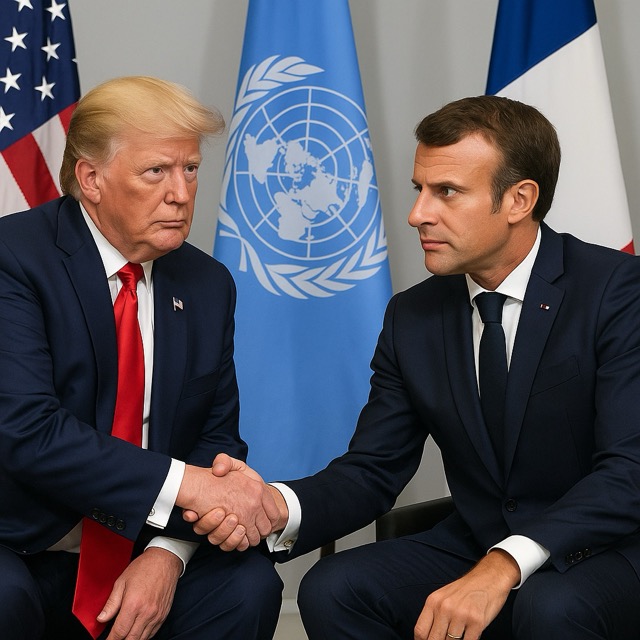
Meeting Emmanuel Macron on the margins of the United Nations General Assembly, U.S. President Donald Trump said “Russia should have stopped” the war in Ukraine — a marked departure from earlier comments casting blame on both Moscow and Kyiv. He added that his oft-touted relationship with Vladimir Putin “did not mean anything,” underscoring a rhetorical pivot that startled diplomats and delighted some European officials.
The remarks came as leaders converged in New York for the UN’s 80th General Assembly. After bilateral and informal huddles with allies, Trump publicly asserted that Ukraine, backed by Europe and NATO, could win back “all of its territory” seized by Russia, framing Moscow as a struggling power facing mounting economic strain. The shift followed weeks of mixed signals from Washington as the White House pursued parallel tracks: pressure on the Kremlin and exploratory channels for a ceasefire.
Trump’s meeting with France’s president, who has pitched himself as a shuttle diplomat between Washington, Kyiv and European capitals, came against a backdrop of visible choreography — and occasionally unscripted moments. A viral street-side exchange showed Macron briefly stuck behind a New York police barricade, phoning Trump as motorcades locked down Midtown. Behind the levity, aides said, were serious talks about synchronizing Western leverage over Moscow and the conditions for any credible peace path.
For months, Macron has pressed Trump to anchor any negotiations in a simple principle: peace cannot mean Ukraine’s capitulation. That message was sharpened during the leaders’ February meeting at the White House and in subsequent calls with European partners, when Macron urged the U.S. to keep sanctions pressure high and to link ceasefire diplomacy to verifiable security guarantees for Kyiv. In New York, the French leader welcomed the tougher line on Russia while cautioning that words would need to be matched by policy.
Trump’s language on Tuesday and Wednesday — calling Russia a “paper tiger,” asserting that the war has exposed profound weaknesses in Moscow’s military and economy, and telling reporters that his personal rapport with Putin “did not mean anything” — contrasted sharply with earlier episodes this year. In February and again over the summer, Trump had floated the idea that Kyiv might have to accept hard compromises, a stance that rattled Eastern Europeans and Ukrainians who feared any ‘land-for-peace’ formula would reward aggression.
Ukraine’s President Volodymyr Zelenskyy, who also met Trump in New York, called the new tone “a big shift,” though he reiterated that Kyiv needs concrete steps — more air defenses, tighter sanctions enforcement, and sustained ammunition flows — to translate statements into battlefield resilience. Privately, Ukrainian officials say clarity from Washington reduces the risk of a rushed settlement that would lock in Russian gains and leave Ukraine exposed to renewed attacks.
European reactions were mixed but cautiously positive. Officials in the Baltics and Poland said Trump’s assertion that Ukraine can retake all its land — including Crimea — aligns U.S. rhetoric more closely with Europe’s stated goals and strengthens deterrence. Others, particularly in southern Europe, expressed concern that heightening expectations without immediate policy adjustments could backfire if Moscow escalates or if Western unity frays over costs.
In practical terms, the immediate U.S. policy picture remains largely unchanged. Secretary of State Marco Rubio signaled at the Security Council that Washington will “impose costs for continued aggression,” but stopped short of unveiling the sweeping new Russia sanctions package that Kyiv has requested. Defense officials continue to emphasize that NATO’s mission is to equip Ukraine while avoiding direct alliance-Russia clashes, even as some European capitals grow more vocal about intercepting or shooting down Russian aircraft if they threaten allied airspace.
Still, the rhetorical shift matters. Diplomats say the message landing in Moscow is that the White House now speaks less about “deals” and more about leverage — sanctions calibrated with European partners, tighter export controls, and green lights for European procurement of U.S. munitions. The calculus, as one senior official framed it, is to convince the Kremlin that prolonging the war worsens Russia’s strategic position by the month.
The Macron–Trump dynamic has oscillated between friction and alignment since February. At their joint appearance in Washington earlier this year, Macron publicly corrected Trump on European support levels for Kyiv and insisted that any ceasefire must be anchored in guarantees and accountability. Those differences have not disappeared, but aides on both sides describe a narrowing gap: a shared willingness to raise economic pressure and a growing acceptance in Washington that Ukraine’s long-term security depends on more than a fragile truce.
For Moscow, the new tone from Washington raises the stakes. Russian officials have dismissed Western statements as bluster, but the combination of improved Ukrainian air defenses, grinding attrition along the front, and deeper European rearmament has made quick victories elusive. Economists point to the long-tail impact of sanctions on technology imports, energy revenues and capital flight — the very vulnerabilities Trump cited in his UN-week messaging.
The road ahead is crowded. European leaders are discussing a package that would sequence tougher sanctions with a framework of security guarantees and reconstruction financing, conditional on a verified pullback of Russian forces. Kyiv is pushing for firm timelines and clear penalties for violations. Washington, for its part, is weighing additional export controls and secondary sanctions, steps that could test unity with partners exposed to Russian markets.
Trump’s declaration that his personal rapport with Putin “did not mean anything” may be as significant as the harder line on Russia itself. For years, allies and critics alike have tried to parse whether the relationship shaped policy. This week’s message — that the relationship is irrelevant and that outcomes will be dictated by Western leverage — is intended to reassure Europeans wary of private understandings or sudden course corrections.
If the administration follows through, the New York pivot could mark a reset in the war’s fourth year: less talk of immediate deals, more emphasis on compulsion; fewer hints at territorial concessions, more clarity that Ukraine’s borders are not bargaining chips. But the test will come quickly. As Macron reminded reporters, peace built on pressure still requires proof — and policy.
What happens next will hinge on whether Washington’s words are matched by measurable steps: a tighter sanctions net, surge deliveries of air defense interceptors and artillery shells, and coordinated European procurement that closes Ukraine’s most acute gaps. The coming weeks will reveal whether Trump’s New York posture was a tactical feint or a durable turn. For now, allies are treating it as the latter — a welcome recalibration that, if sustained, could reshape the diplomatic geometry around the war.
 The Tower Post