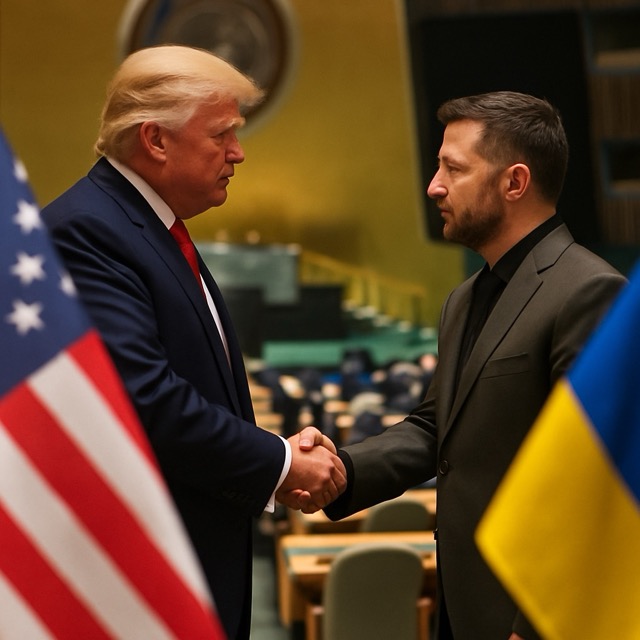
After a UNGA meeting with Volodymyr Zelenskyy, the U.S. president says Ukraine is “in a position to fight and WIN all of Ukraine back,” signaling the sharpest rhetorical shift of his presidency on the war.
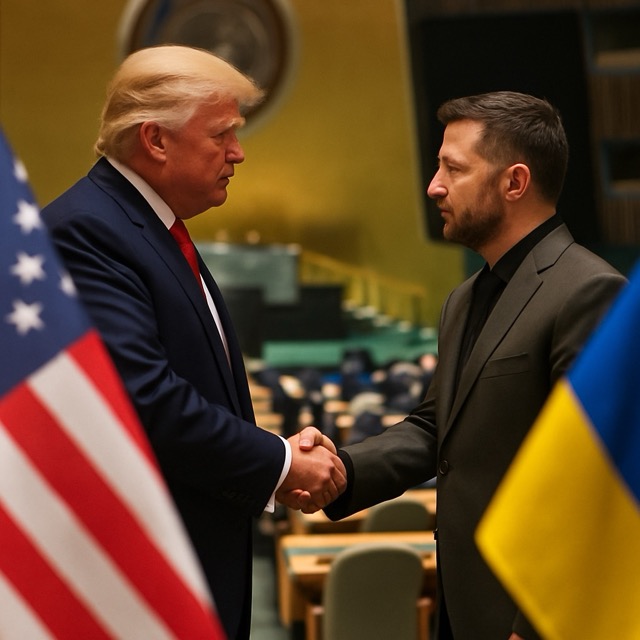
NEW YORK — In a dramatic departure from his earlier posture on the war, U.S. President Donald Trump said Ukraine, with robust backing from Europe, is capable of reclaiming “all of Ukraine … in its original form.” The declaration followed a one‑hour bilateral with President Volodymyr Zelenskyy on the sidelines of the United Nations General Assembly and instantly reset the political conversation in Washington and across European capitals. For Kyiv, the statement validates its stated objective: the full restoration of its internationally recognized borders, including the occupied parts of the Donbas and Crimea.
The words matter because they scrub away a red line the White House itself had helped draw. For months, Trump had mused about land‑for‑peace formulas and suggested that Ukraine might eventually have to make territorial concessions to end Europe’s bloodiest war in decades. By asserting that Ukraine can “win it all back,” the president inverts that logic and, at the very least, gives political oxygen to those in Kyiv and Brussels who argue that deterrence in Europe depends on the defeat — not accommodation — of Russia’s invasion.
What changed? People close to the president point to two converging dynamics. First, the accumulation of Russian equipment losses and the strain of a sanctions‑shadowed economy. Second, a steadier flow of European weaponry and production commitments that, they contend, are gradually closing the gap between Ukrainian requirements and Western output. In this reading, the battlefield has not flipped — but Russia’s margin of advantage has narrowed enough to make Kyiv’s long‑term objectives plausible with sustained support.
Yet the White House stopped short of translating rhetoric into new policy. There were no immediate announcements of tougher U.S. sanctions, fresh security guarantees, or a dramatic increase in American weapons transfers beyond packages already in the pipeline through NATO mechanisms and existing appropriations. That gap between message and mechanics will define the next phase of the debate: a promise that Ukraine can regain everything it has lost, without a detailed public plan to help make it so.
Zelenskyy welcomed the remark as a “big shift,” and used his New York schedule to press for stricter energy sanctions, deeper air‑defense stocks, and tight export controls on dual‑use electronics. Ukrainian officials frame the next year as a contest of production curves and air superiority. If Kyiv can thicken its air‑defense belt — interceptors, sensors, and command networks — while continuing deep‑strike pressure on Russian logistics, they argue, the costs to Moscow will mount faster than it can adapt.
European responses ranged from relieved to cautious. Baltic and Polish leaders have long argued that any settlement short of full territorial restoration would reward aggression and corrode security guarantees across the continent. Berlin and Paris, mindful of domestic headwinds and industrial constraints, applauded the tone while asking what comes next. The European Commission is exploring additional measures to throttle Russia’s evasion of sanctions via third countries, but implementation is uneven and politically fraught.
On Capitol Hill, reaction largely split along familiar lines but with notable cross‑currents. Some Republicans who had criticized open‑ended aid embraced the president’s harder line toward Moscow, framing victory in terms of sustained pressure and smarter burden‑sharing with Europe. Several Democrats, welcoming the rhetorical clarity, warned that words will not intercept missiles or reload artillery tubes and called for multi‑year financing to expand missile and ammunition production. Defense‑industrial executives, for their part, said predictability — not headline announcements — is the constraint that matters most.
The timing underscores the political calculus. Trump arrived at UN week seeking to project command of foreign policy amid a volatile domestic agenda. His UN speech criticized Moscow’s escalation, urged NATO to respond firmly to Russian airspace violations, and cast the alliance’s role as central to European security. The new line on Ukraine dovetailed with that message and positioned the president — at least rhetorically — alongside European hawks who insist that deterrence is rebuilt only when borders are restored.
For Kyiv, the optics are secondary to the kit. Ukrainian commanders are explicit about what a resource‑backed version of the president’s promise would require: more air defenses to protect cities and logistics hubs; counter‑battery systems to suppress Russian artillery; long‑range precision fires to cut rail lines and depots; and repair capacity to keep Western armor in the fight. Energy planners, bracing for winter strikes on power infrastructure, are mapping redundancies and black‑start options to reduce the humanitarian toll of outages.
Human‑rights groups emphasize another dimension: the lives unfolding under occupation. Reports of forced deportations, property seizures, and filtration camps predate this week’s rhetoric and will outlast it unless the ground reality changes. For them, the president’s sentence lands not as a geopolitical thesis but as a moral claim: that the state most violated by the invasion should not be told to surrender pieces of itself for peace.
Skeptics warn against conflating momentum with inevitability. Russia retains significant manpower, layers of fortified defenses, and the capacity to absorb losses while reconstituting units. Ukraine still depends on Western training pipelines and ammunition deliveries that, despite recent progress, remain tight. Without a durable ramp‑up in production — across interceptors, artillery rounds, and spare parts — the battlefield could settle back into a grinding stalemate.
Markets and energy watchers will parse any follow‑through for clues: a tougher squeeze on Russia’s energy revenue; broader secondary sanctions on procurement networks; and a faster European shift toward defense industrial sovereignty. None of these steps is cost‑free. All require political capital, budgetary trade‑offs, and coordination that has, at times, proved elusive.
Moscow’s public line was dismissive, insisting that statements from Washington do not alter facts on the ground. Yet the Kremlin is keenly attuned to coalition dynamics. If Trump’s pivot catalyzes a more reliable European funding framework and a steadier cadence of air‑defense shipments, the calculus in Moscow becomes harsher: higher costs for fewer gains, and a longer war that corrodes domestic stability.
Ultimately, the significance of this week’s sentence will be measured by decisions that follow. If the administration couples its rhetoric with clear targets — air‑defense density, deep‑strike integration, and industrial expansion across NATO — then the claim that Ukraine can “win it all back” will read less like a provocation and more like a plan. If not, the words will hang over an unchanged battlefield, a bold post clipped to a news cycle.
For now, the politics have shifted. A White House that once floated land swaps is telling the world that Ukraine can regain everything it has lost. For Ukrainians under occupation — and for European leaders who have argued the same for years — that is no small thing. Whether it becomes consequential policy is the next test.



 The Tower Post