Behind closed doors in New York, the U.S. president’s pledge seeks to steady fraying alliances and head off a regional rupture
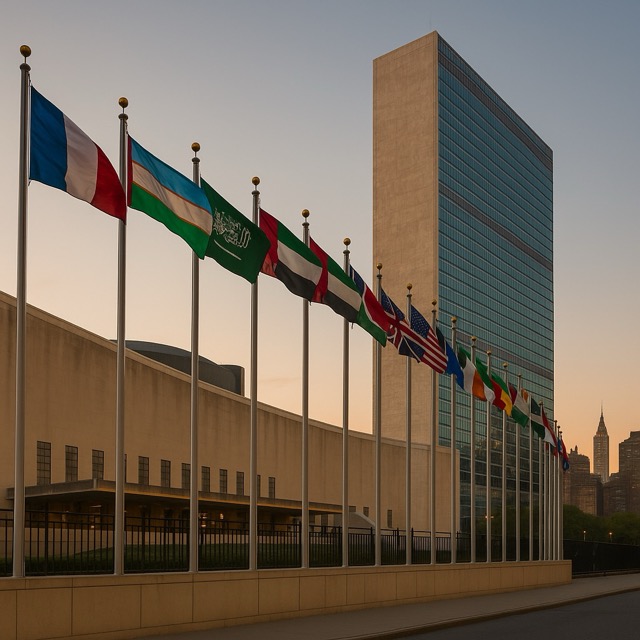
New York / United Nations
NEW YORK — On the sidelines of this week’s United Nations General Assembly, President Donald Trump privately assured a group of Arab and Muslim leaders that he would not allow Israel to annex the occupied West Bank, according to several people familiar with the conversations. The pledge, delivered in a series of closed‑door meetings in Manhattan hotels and the UN’s blue‑carpeted corridors, marked the most explicit statement to date by the White House that annexation is a red line for Washington.
The commitment, relayed by multiple attendees and later echoed by senior U.S. officials, is the centrepiece of a broader push by the administration to de‑escalate the Gaza war and restore a pathway—however narrow—toward a two‑state political track. Trump’s national security team circulated a white paper and a 21‑point concept to regional interlocutors, framing an endgame that ties a sustained ceasefire and hostage releases to governance reforms within the Palestinian Authority and coordinated reconstruction.
Leaders and senior envoys from Saudi Arabia, Egypt, Jordan, Qatar, the United Arab Emirates, Turkey and Pakistan pressed the U.S. to draw a hard boundary against any Israeli move to absorb territory or to change the status of Jerusalem’s holy sites, according to participants. Some warned that annexation would detonate what remains of Arab‑Israeli normalization begun under the Abraham Accords and could trigger a wider rupture in political and economic ties with Israel.
In the meetings, Trump was described as alternately emphatic and transactional. People present say he cast the prohibition on annexation as both a moral and strategic necessity—arguing that formal absorption of West Bank land would end any realistic prospect of a negotiated settlement, lock in perpetual conflict, and force Washington to choose between its closest Middle Eastern partner and a coalition of states whose cooperation the U.S. needs on energy markets, maritime security and counter‑Iran policies.
The messaging was reinforced by U.S. diplomats who, over recent days, amplified the view that annexation would be unacceptable to Washington. Secretary of State Marco Rubio, in remarks ahead of the UN week, cautioned Israeli ministers floating the idea that any such step would carry severe diplomatic consequences. European leaders conveyed a similar line in New York; French President Emmanuel Macron called annexation a “red line” for the West and warned that it would shatter prospects for regional deals and prompt new EU debates over punitive measures.
Israel’s government has not tabled a formal annexation decision, but senior ministers close to Prime Minister Benjamin Netanyahu have publicly urged de facto or de jure extension of Israeli sovereignty to parts of the West Bank, including the contentious E1 corridor that critics say would bisect Palestinian territory and foreclose territorial contiguity. Netanyahu, who arrived in New York amid sharp international criticism of Israel’s conduct in Gaza, is expected to consult his war cabinet and hold further talks with the U.S. side before conveying any decision.
Arab officials emerged from the UN sessions portraying Trump’s pledge as a necessary, if belated, course correction after months in which regional capitals doubted Washington’s willingness to restrain Israel. “We heard clarity,” one Gulf diplomat said afterward. “If there is annexation, there will be consequences—and the United States will not support it.” Several added that they sought concrete mechanisms: withholding certain forms of military assistance tied to settlement expansion; conditioning diplomatic cover in international forums; and linking future normalization steps to verifiable freezes on land grabs and outpost legalization.
For the White House, the calculus is part crisis management, part legacy‑minding. The administration spent much of early 2025 defending a sweeping—and controversial—proposal to internationalize administration of the Gaza Strip until a reformed Palestinian Authority could assume control. That plan, deeply divisive at home and abroad, has gradually been subsumed into a more conventional diplomatic package: a sustained ceasefire; phased prisoner and hostage exchanges; a reconstruction fund governed by strict oversight; and, now, an explicit veto on annexation.
The shift also reflects the new diplomatic math created by a wave of recognitions of Palestinian statehood by traditional U.S. allies earlier this year. The United Kingdom, Canada, France and Australia joined a growing list of European and Pacific nations endorsing a two‑state outcome in principle, even as fighting raged. Arab diplomats say that unless Washington corrals Israel away from irreversible steps in the West Bank, the center of gravity within the UN and other institutions will drift toward punitive resolutions, boycotts and legal challenges that the U.S. has historically opposed but may no longer be able to block without fracturing allied unity.
Whether Trump’s words amount to policy will be tested soon. Israeli officials have telegraphed that a decision could follow the prime minister’s post‑UN consultations. If annexation plans remain under consideration, Washington will face an immediate choice: deploy tools of leverage that have long been theoretical—such as slowing certain weapons transfers, narrowing diplomatic cover at the Security Council, or conditioning parts of security cooperation—or risk the very regional blowback the president warned against.
Inside Israel, the political ramifications are volatile. Netanyahu’s governing coalition relies on parties for whom settlement expansion is an ideological imperative. A public U.S. rebuke of annexation could fracture that coalition or push the prime minister to test the limits of U.S. resolve. Security professionals, meanwhile, warn that any move toward annexation would spur escalation across the West Bank and could ignite a new front for militant groups already active in Gaza and along Israel’s northern border.
Palestinian leaders responded cautiously to the UN‑week signals. Advisors to President Mahmoud Abbas welcomed any U.S. guarantee that protects land designated for a future Palestinian state, but insisted that words must be matched by enforcement and by a political horizon that goes beyond crisis containment. Civil society groups and economists also stress that West Bank stability requires curbing settler violence, restoring freedom of movement, reopening trade arteries and reviving donor‑backed institution‑building lost amid years of conflict and dysfunction.
Regional partners are watching for signs that the White House means to invest sustained capital in this track. Saudi officials repeated that any Israeli‑Saudi normalization would require an irreversible path to Palestinian statehood and firm protections for the custodianship of Islamic holy sites. The UAE, a signatory to the Abraham Accords, warned that annexation would effectively suspend the agreement’s remaining dividends, from joint ventures to security projects in the Gulf and the Red Sea.
At the UN, the pledge landed in a forum already primed for a policy inflection. The General Assembly’s debates were dominated by the humanitarian catastrophe in Gaza—where local health authorities report tens of thousands of deaths and international agencies flag pockets of famine—and by the sense among non‑aligned states that the post‑Cold War rules are unraveling. For diplomats steeped in those currents, a U.S. line against annexation is necessary but insufficient: a floor, not a ceiling, for a diplomatic reset.
Still, in a week saturated with grim warnings, the assurance was notable for its clarity. It signaled to Arab and Muslim capitals that, at least on this question, Washington is prepared to say “no” to an ally and to use its influence to prevent a step that many believe would formalize permanent occupation. Whether that signal becomes a sustained policy—and whether it can be leveraged into the harder work of stitching together a ceasefire and a credible political horizon—will determine if the UN week’s quiet vow is remembered as a turning point or as another unkept promise.
What comes next will unfold in a tight window. The administration’s envoys say they expect movement on a Gaza ceasefire framework within days; European leaders are privately drafting contingency measures should annexation proceed; and Arab states are coordinating economic steps they could trigger in response to Israeli decisions. For now, the immediate impact of Trump’s words is diplomatic breathing room—a pause in a cascade of worst‑case announcements. Whether that pause holds depends on choices still to be made in Jerusalem and Washington.
Reporting informed by briefings and accounts from diplomats present at UNGA meetings and contemporaneous statements from U.S. and European officials.


 The Tower Post