As an election looms, President Faustin-Archange Touadéra says 1,500 Russian operatives help keep rebels at bay, while critics warn of deepening dependence and a shifting Kremlin playbook.
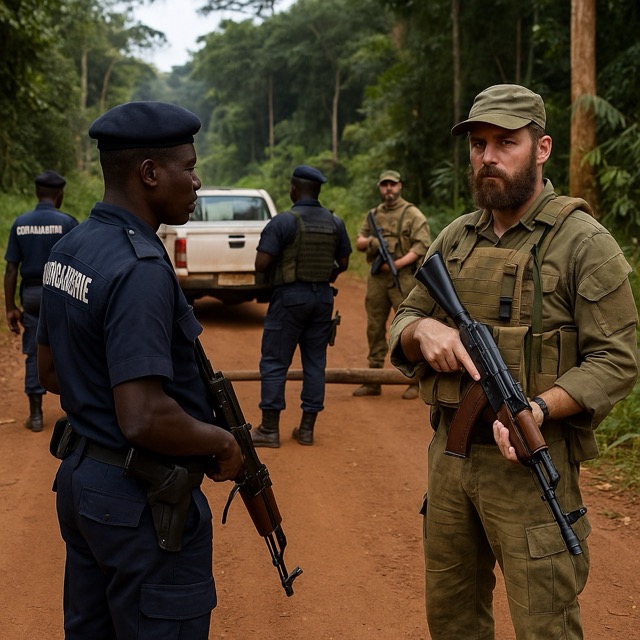
BANGUI — In the Central African Republic (CAR), President Faustin‑Archange Touadéra has mounted a full‑throated defense of the roughly 1,500 Russian Wagner operatives stationed in his country, arguing that the controversial force remains pivotal to keeping armed groups from threatening the capital and key trade corridors. In recent remarks this month, Touadéra praised the Russians, alongside Rwandan troops, for their rapid intervention during the 2020–2021 crisis, when a new rebel coalition surged toward Bangui and parts of the state appeared to be unraveling. Yet the president insists the country is not in Moscow’s orbit, describing CAR’s foreign policy as “open to all partners” and guided by security needs rather than ideology.
The president’s case has a plain‑spoken logic: where foreign partners pulled back, others stepped in. France, once the dominant security actor, ended its mission and froze defense cooperation in a bitter, public rupture. The United Nations’ peacekeeping mission, MINUSCA, remains present but constrained by its mandate and its rules of engagement. Into that vacuum came the Wagner network, now estimated by diplomats and researchers to field between 1,500 and 2,000 personnel across training, combat support, and protection duties. Their footprint is most visible around strategic mining sites, the presidential compound, and along arteries where ambushes once strangled commerce.
In an interview published this week, Touadéra reiterated that security partnerships are not exclusive, arguing Bangui will “cooperate with all” who bring resources and respect CAR’s sovereignty. The message is aimed as much at Western capitals as it is at Moscow. After years of withering criticism over alleged abuses by Russian fighters and opaque mining deals, the presidency has tried to reframe its strategy as pragmatic rather than ideological—inviting investment in solar power, roads and agribusiness, while keeping a tight embrace on security auxiliaries that, officials say, have blunted rebel momentum.
The Kremlin’s own posture is changing. After the 2023 death of Yevgeny Prigozhin, Russian officials began encouraging African partners to channel security ties through a new state‑run “Africa Corps.” In Bangui, the transition has been partial at best. Russian instructors and advisors aligned with the Defense Ministry have arrived, but many of the on‑the‑ground structures, business vehicles and commanders associated with Wagner persist. Officials in both capitals speak of ‘continuity,’ yet diplomats say the tug‑of‑war over who commands whom—and who profits—remains unresolved.
That business dimension is central. In CAR, the Wagner network and related companies have acquired privileged access to gold, timber and logistics. The Ndassima gold concession, the country’s only industrial‑scale gold mine, has become emblematic of what critics call a “guns‑for‑resources” bargain. U.S. and European sanctions have targeted entities linked to the mine and to Wagner’s financial architecture, alleging that proceeds help fund operations across Africa. Bangui responds that such deals are legal under national law and necessary to attract capital to a fragile economy.
For ordinary Central Africans, the ledger is more intimate: fewer rebel roadblocks, but lingering fear. Human rights groups and U.N. experts have documented killings, torture and sexual violence attributed to Wagner personnel and allied forces, allegations Moscow and Bangui deny. Community leaders in mining areas speak of displacement and heavy‑handed “security zones.” In the capital, some residents credit the Russians with preventing the fall of Bangui in 2021; others see a foreign force answerable to no one. In April, thousands rallied against what they called creeping authoritarianism and the mercenaries’ presence, a reminder that the social contract around security is fraying in places.
Touadéra’s denial that CAR is in Moscow’s grip is, in part, an argument about options. His government is courting Gulf financiers for energy projects, leaning on the African Development Bank for roads, and quietly testing whether European partners might return with training and development packages that stop short of deploying combat troops. Bangui has also held up an overdue calendar of local elections—paired with a presidential race now slated for December—as proof that institutions are extending beyond the capital. Critics counter that the vote‑timing and the 2023 constitutional change that scrapped term limits reflect elite consolidation more than democratic deepening.
One reason the 1,500‑strong figure carries weight is the state’s enduring fragility. The national armed forces, the FACA, have expanded in recent years but still lack mobility, air assets and medical evacuation. Rebel formations have splintered and rebranded, but retain the ability to tax commerce, sabotage bridges and intimidate local officials. In that context, a contingent of hardened, well‑equipped foreigners—backed by surveillance drones, armored vehicles and battlefield advisers—can tilt the balance in specific theaters. Whether that translates into sustainable stability without political settlements and public accountability is the unresolved question.
Regionally, CAR is a test case for Russia’s evolving expeditionary model. In Mali, Niger and Burkina Faso, juntas have signed state‑to‑state pacts with Moscow even as some Wagner‑branded units are absorbed into new formations. In CAR, resistance to a wholesale re‑badging has been more pronounced, in part because the commercial relationships that underpin the security presence are deeply embedded and locally powerful. The result is a hybrid: advisers in new uniforms, operators in old ones, and contracts that straddle both.
Western policymakers face their own dilemma. They decry abuses and opaque deals, yet so far have been unwilling—or politically unable—to field the kind of rapid, risk‑tolerant force that could meaningfully deter rebel offensives while broader reforms take hold. Sanctions have raised compliance costs but have not shut the trade in gold and cash that greases the system. Diplomats talk about “re‑engagement,” but Central Africans measure promises against the memory of who showed up when the front lines were close to the city.
What might change the calculus? Two factors loom. First, the conduct of this year’s vote: if electoral management is broadly credible and violence limited, the government could claim a stronger mandate to diversify partners and domesticate the security file. If the process turns ugly, the impulse will be to double down on what has kept the capital calm. Second, the internal Russian debate about command and control in Africa is not over. If the ‘Africa Corps’ model consolidates and Prigozhin‑era business structures are pruned, contracts and command lines in CAR will shift accordingly—possibly in ways that give Bangui less room for maneuver than the president suggests.
For now, the president is walking a narrow ridge: embracing the utility of 1,500 Russian operatives while insisting his country is nobody’s satrapy. In a place where sovereignty has so often been theoretical, the distinction is more than semantics. It is a wager that security borrowed on commercial terms can be parlayed into sovereignty earned—through improved governance, better roads and reliable salaries for soldiers and teachers. Central Africans have heard versions of that promise before. The proof, as ever, will be who benefits, who is held to account and whether the guns, this time, fall silent beyond the main roads.
As the campaign accelerates, Bangui is likely to double down on a familiar refrain: the Russians help us keep the peace; they do not write our policy. The first half of that claim remains visible on the ground. The second will be tested in the months ahead—not just in the ballot boxes of Bangui and Bambari, but in boardrooms where mining rights are signed and in command posts where orders, and loyalties, are issued. For a country scarred by a decade of war, the measure of success is simple: fewer funerals, more markets open, and the sense, at last, that the state can protect without fear or favor. On that score, 1,500 men can change a season. Only institutions can change a future.



 The Tower Post