Europe’s largest bank redraws the line between permitted and prohibited arms — widening the aperture for defence lending as the continent rearms
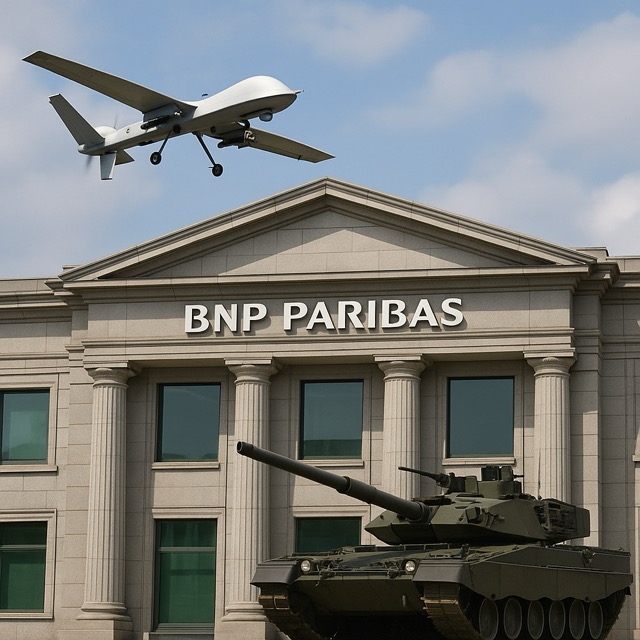
BNP Paribas has relaxed a long‑standing policy that barred it from financing the production and trade of so‑called “controversial weapons”, sharpening a distinction between arms authorised under international law and those that are not. The change, made this year in an update to the French lender’s Defence & Security sector policy, removes a 2010‑era pledge to avoid any financing linked to “controversial weapons”, according to people familiar with the matter. Senior executives concluded the label had grown too elastic as technology blurred lines between civilian, dual‑use and battlefield applications. The bank will continue to exclude categories explicitly banned by treaties, while taking a more permissive stance toward equipment that is legal under international humanitarian law.
The recalibration places BNP Paribas squarely within a fast‑shifting European debate: how to reconcile wartime security imperatives with environmental, social and governance (ESG) commitments that for years steered banks and investors away from the defence industry. Since Russia’s full‑scale invasion of Ukraine in 2022, European governments have launched multi‑year rearmament programmes and encouraged private capital to help rebuild stockpiles. Brussels has also clarified that financing compliant defence companies can be compatible with sustainability objectives, provided clear exclusions for banned munitions remain in place. That guidance opened political space for lenders to revisit internal prohibitions drafted in a different era.
BNP Paribas’s revised policy formalises that direction of travel. People who have reviewed the update say it explicitly differentiates between, on the one hand, weapons and equipment permitted under international law and multilateral treaties and, on the other, munitions outlawed by such agreements. The latter group — including antipersonnel landmines and cluster munitions covered by the Ottawa and Oslo conventions, along with chemical and biological weapons — remains off‑limits. But for defence clients whose products fall outside those bans, the bank may now extend a fuller suite of financing, subject to customary due‑diligence and export‑control checks.
A key driver was definitional. Internally, the term “controversial weapons” had come to sweep in activities that are lawful but politically sensitive, such as certain types of drones, electronic‑warfare components or long‑range precision munitions. In practice, that ambiguity generated uneven outcomes across business lines and geographies. By retiring a catch‑all label and anchoring decisions in international law, executives argue they can offer clients clearer rules of the road while maintaining bright‑line exclusions. The bank’s compliance teams are said to have updated screening tools to map products and clients against treaty obligations, embargo lists and human‑rights risk indicators.
The move is notable given the institution’s heft. With a balance sheet approaching €3tn and a sprawling corporate and investment bank, BNP Paribas is a cornerstone of European capital markets. Its posture influences risk appetites across the region. In March, the group publicly reaffirmed support for financing defence companies mainly within NATO countries, outlining services that range from revolving credit and guarantees to export finance, bond underwriting and equity investments for both prime contractors and small‑and‑medium‑sized suppliers. The policy refinement aligns the internal handbook with that outward‑facing stance.
Critics see a slippery slope. Civil‑society groups argue that narrowing the definition of “controversial” to only those weapons expressly banned by treaty leaves a wide grey zone around systems that may have indiscriminate effects in practice, depending on how they are used. They also question whether ESG frameworks should ever bless weapons finance, warning that the rush to label defence as “sustainable” risks war‑washing. For these stakeholders, banks should adopt a precautionary approach that errs toward exclusion where battlefield impacts on civilians are hard to control or verify.
BNP Paribas counters that a rules‑based framework provides greater clarity without diluting safeguards. The revised policy, people say, continues to prohibit involvement with any weapons outlawed by major treaties and bars transactions linked to exports into countries where there is a material risk of severe human‑rights violations or breaches of international humanitarian law. It also preserves enhanced due diligence on end‑use, intermediaries and re‑export risks. In practical terms, that still rules out financing related to cluster munitions or antipersonnel mines and constrains deals touching high‑risk destinations, while opening more space for European programmes focused on air defence, munitions resupply and industrial capacity.
Commercial incentives are unmistakable. Defence prime contractors across Europe are ramping production of air‑defence systems, artillery shells and armoured vehicles, while hundreds of SMEs in their supply chains seek working capital to expand capacity. European banks that once shunned the sector are re‑engaging, arguing that defence — like energy security — is now foundational to the continent’s resilience. Several lenders have disclosed pipelines of transactions tied to NATO members’ procurement plans. For a universal bank with deep corporate relationships, the opportunity spans revolving credit facilities, term loans, guarantees, ECA‑backed structures and bond and equity capital‑markets mandates.
By substituting a legally defined perimeter for a broad taboo, BNP Paribas positions itself closer to peers while preserving formal exclusions where treaties speak clearly. The bank’s investment‑banking teams stand to benefit from more headroom to support European defence names. Export‑credit agency partnerships, critical for big‑ticket platforms, may also be easier to structure when a lender’s internal policy mirrors the legal strictures already embedded in ECA frameworks. For clients, the change reduces uncertainty: fewer ad‑hoc committee waivers, more predictable timelines and a shared vocabulary around what is in‑ and out‑of‑scope.
Still, the bank will have to navigate a patchwork of investor expectations. Many institutional investors retain explicit exclusions for weapons deemed to have disproportionate humanitarian impact, regardless of legal status, and some sovereign wealth funds and pension plans maintain near‑blanket restrictions on defence exposure. BNP Paribas Asset Management applies its own responsible‑business conduct standards that go beyond minimum legal thresholds and continue to exclude producers of banned weapons. That creates a complex internal mosaic in which different arms of the group may take differing positions on the same client, depending on mandate and product.
From a risk‑management perspective, execution will be everything: how the bank defines permissible clients, applies enhanced due diligence to end‑use and geographic risk, and updates screens for technology that evolves rapidly. Drones offer a case in point. The term spans small reconnaissance quadcopters, military‑grade ISR platforms and long‑range loitering munitions. Components can be dual‑use and supply chains are global. A treaty‑anchored approach sets a clear floor, but governance processes will be tested by edge cases — especially where civilian and military applications overlap and where export‑control regimes are being rewritten in real time.
Regulatory clarity will also matter. The European Commission has urged banks not to treat defence uniformly as an ESG pariah, but national supervisors and disclosure regimes still vary. Investors want hard data: exposure by sub‑sector, geography and weapons category; the share of financing tied to maintenance versus new production; and the thresholds that trigger an automatic “no”. BNP Paribas has said it will continue to report against principal adverse impact indicators, including exposure to banned weapons, and to screen clients against sanctions and embargoes. Greater granularity would help stakeholders judge whether the new policy results in a measured expansion or a step‑change in risk appetite.
For policy‑makers, the BNP Paribas shift is a barometer of market sentiment. It suggests large universal banks are testing the boundaries of ESG frameworks to support strategic‑autonomy goals while attempting to hold fast to humanitarian norms. If others follow, the flow of private finance into defence may rise, complementing state budgets and public‑guarantee schemes designed to crowd in capital. The political debate will remain heated, not least as conflicts from Ukraine to the Middle East keep ethical stakes front‑of‑mind for consumers and activists. Expect pressure on banks to demonstrate rigorous end‑use controls and transparent reporting, or risk reputational blowback.
What to watch next: whether BNP Paribas discloses more granular data on its defence exposure; how it handles client relationships in jurisdictions at heightened human‑rights risk; and whether European regulators go further in standardising what counts as acceptable defence finance under ESG regimes. For now, by replacing a broad taboo with a treaty‑driven rulebook, the bank has signalled that financing Europe’s defence industry is not only permissible but, within clear legal limits, part of its mainstream franchise. As security considerations move to the centre of Europe’s economic strategy, more lenders are likely to make similar calculations.




 The Tower Post