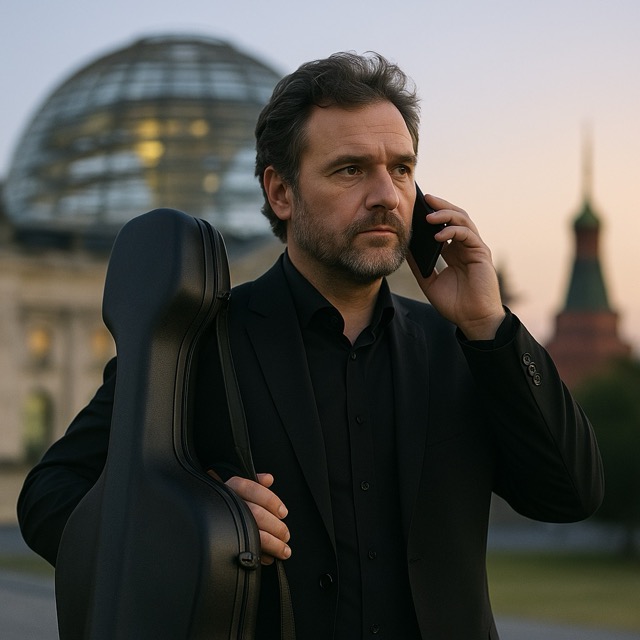
How AfD lawmaker and professional cellist Matthias Moosdorf’s chats with a Putin adviser turned ‘cultural exchange’ into a political storm

Berlin — The phone calls were, by his account, routine and unremarkable: conversations about festivals, orchestras and the mechanics of bringing Russian and European musicians back on the same stage. But because the other voice on the line was Anton Kobyakov — a long‑time adviser to Vladimir Putin and a senior figure in Russia’s state‑run events ecosystem — those calls have thrust Matthias Moosdorf, a professional cellist turned far‑right lawmaker, into Germany’s latest argument over where culture ends and geopolitics begin. Moosdorf, a Bundestag member for Alternative für Deutschland (AfD) since 2021, says he sees nothing wrong with keeping the line to Moscow open.
The controversy over Moosdorf’s contacts burst into the open this year after reports that he had maintained regular communications with Kobyakov and traveled repeatedly to Russia for cultural and business forums, including the St. Petersburg International Economic Forum. The Financial Times first detailed the scope of his Moscow ties, noting the calls with Kobyakov and party sanctions imposed after an unauthorized trip to Russia in June. AfD fined Moosdorf €2,000 and temporarily curtailed his speaking rights in the Bundestag — an unusually public rebuke for a party that itself is often accused of being soft on the Kremlin.
To Moosdorf, the episode is a category error. The 60‑year‑old cellist — for three decades a fixture of the Leipzig String Quartet — frames his outreach as cultural diplomacy, not political alignment. He has argued that music is a language of reconciliation and insists that his engagements in Moscow, including an honorary teaching role at the Gnessin Academy, should be read through an artistic lens. The AfD politician has said he does not speak for the German government and that maintaining dialogue with Russian cultural institutions should not be taboo.
Yet the facts of who his interlocutors are, and what those institutions represent, have sharpened the political stakes. Kobyakov is described in public records as a special adviser to President Putin and a leading organizer of state‑sponsored economic and cultural showcases. Critics in Berlin argue that any German lawmaker conducting back‑channel conversations with such a figure — even about choirs and chamber music — necessarily intersects with the Kremlin’s narrative war over Ukraine and sanctions.
The timing has made the backlash more combustible. Germany remains a pivotal financial and military backer of Kyiv. Berlin’s own political class is under intense scrutiny after a string of foreign‑influence scandals touching several parties — AfD most prominently. Separately from Moosdorf, one of AfD’s best‑known figures, Maximilian Krah, has faced a rolling investigation over alleged ties to China, underscoring the climate of suspicion around external leverage in German politics. Against that backdrop, Moosdorf’s insistence that culture can float above geopolitics has found limited patience among opponents — and not a little discomfort within his own party.
AfD’s censure was spurred by process as much as principle. Parliamentary leaders said Moosdorf traveled to Moscow without proper notification and afterwards stoked doubts by downplaying the political context of his meetings. The party’s sanction — a modest fine and a six‑week suspension from speaking in the Bundestag — was calibrated to signal disapproval without expelling one of its more publicly recognized personalities. Inside AfD, strategists fear the optics of Russia‑friendly freelancing at a moment when the party is working to broaden its appeal beyond its eastern strongholds.
Moosdorf’s music résumé is beyond dispute. Born in Leipzig and trained at the city’s conservatory, he helped propel the Leipzig String Quartet to international stature, recording more than a hundred albums and touring widely before turning to politics. That biography is central to his defense: he argues that the networks he built as a musician predate the war and that abandoning them would amount to self‑censorship by Western artists. His part‑time, honorary affiliation with the Gnessin Academy — a prestigious Moscow conservatory that operates under Russia’s culture ministry — was, in his telling, a statement of solidarity with young musicians, not with the government that funds the institution.
Policy experts counter that Russia’s cultural front is inseparable from its political one. The Kremlin has long used splashy conferences, festivals and conservatory partnerships to signal normality abroad even as it prosecutes the war at home. In that reading, a German MP’s friendly calls with a Putin aide help launder the image Moscow wants to project: that Western elites remain divided and open to persuasion. Even innocuous‑sounding projects — a choir festival here, a touring quartet there — can be leveraged as proof that sanctions fissures are widening.
For AfD, which polls show attracting protest voters disillusioned with the political mainstream, the case has been awkward. Party leaders have defended their right to dissent from Berlin’s Ukraine policy while also insisting they do not take cues from Moscow. Sanctioning Moosdorf allowed the leadership to claim it polices its own, yet it also kept the story in headlines and invited fresh scrutiny of AfD’s Russia posture. That scrutiny is unlikely to ebb as long as Moosdorf continues to frame his outreach as a matter of artistic principle — and as long as his conversation partner sits in the Kremlin’s inner circle.
There is also the constitutional question: how far can, or should, the German state constrain the off‑duty contacts of elected officials? Members of the Bundestag are not employees of the foreign ministry; they do not require permission to attend cultural events abroad, nor are they barred from speaking with foreign officials. But they are public office‑holders whose actions feed public perceptions — and whose travel can be exploited by foreign governments as propaganda. AfD’s leadership opted for party discipline rather than pushing for legal restrictions, a path that underscores how much of the argument is political rather than judicial.
In interviews and statements, Moosdorf has returned to a simple refrain: that the bridges he tends in the arts will be needed when the guns fall silent. Even many critics concede that cultural ties have historically helped societies navigate a post‑conflict thaw. What grates is his timing and choice of counterpart. In the wartime present, phoning a presidential adviser — whatever the topic — feels to opponents like moral myopia at best and useful idiocy at worst.
The episode illustrates a broader tension gripping Germany in the fourth year of Russia’s full‑scale invasion: how to balance a society‑wide rejection of Kremlin aggression with the pragmatics of living next to a nuclear‑armed power that Europeans will eventually have to negotiate with. Berlin’s approach has oscillated between strict lines (no business as usual) and selective openings (carefully curated diplomatic contacts). Private initiatives by politicians — especially from a party already dogged by questions about foreign influence — complicate that calibration.
What happens next depends less on ethics tribunals than on events. If battlefield dynamics or diplomatic initiatives shift, the appetite for unofficial cultural intermediaries could change with them. For now, the signals from Germany’s mainstream are clear: cultural dialogue with Russia may resume in time, but not on terms that allow Moscow to claim that nothing fundamental has changed. Moosdorf’s calls to the Kremlin’s orbit will keep ringing — as political noise, if not as a bridge to peace.
Facts at a glance:
• The Financial Times reported that Moosdorf, an AfD MP and professional cellist, has maintained regular contact with Kremlin adviser Anton Kobyakov and faced AfD sanctions after a June trip to Moscow.
• Moosdorf previously took an honorary teaching role at Moscow’s Gnessin Academy, prompting criticism inside AfD and beyond.
• Anton Kobyakov is publicly described as a special adviser to President Vladimir Putin and an organizer of Russian state‑sponsored forums.
• The affair unfolds amid wider probes into foreign influence in German politics, including unrelated investigations into other AfD figures.
Editor’s note: This article draws on public reporting and records available as of September 25, 2025.
 The Tower Post