Berlin throws its weight behind a new financing blueprint that would leverage immobilized Russian reserves—without seizing them—to sustain Kyiv’s defense for years
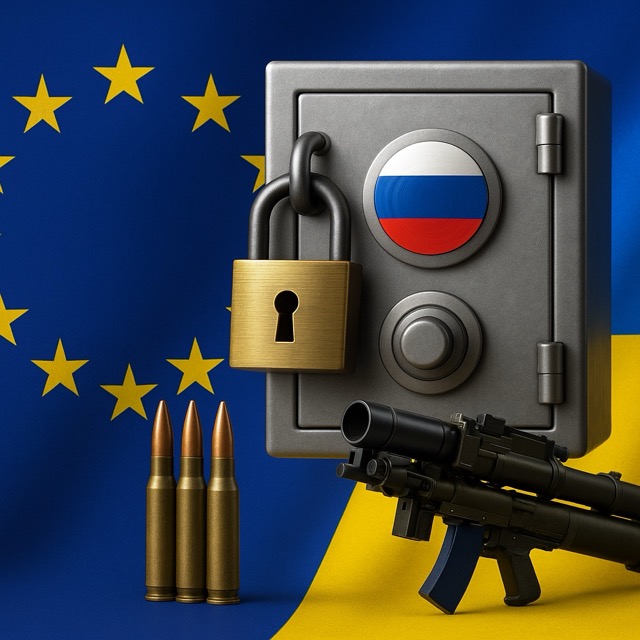
German Chancellor Friedrich Merz has called on the European Union to devise a legal mechanism to deploy frozen Russian state assets in Europe to finance Ukraine’s war effort, arguing the move would unlock an interest‑free loan of roughly €140 billion and demonstrate the bloc’s staying power against Moscow. The push, delivered in Berlin and echoed in allied capitals, marks the clearest signal yet that Germany is prepared to back a bolder financing architecture for Kyiv after months of caution.
Merz framed the proposal as both a moral obligation and a strategic necessity: Europe, he said, must ‘systematically and massively raise the costs of Russia’s aggression’ while ensuring Ukraine’s defense is funded ‘for as long as it takes.’ The plan would not seize the underlying capital—most of which is immobilized Russian central bank reserves concentrated in clearing houses such as Euroclear—but would leverage the predictable profits and legal structure around those holdings to underwrite a large, multi‑year EU loan for Ukraine.
The contours are becoming clearer. European officials have already agreed to channel the windfall profits generated by the frozen reserves—several billion euros annually—toward supporting Ukraine. The new twist is scale and timing: an upfront, interest‑free facility on the order of €140 billion, secured against the future income stream and structured to minimize legal risk to member states and market participants. Advocates say this would give Kyiv long‑term budget certainty at a moment when battlefield costs are rising and air‑defense stocks remain under strain.
Berlin’s shift matters. Germany’s buy‑in has long been seen as pivotal to any expansion of the frozen‑assets toolbox. Publicly embracing a loan of this magnitude signals that the political center of gravity has moved. It also dovetails with Merz’s broader positioning since taking office in May: a blend of hawkishness toward Russia and pragmatism about European legal constraints, paired with efforts to accelerate defense industrial output at home and inside the EU single market.
The legal line to walk is narrow. EU lawyers have argued that outright confiscation of Russian state assets would run afoul of property and sovereign‑immunity protections and could unsettle European financial stability. The emerging approach seeks to keep the principal intact while mobilizing the revenue and legal encumbrances surrounding it—essentially treating the assets’ profits and custody arrangements as collateral for a collective EU‑level loan. That would make ‘Russia pay’ without crossing the red line of expropriation.
Politically, momentum has been building. A leaked non‑paper circulating in Brussels this week sketched a pathway to a large‑scale facility that could, crucially, be constructed without unanimity—sidestepping an oft‑threatened veto from Budapest. Central and Eastern European capitals, along with the Baltics, have pushed hardest for speed. Paris and Berlin, meanwhile, have focused on legal defensibility and the implications for Europe’s role as a financial hub.
Kyiv’s ask is straightforward: predictable, multi‑year funding for both the state budget and core defense needs, ring‑fenced from election cycles elsewhere. An EU facility backed by frozen‑asset income could complement existing commitments—including the G7‑backed loan mechanism agreed last year—while creating a European instrument with its own political and financial identity. For Ukraine’s defenders, the timing is critical. Drone and missile salvos have intensified across the eastern flank, stretching air‑defense networks from the Black Sea to the Baltic and forcing governments to weigh the cost of intercepting cheap drones with expensive missiles.
There are risks. Lawyers warn that even a carefully engineered scheme could face legal challenges in European courts or arbitration venues, especially if Russia—or affected private parties—argue that using income streams amounts to de facto confiscation. Financial regulators are also sensitive to knock‑on effects in repo and collateral markets if custodians face new liabilities. To mitigate that, drafts seen by diplomats emphasize strict adherence to EU sanctions law, transparency in how returns are calculated and distributed, and explicit guarantees for financial‑market intermediaries.
Another variable is transatlantic synchronization. Washington has pushed hard for an approach that makes fuller use of Russia’s immobilized wealth, while some EU capitals have worried about precedents for sovereign‑asset treatment. Still, the logic of allied alignment is strong: if Europe can anchor a €140 billion line using assets under its jurisdiction, it would signal strategic endurance, complement U.S. bilateral assistance, and reduce the risk that short‑term political swings derail Ukraine’s funding pipeline.
On the home front, Merz is betting that German voters will accept a long‑haul commitment framed as both deterrence and insurance. The chancellor has tied the initiative to a broader agenda—ramping up defense investment, expanding munitions production, and pushing EU‑wide procurement reforms—arguing that the least costly war is the one deterred by credible capacity. The proposal also lets Berlin demonstrate leadership in Brussels after years of hand‑wringing over legal exposure and market stability.
Even supporters concede that delivery will be complex. The European Commission would have to design the loan instrument, specify the revenue‑backing mechanism, and secure a political mandate from member states. The European Parliament would want visibility over governance and oversight. And national parliaments—Germany’s Bundestag included—would scrutinize the legal basis, collateral structure, and any contingent liabilities. The timeline, optimists say, could be measured in weeks if leaders converge on the same blueprint; pessimists warn that one or two holdouts could still slow‑roll the process.
As Europe debates mechanics, the battlefield will not wait. Ukraine’s ability to keep interceptors, artillery shells, and drones flowing to the front depends on predictable cash as much as on donated kit. A €140 billion, interest‑free EU loan would not resolve every shortfall, but it would stabilize the financing horizon and send a message to Moscow that time favors Kyiv’s backers. For Merz, that strategic signaling is the point: to show that Europe can sustain a hard‑power contest without flinching, and to do so within the rule of law.
What comes next: EU ambassadors will test legal options with the Commission and Council legal services, while finance ministries stress‑test the structure against market risk. If a broad consensus emerges, leaders could aim to bless a framework at their next summit, with workstreams on governance and disbursement following quickly. In parallel, capitals are finalizing a separate ‘drone wall’ initiative along the EU’s eastern flank—a reminder that fiscal architecture and physical defenses are now parts of the same strategic equation.
The question hanging over Brussels is no longer whether to use Russia’s immobilized wealth to help Ukraine—but how far, and how fast. Merz has placed a clear bet: that Europe’s legal creativity and political will can turn frozen funds into real deterrence. The coming weeks will show whether the EU is prepared to cash that check.
“Systematically and massively raise the costs of Russia’s aggression.” — Friedrich Merz
 The Tower Post