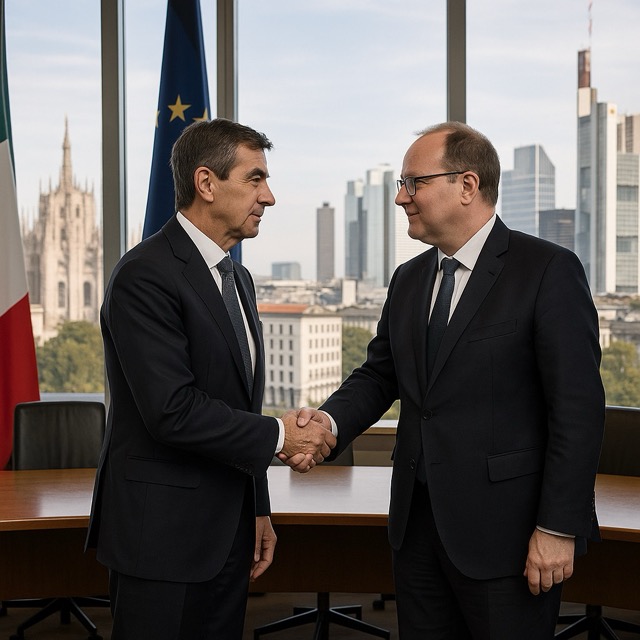
The Italian lender tests Berlin’s red lines with governance concessions, a creeping stake, and patience that could last into 2027
In Europe’s most-watched banking courtship, Italy’s UniCredit is testing whether governance optics can soften hard politics. After months of stock purchases and derivative-driven moves that lifted its stake in Commerzbank to roughly a quarter of the German lender’s equity, UniCredit is now signaling it would make its own board “more German” if that is what it takes to secure Berlin’s blessing for a cross‑border takeover. It is a symbolically potent offer in a country where bank ownership remains entangled with ideas of national sovereignty and industrial policy.
People familiar with UniCredit’s thinking say the bank could allocate a meaningful share of board seats to German nationals and consider other concessions — from maintaining loan capacity for Mittelstand clients to preserving branch footprints and senior decision‑making in Germany. Variations on these pledges have circulated for months, but the board‑composition gambit adds a new political lever. It echoes UniCredit’s approach two decades ago when it kept deep German roots at HypoVereinsbank (HVB) following its 2005 acquisition: local leadership, local balance sheet, and a promise that German clients would not be orphaned inside a foreign empire.
The calculation is straightforward. Berlin’s opposition has hardened throughout the summer, with officials publicly branding UniCredit’s overtures “uncoordinated and unfriendly.” Chancellor Friedrich Merz and Finance Minister Lars Klingbeil have both reiterated support for Commerzbank’s independent strategy and signaled that a sale of the state’s residual stake is not on the table. Commerzbank’s own management — led by Chief Executive Bettina Orlopp — has likewise pushed back, insisting that any talks require a concrete, value‑creating proposal and warning against a hostile approach. Against this backdrop, governance concessions are meant to turn a national‑interest argument on its head: if the combined group is effectively co‑governed, how “foreign” is it?
There are hard numbers behind the theater. Over recent weeks UniCredit said it had lifted its physical equity stake in Commerzbank to about 26%, with plans to edge towards just under 30% — a threshold that maximizes influence without automatically triggering a full takeover bid under German law. Berlin has criticized the tactic, noting that derivatives allowed UniCredit to build economic exposure faster than conventional share purchases. For UniCredit, though, the creeping stake is leverage — a way to keep the option alive while it builds the narrative of a European banking champion.
Commerzbank has not been passive. On Wednesday the Frankfurt lender unveiled another share buyback — up to €1 billion — its fifth since 2023, framed as both a capital‑return commitment and a signal that it can deliver value alone. Buybacks reduce the free float and, at the margin, raise the price UniCredit would need to pay to win control. They also play well domestically, telegraphing confidence as Germany wrestles with weak growth, a demanding regulatory environment, and the politics of consolidation.
The unresolved question is whether the politics shift before the numbers do. UniCredit’s chief executive, Andrea Orcel, has said he can wait — even into 2027 — before forcing the issue. That patience buys time for three things: for Commerzbank’s valuation to settle after buybacks; for regulatory winds in Frankfurt and Brussels to clarify; and for Berlin to recalibrate its stance if the case for scale in European banking becomes more urgent. It also gives UniCredit latitude to keep sweetening the package: more German directors, more ring‑fenced commitments on lending and jobs, more operational hubs in Frankfurt.
Whether that is enough is a different matter. Germany’s political skepticism is not just about jobs in Frankfurt or the Mittelstand’s loan lines. It is about control during the next crisis and about the symbolism of a national lender absorbed by an Italian group. Even if UniCredit pledged to keep a dual‑headquarters model or anchor core functions in Germany, the federal government would need to be convinced that supervision, resolution planning, and public‑interest obligations would be at least as robust as today. In the meantime, Commerzbank can point to improving profitability and capital strength to argue that independence is not a second‑best outcome.
In markets, the story has become a tug‑of‑war between deal premium and political discount. Investors who buy into UniCredit’s vision of a pan‑European bank with German scale can pencil in cost synergies, balance‑sheet diversification, and a deeper corporate‑and‑SME franchise. Skeptics ask whether the political toll — and the concessions required to clear it — would dilute those very gains. If a third of UniCredit’s board becomes German and the combined group hard‑codes local lending, branch, and employment undertakings, the savings from consolidation may erode even as integration risk rises.
There is also an undeclared race against time. Every additional percentage point UniCredit acquires nudges it closer to mandatory‑bid territory and the need to present a formal offer that the Commerzbank board cannot ignore. Yet each step also hardens political opposition, as evidenced by Berlin’s recurring statements that it does not want to see a hostile takeover. Orcel’s suggestion that he can bide his time hints at another path: keep accumulating influence, lock in governance concessions publicly, and attempt to win shareholders over deal‑by‑deal rather than overnight.
For German policymakers, the calculus is not purely defensive. Europe’s banking map remains fragmented compared with the United States, and the European Central Bank has made no secret of its desire for more cross‑border combinations to reduce home‑bias risks and deepen the single market. A UniCredit‑Commerzbank tie‑up would test whether that vision can survive contact with national politics. If it fails, the message is that Europe is still a collection of protected banking fiefdoms — a conclusion with consequences for capital costs, digital investment, and the continent’s ability to finance its energy and supply‑chain transitions.
In the background, UniCredit is sketching fallback options. Executives have hinted at targeted growth in faster‑growing markets such as Poland — where banks like mBank remain strategic chess pieces — and at continued organic expansion powered by capital returns. Those alternatives are leverage too: the more credible UniCredit’s Plan B appears, the less Berlin can say the Italian bank has nowhere else to go. But they are also a reminder that the Commerzbank campaign is an expression of strategy as much as scale: Germany is Europe’s largest economy, the heartland of SME lending, and a prize that can reshape UniCredit’s profile for a generation.
What would make the deal acceptable? Start with predictability: firm, monitorable commitments on lending volumes to German SMEs; employment protections with clear timelines; and codified governance that grants German directors meaningful committee roles beyond mere symbolism. Add operational clarity: a major Frankfurt hub with defined remits for risk, markets, and corporate banking; and a resolution‑ready structure that satisfies both the ECB and Germany’s BaFin that taxpayer risk does not rise. Finally, insist on a price that rewards Commerzbank shareholders for surrendering independence while leaving UniCredit room to earn its cost of capital after concessions.
None of this will be decided this autumn. Commerzbank’s fresh buyback runs into early February; Berlin’s rhetoric shows little give; and UniCredit has telegraphed that it can wait. Yet the governance trial balloon — a “more German” UniCredit board — is meaningful. It reframes the debate from pure ownership to shared control, from flags to functions. If the idea gains traction with investors and regulators, it may become the blueprint for how European banks attempt the next round of cross‑border consolidation: not by erasing national identities, but by binding them into the architecture of the acquiring group.
For now, Milan has made the opening bid in a contest that will be settled in Berlin. UniCredit’s sweetener is cheap to announce and costly to abandon later. Whether it is enough to swing Germany’s second‑largest listed lender — and whether the politics of sovereignty yield to the economics of scale — will define not only the fate of this deal but the trajectory of European banking integration into the late 2020s.



 The Tower Post