Paris court convicts Nicolas Sarkozy of criminal conspiracy over alleged Libyan campaign financing, triggering legal, political, and democratic reverberations.
Paris —
France awoke to a constitutional novelty—and a political earthquake—after the Paris criminal court handed former president Nicolas Sarkozy a five-year prison term for criminal conspiracy in the long-running probe into alleged Libyan financing of his victorious 2007 campaign. The ruling, delivered on September 25, stipulates incarceration even if he appeals, making Sarkozy the first ex-head of state of the Fifth Republic set to serve time behind bars. The 70-year-old conservative leader denounced the judgment as a “scandal,” but pledged to comply with legal procedures while maintaining his innocence.
A historic verdict
The court found that Sarkozy took part in a scheme in which intermediaries courted Muammer Gaddafi’s regime to channel illicit funds toward the French race for the Élysée Palace. Judges concluded there was a concerted plan—an association of wrongdoers in French legal terms—to solicit clandestine support from Tripoli, breaching campaign finance and anti-corruption rules. Prosecutors had sought a stiffer sentence, but the panel settled on five years, paired with a €100,000 fine and the loss of certain civic rights. Bribery per se was not retained by the court; instead, it anchored its decision on the conspiracy charge and the networked efforts built around it.
Immediate consequences, limited options
Though Sarkozy’s lawyers filed notice of appeal within hours, the court ordered provisional enforcement, a rare move for a figure of his stature. Barring a successful challenge to that provision, he is expected to be processed within weeks. Legal experts say La Santé prison in Paris is the most likely destination, given its high-security units and experience with sensitive detainees. Because of the nature of the conviction and the length of the sentence, early alternatives such as home confinement with an electronic bracelet are not expected at the outset, though a later application for sentence adjustment remains possible depending on behavior and time served.
Why Libya? Why now?
The so-called “Libyan affair” has shadowed French politics for more than a decade. Investigators pursued claims, some bolstered by document trails and witness testimony, that emissaries linked to Sarkozy courted Gaddafi’s inner circle for covert cash before the 2007 vote. The prosecution’s story drew on a mosaic of bank records, intercepted communications, and testimonies from intermediaries active in Franco-Libyan business and diplomatic channels. The court’s ruling signals that, even absent conclusive proof that every euro reached the campaign coffers, the orchestration of a covert financing pipeline—and the intent to benefit politically from it—crossed criminal thresholds.
The political shock wave
Sarkozy’s party family, the center-right Les Républicains, quickly closed ranks, lamenting a politicized prosecution and hinting at a double standard. Some loyalists floated the idea of a presidential pardon, an avenue that is legally constrained until appeals are exhausted and that President Emmanuel Macron’s office has not entertained publicly. Other voices—from the center and left—countered that the case affirms equality before the law at a moment when faith in institutions is fragile. The symbolism is stark: a conservative icon who once campaigned on law-and-order themes now preparing for incarceration ordered by an ordinary court.
A test of French justice
For magistrates, the verdict will be read as a declaration of independence. Over years of bruising attacks from politicians, the judiciary has faced accusations of overreach. By painstakingly threading the conspiracy count and shelving others for lack of proof, the court attempted a narrow, legally rigorous path: punish the organized solicitation of illegal foreign money without imputing every downstream transaction. That careful calibration helps explain why some charges fell away while the central conspiracy survived—and why the court felt empowered to order immediate enforcement despite the defendant’s elevated stature.
What happens next, legally
The appeals roadmap is complex. Sarkozy’s team may challenge both the merits and the provisional enforcement. But appellate review is not automatic leniency, and appeals courts tend to be slow, measured, and conservative about revisiting lower-court fact-finding. Even if successful in trimming the sentence or reshaping its modalities, Sarkozy would still have to reckon with the collateral consequences: a criminal record in a marquee corruption case and curtailed civic rights at a time when his informal influence on the right remains significant.
Collateral cases and a crowded calendar
The former president’s docket is not empty. Separate proceedings over campaign overspending—the so-called Bygmalion affair—are up for a ruling in early October, while parallel inquiries tied to influence-peddling and lobbying continue to simmer. The Libyan case was always the legal keystone, the one that could transform allegations into confinement. Now that the keystone has fallen into place, every other judicial turn will be measured against the image of a former head of state reporting to prison.
International reverberations
Beyond France, the verdict reopens difficult chapters in European and North African politics. Sarkozy’s presidency was a central arena for debates about engaging with Gaddafi before the Arab uprisings and then leading the 2011 NATO intervention in Libya. To supporters, that intervention curtailed a dictator’s brutality; to critics, it destabilized Libya and reshaped Mediterranean migration and security patterns. That the same leader is now convicted in a case tied to Gaddafi-era funds will be read abroad as a cautionary tale about the porous border between diplomacy, business, and political finance.
The public mood
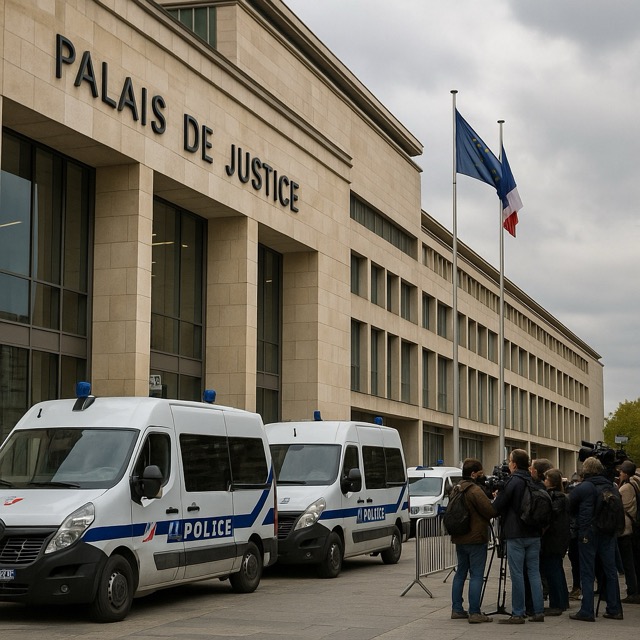
Reactions in Paris were polarized but subdued: no great marches, no jubilant crowds, only the steady glare of cameras outside the Palais de Justice and the quiet churn of talk shows and Telegram channels. For a nation wrestling with cost-of-living pressures, farmer protests, and security anxieties ahead of winter, the Sarkozy affair is one more stress test for civic trust. Surveys in recent years have shown high skepticism about political ethics; a former president going to jail can cut in two directions—either deepening cynicism or reaffirming the notion that the system, slowly and unevenly, can correct itself.
Macron’s delicate posture
Élysée aides, true to form, offered no commentary. Any hint of schadenfreude would boomerang, and any appearance of leaning on the justice system would be incendiary. Nor is a pardon—in theory available under the Constitution—politically viable while appeals are pending. The presidency’s safest harbor is institutional restraint. That leaves the airwaves to opposition figures who see either an injustice to be denounced or a rule-of-law milestone to be defended.
Sarkozy’s message—and his legacy
In a short, defiant appearance after the verdict, Sarkozy insisted he would “sleep in prison with [his] head held high,” casting himself as a victim of a prosecutorial vendetta. His supporters amplify that narrative; detractors point to the court’s painstaking opinion to argue that power, far from shielding him, merely slowed the legal clock. Either way, the verdict recasts his political epitaph: not only the president who steered France through the financial crisis and launched the Libya war, but the statesman condemned for a criminal conspiracy tied to Gaddafi’s oil-soaked networks.
Why this case matters
The Libyan financing saga is about more than one man. It is a stress test for democratic guardrails in an era of transnational influence operations and opaque money flows. It is also a message to political operatives: that cutting corners with foreign funding can trigger consequences years later, when documents surface, witnesses talk, and prosecutors stitch together the timeline. For voters, the case exposes the vulnerabilities of campaign oversight and the need for stronger defenses against offshore political cash.
The road ahead
In the coming weeks, attention will shift from the courtroom to the practicalities of incarceration: where Sarkozy sleeps, how long before any sentence adjustment could be contemplated, and what political vacuum opens on the French right. Appeals will grind on. Allies will keep up the rhetorical bombardment. And France will navigate a paradox: punishing a former president to vindicate republican equality, even as it confronts the uncomfortable spectacle of placing a past tenant of the Élysée behind the high walls of La Santé.
If the goal of justice is to be seen as well as done, this case achieves both—and invites a hard look at the gray zones where diplomacy, money, and power meet. For the Fifth Republic, it is a moment of reckoning that will echo far beyond a single prison cell.


 The Tower Post