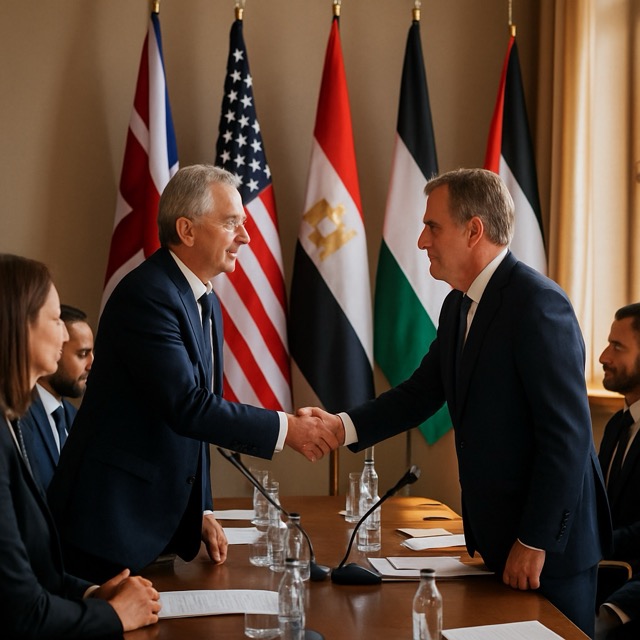
Sources say the former UK prime minister has signaled interest in joining — and possibly chairing — a proposed ‘Gaza International Transitional Authority,’ as Washington courts Arab and Israeli buy-in.
LONDON/WASHINGTON
Sir Tony Blair is seeking to play a senior role in running postwar Gaza under a peace plan being developed by the Trump administration, according to people briefed on the proposal who say he has expressed interest in serving on — and potentially helping lead — a supervisory board that would oversee a transitional authority.
The concept, described by officials and diplomats in London, Washington and the region, envisions a ‘Gaza International Transitional Authority’ (GITA) to stabilize and rebuild the Strip after major combat subsides. Under drafts circulated in recent weeks, GITA would operate with backing from the United States, a UN mandate and contributions from Gulf states, while coordinating closely with Egypt and Jordan. It would ultimately hand day‑to‑day governance to a reformed Palestinian Authority, people familiar with the talks say.
Blair, 72, a former Middle East envoy who led Britain from 1997 to 2007, has held consultations with senior U.S. officials and regional interlocutors in recent months, including an August meeting with President Donald Trump at the White House, according to multiple reports. His Tony Blair Institute for Global Change has declined to comment in detail but has emphasized that any plan he supports would exclude forced displacement of Gaza’s residents and seek a path back to Palestinian self‑rule.
The push around GITA coincides with a broader, U.S.-drafted 21‑point framework aimed at ending hostilities and creating a pathway toward a future Palestinian state. Elements of the draft have been discreetly shared with Arab and Muslim leaders on the sidelines of the UN General Assembly this month, diplomats said.
While details are fluid, the current iteration would set up a small secretariat — roughly two dozen professionals — overseen by a seven‑member board. Blair, according to two people who have seen recent drafts, has indicated interest in serving on that board; some backers have floated him as interim administrator during the first phase, given his network and experience convening donors.
Israeli reaction is mixed. Some senior figures, including former Mossad chief Yossi Cohen, have publicly praised the idea of Blair steering a transition as a credible, pragmatic choice. Others across Israel’s coalition remain staunchly opposed to any arrangement they believe could seed a Palestinian state, and insist that security control must remain with Israel for the foreseeable future.
For Washington, elevating Blair offers advantages and risks. A recognizable face with relationships from Doha to Riyadh to Brussels, he could help raise funds, unlock border bottlenecks and knit together a civilian administration that is not perceived as Hamas-run. But his association with the U.S.-led invasion of Iraq will be controversial in Arab public opinion, and among segments of the British public, potentially complicating efforts to confer local legitimacy on a foreign‑backed body.
Officials involved say GITA would likely begin work from Egypt’s North Sinai, near El‑Arish, with an eventual move into Gaza as security conditions permit. Planning documents reference rapid‑impact priorities: restoring municipal services, scaling up aid logistics, reopening hospitals and schools, repairing water and power infrastructure, and launching a vetted local police service under international supervision.
Financing remains a central test. Gulf states are expected to anchor an initial multi‑billion‑dollar package for relief and reconstruction, contingent on governance benchmarks and tight oversight. European donors would be tapped for technical assistance, while Washington would bear a significant security and diplomatic load — particularly if a UN‑backed multinational force deploys to protect critical sites and crossings.
A crucial piece of sequencing — and a key precondition for public rollout, U.S. officials stress — is the fate of the hostages still held in Gaza and the demobilization of remaining Hamas units. The White House has privately signaled that formalizing the transitional authority would depend on progress on both fronts, as well as Israeli acquiescence and at least tacit buy‑in from the Palestinian Authority in Ramallah.
Inside London, Blair’s prospective role has revived an old debate about the scope of his post‑premiership diplomacy. As the Quartet’s envoy from 2007 to 2015, he helped broker economic openings and coordinated aid but struggled to translate that into durable political gains. Supporters argue that the current moment is more transactional than ideological — a space in which Blair’s convening power could matter. Critics counter that any arrangement perceived as externally imposed will falter without a parallel political horizon for Palestinians.
What sets the new U.S. plan apart, say diplomats, is its attempt to codify that horizon early: the 21‑point framework sketches milestones for Palestinian institutional reform, security sector vetting and anti‑corruption measures, paired with steps by Israel on settlements and movement, and a timetable to unify Gaza and the West Bank under a reconstituted Palestinian Authority. Whether Israel’s current leadership would accept such benchmarks is unclear.
Even among advocates, there is quiet recognition that a Blair‑fronted experiment would be fragile. International governance projects tend to falter when mandates are fuzzy, local counterparts are weak, and security conditions are volatile. Kosovo and Timor‑Leste — two models cited in brainstorming papers — were never close analogues to Gaza’s dense urban terrain and the unresolved Israeli‑Palestinian conflict.
Still, senior Arab officials say they see a narrow opening. With Gaza’s humanitarian collapse acute, an internationally supervised authority with a finite mandate could give donors a structure they trust, while insulating Arab capitals from accusations of normalizing Hamas or endorsing indefinite Israeli control. If Blair can corral European cash and Trump can deliver Israeli flexibility, one Gulf diplomat said, “there is a deal to be made — but the window is closing.”
For now, Blair’s allies are focused on coalition‑building rather than titles. One person familiar with the talks said the supervisory board’s composition — and whether Blair chairs it — matters less than cementing a credible division of labor between security actors and civilian administrators. “If this becomes a personality contest, it will fail,” the person said. “If it becomes a results machine — keeping water flowing, salaries paid and borders open — it might just work.”
Whether Blair ultimately joins the board, leads an interim secretariat or remains an outside broker, his shadow looms over the next phase of Gaza diplomacy. Backers see a seasoned fixer positioned to translate a sprawling U.S. blueprint into paychecks and bulldozers. Detractors see an emblem of Western overreach. Both agree that the stakes — for Gaza’s 2.2 million people and for a region exhausted by war — could not be higher.
Sources: Financial Times reporting that Blair is seeking a senior role and has asked to join the supervisory board; Wall Street Journal on a White House plan proposing Blair as interim administrator and on GITA; Al‑Monitor/AFP roundup noting BBC/Economist details of a seven‑member board and 25‑person secretariat and that Blair’s institute declined detailed comment; Times of Israel reports on a U.S. 21‑point framework presented to Arab and Muslim leaders; Sky News on August White House meeting and the proposed supervisory board.


 The Tower Post