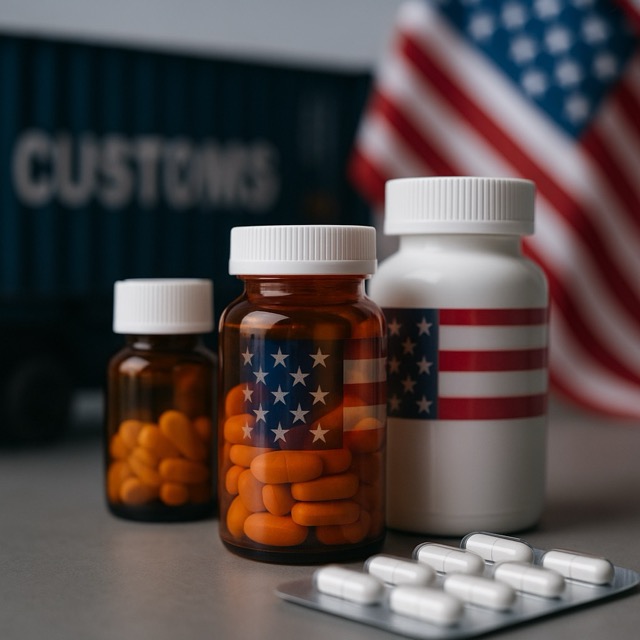
Effective October 1, the administration’s tariff on branded pharmaceutical imports jolts trade partners, rattles markets, and tests America’s drug supply chain—while exemptions and caps sow confusion.
Washington, D.C. — The White House’s abrupt decision to levy a 100% tariff on imported branded and patented pharmaceuticals has set off a high‑stakes scramble across the global drug industry, foreign capitals, and U.S. health systems. Announced late Thursday and slated to take effect on October 1, the measure spares generic medicines but targets a swath of high‑value therapies—from oncology and rare‑disease treatments to vaccines—unless manufacturers are already “breaking ground” or “under construction” on U.S. production sites.
The policy—pitched as a way to “re‑shore” critical medicine manufacturing—arrives amid broader tariff actions on heavy trucks and furniture, and after a national security probe into pharmaceutical supply chains earlier this year. Within hours of the announcement, European Union and Japanese officials pointed to recent trade understandings they say effectively cap tariffs on pharmaceutical products from their exporters at 15%, injecting a layer of ambiguity into how the administration’s headline 100% rate will actually be applied.
At the center of the confusion is a set of carve‑outs and conditional language. The administration said products from companies with U.S. facilities under construction would be exempt from the punitive rate. Trade lawyers say that could trigger a race among multinationals to demonstrate shovel‑ready projects, or to certify that existing U.S. plants can be retooled to produce the tariff‑exposed medicines. Industry strategists, meanwhile, are drawing up contingency plans that range from accelerated U.S. investments to short‑term stockpiling of certain therapies.
The immediate market reaction has been uneven. Shares of U.S.‑listed drug distributors and hospital suppliers dipped on fears of near‑term procurement costs and paperwork delays. Large European and Japanese pharma groups were mixed—reflecting both the potential bite of the 100% headline rate and the possibility of caps, exemptions, or fast‑tracked U.S. plant announcements that could blunt the impact. Analysts at major banks described the policy as “forceful but unstable,” noting that the implementation details will determine whether the move meaningfully changes pricing power or simply shifts supply routes and corporate structures.
Generics vs. brands: who pays—and how much—will vary widely. Because the order targets branded and patented medicines, the vast majority of generic imports should continue to enter at current tariff levels. That distinction matters: generics account for most U.S. prescriptions by volume, and wholesalers say they are the backbone of hospital and retail pharmacy formularies. Still, hospital systems warn that even a small subset of brand‑name products can be mission‑critical—think oncology lines, advanced biologics, and cell or gene therapies. The risk is that a handful of high‑cost molecules facing tariff whiplash could distort budgets and patient access far beyond their market share.
Hospitals and payers are bracing for paperwork as much as price pressure. “Every exception requires documentation,” said the chief pharmacy officer at a multi‑state health system, who requested anonymity to avoid spooking suppliers. “If exemptions hinge on ‘under construction’ definitions, that means manufacturers, distributors, and hospitals will need clear attestations for each National Drug Code at the lot level. Missing or delayed paperwork can create the functional equivalent of a tariff.”
Foreign capitals responded with a blend of pushback and pragmatism. Officials in Brussels and Tokyo publicly expressed confidence that recent agreements with Washington would limit the effective tariff rate on pharmaceuticals to 15%—a ceiling they say is spelled out in joint statements accompanying summer trade talks. Such caps, if honored, would reduce the shock for EU and Japanese exporters while leaving the 100% rate in place for countries without similar understandings—or for companies that lack qualifying U.S. investments.
Inside the industry, executives are parsing the ‘is building’ clause. The administration’s guidance defines eligible U.S. projects as those that have “broken ground” or are “under construction.” That could spare companies already erecting vaccine, biologics, or fill‑finish capacity in the United States. Several firms—including European vaccine makers and Swiss drug companies—have announced or accelerated stateside investments in recent months, positioning themselves for exemption claims. Others may attempt “contract manufacturing by proxy,” partnering with U.S. plants to shift finishing steps domestically while keeping active ingredient production abroad—raising the question of what supply‑chain thresholds qualify as ‘U.S.-made.’
Patients and providers are caught in the middle. Insurers typically negotiate brand‑drug prices months in advance, but sudden trade shocks can pierce those arrangements, especially for hospital‑buy biologics and specialty drugs billed under medical benefit codes. Pharmacy benefit managers (PBMs) say they can reroute some therapies to alternative suppliers or therapeutic substitutes, yet many cutting‑edge treatments lack close analogues. Patient advocates warned of potential delays for rare‑disease and oncology patients if importers pause shipments to sort out tariff status or re‑label origin documentation.
Consider semaglutide, a blockbuster weight‑loss and diabetes therapy whose global supply is already constrained. If a version of the product is deemed a branded import without a qualifying U.S. buildout, importers could face a doubling of landed cost overnight. Even if EU and Japanese products are capped at 15%, the price shock could ripple across formularies and employer plans. By contrast, cardiovascular mainstays that are largely generic may see little to no direct tariff effect—though any shipping‑lane congestion or customs scrutiny could still create outages.
Legally, the administration could rely on a mix of trade authorities. Prior administrations leaned on Section 301 (targeting unfair trade practices) and Section 232 (national security) to adjust tariffs. Here, officials have consistently framed pharmaceuticals as a strategic sector after the pandemic exposed fragilities in medical supply chains. A springtime “national security” review into drug imports laid the predicate. But the clash with trade‑cap commitments for close allies underscores a recurring tension in U.S. tariff policy: marrying muscular industrial goals with the legal fine print of international obligations.
Can domestic production ramp fast enough? Industry veterans say building sterile manufacturing and biologics capacity is a multi‑year endeavor, constrained by cleanroom buildouts, validation timelines, and a tight labor market for specialized engineers. Even expansions at existing facilities must clear regulatory hurdles with the FDA. In the near term, the most likely outcome is a patchwork: accelerated U.S. fill‑finish and packaging, more secondary suppliers in the Americas, and selective reshoring of active pharmaceutical ingredients (APIs) where cost and complexity permit.
For now, distributors are hedging. Several wholesalers told clients they would prioritize buffer inventories for oncology injectables and certain specialty therapies, where any customs delay can strand patients mid‑regimen. Hospital group purchasing organizations are drawing up alternative product lists and seeking written tariff‑status assurances from manufacturers. State Medicaid programs, which have less room to maneuver on rebates and formularies, are quietly modeling budget contingencies for the fourth quarter and into 2026.
Trade partners are simultaneously pushing for clarity and preparing for escalation. If Washington formally codifies a 15% cap for EU and Japanese pharmaceutical shipments—as Brussels and Tokyo suggest—other exporters will likely lobby for parity. Countries without caps may explore challenges at the World Trade Organization or reciprocal measures on U.S. exports. Within the United States, import‑heavy sectors beyond pharma—such as kitchen cabinetry and furniture, also targeted this week—are watching how exemptions are awarded, anticipating similar rule‑of‑origin battles.
The political economy is equally fraught. Americans remain acutely sensitive to prescription drug costs, and the administration has framed the tariff as a lever to force overseas giants to “build in America” rather than to raise prices at home. Yet short‑term disruptions can land squarely on patients, particularly those on specialty drugs. The optics will depend on how quickly companies announce U.S. projects, how broadly exemptions are granted, and whether drug makers absorb part of the tariff hit to maintain market share.
What to watch next: First, a formal rulemaking or guidance document that clarifies product coverage (biologics, cell and gene therapies, vaccines, and combination products), proof of construction standards, and how country‑specific tariff caps integrate with the 100% rate. Second, company‑by‑company disclosures on U.S. buildouts; expect press releases detailing groundbreaking dates, site addresses, and the specific molecule lines slated for domestic production. Third, purchasing advisories from major distributors and PBMs that convert legalese into SKU‑level do‑and‑don’t lists for hospital pharmacies.
Even with sharper rules, the policy’s endgame remains contested. Optimists argue the shock will catalyze durable domestic capacity for essential medicines, reducing future scarcity risk. Skeptics counter that punishing tariffs will raise costs, complicate clinical care, and invite legal fights that cloud investment. In the months ahead, the test of success will be painfully practical: Did patients get their drugs on time and at a price they (and taxpayers) can bear?
—
Editor’s note: This article reflects developments and statements through the morning of September 27, 2025. Implementation details may shift as formal guidance is published and as negotiations with allies progress.
Sources: public statements and reporting from Reuters, the Financial Times, the Associated Press/Washington Post, Al Jazeera, and U.S. industry and hospital groups.


 The Tower Post