A brief closure at Schiphol underscores Europe’s widening drone anxiety, while Commissioner Valdis Dombrovskis says the bloc is already in a hybrid conflict with Moscow
Amsterdam/Brussels
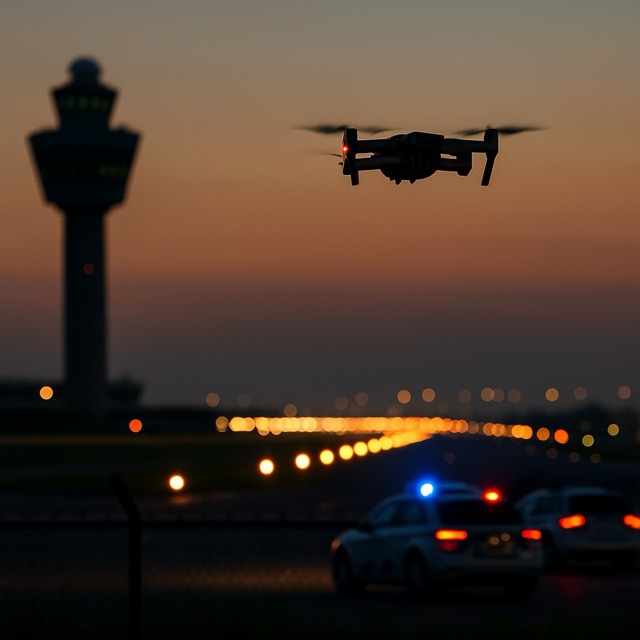
One of Amsterdam Schiphol’s six runways was temporarily closed on Saturday after air traffic controllers reported a suspected drone near the airport perimeter. Operations continued on alternative runways and the affected strip reopened roughly 45 minutes later after checks found no confirmed drone or operator. The incident—minor in disruption but major in symbolism—arrived amid a spate of drone scares across northern Europe and a blunt warning from the European Commission’s Valdis Dombrovskis that the EU is “already in a hybrid war” with Russia.
Dutch military police (Marechaussee) said the runway was shut early Saturday afternoon as a precaution while aircraft were rerouted. Spokesman Doron Wallin told reporters there was no interdiction or arrest, and that similar reports have been logged repeatedly this year. The latest episode adds to the continent’s jitters: days earlier, Copenhagen Airport halted traffic for hours after multiple unidentified drones loitered over its terminals—an event Danish officials labeled one of the most serious attacks on critical infrastructure in years.
By Saturday evening, Dutch authorities had not produced evidence of a drone or its pilot, and some investigators privately cautioned that misidentified objects—such as balloons—can trigger alerts. Whether hobbyist mischief or hostile probing, however, the cumulative signal is clear: low-cost, hard-to-trace unmanned aircraft are repeatedly intruding on sensitive airspace and testing institutional response times.
A pattern across the map
The Schiphol scare sits within a wider pattern. Denmark has reported waves of drone sightings this month over military facilities and near airports; Germany has stepped up counter‑drone defenses in its northern states; and Norway has investigated flyovers near NATO‑linked bases. NATO officials, meeting in Riga this weekend, framed the incursions as part of a broader contest in which airspace violations, electronic warfare and disinformation are used to stretch defenses and sow uncertainty.
That framing is increasingly echoed in EU capitals. In a France 24 interview broadcast Saturday, European Commissioner for Economy and Productivity Valdis Dombrovskis said the bloc is already engaged in a “hybrid war” with Moscow—one that blends kinetic threats, sabotage, cyberattacks and psychological operations. He urged a coordinated European push on air defense, critical‑infrastructure protection and sanctions enforcement.
What happened at Schiphol
Schiphol, one of Europe’s busiest hubs, has a layered counter‑drone posture that integrates airport security, the Dutch air traffic network LVNL and the Marechaussee. Saturday’s closure followed a standard protocol: suspend operations on the potentially affected runway, monitor radar and visual feeds, and re‑sequence arrivals and departures on parallel strips. Airlines reported delays but no diversions of note, according to initial operations logs. The runway reopened after roughly three‑quarters of an hour.
Dutch authorities have recorded dozens of drone‑related alerts so far in 2025, officials said, most of which turned out to be false or untraceable. But even false alarms carry cost. Every stop‑start cycle forces controllers to rebuild traffic flows, tugs at crew duty limits, and erodes public confidence at a time when Europe is trying to harden its skies against evolving threats.
The ‘drone wall’ idea—and its limits
Northern and eastern EU states are rallying behind a proposed “drone wall” spanning vulnerable borders to detect, track and neutralize intrusions. Denmark this week accepted Swedish military anti‑drone systems on loan and several governments are weighing legal changes to let critical‑infrastructure operators disable or shoot down rogue aircraft. Yet the technical challenge is formidable: commercial quadcopters are small, quiet and cheap; long‑range fixed‑wing models can ride low on radar; and both can spoof their signal signatures.
Airport environments are especially tricky. Any kinetic takedown risks debris near fuel farms and passenger areas; jamming can bleed into navigation aids; laser or net‑gun capture requires line of sight and trained teams. The safest response, experts note, is often the least satisfying—hold traffic until the object leaves or the picture clarifies.
A moving target set
Europe’s drone problem is not only about hardware. It’s about ambiguity. Attribution is difficult; payloads can be innocuous until they aren’t; and the strategic effect relies as much on disruption as on destruction. This is classic hybrid warfare terrain, where the threshold for a formal military response remains deliberately fuzzy while the social and economic costs accumulate.
For Moscow, analysts say, the appeal is obvious: low‑cost pressure that diverts resources, fuels domestic political debate and tests allied cohesion—especially as the EU debates new sanctions and financing mechanisms to sustain Ukraine. For European governments, the answer will be a grind: more sensors and shooters, clearer rules of engagement, faster forensic sharing—and consistent messaging that distinguishes nuisance from attack without downplaying the risk.
What to watch next
In the coming weeks, expect EU interior and transport ministers to revisit common standards for counter‑UAS deployments at airports and other critical sites, including when and how to neutralize hostile craft. A parallel push is underway to expand air‑defense production and to coordinate cross‑border investigations when drones fly patterns that cross jurisdictions. Schiphol’s brief closure may look minor on paper, but as Europe’s northern tier has learned, the measure of the threat is cumulative.
For travelers, the practical advice is unglamorous: build in buffer time, keep alerts on for gate changes, and assume that what looks like a clear‑blue‑sky day can still get complicated. For policymakers, Schiphol is a reminder that airspace sovereignty in 2025 is as much about inexpensive hobby‑grade devices as it is about fighter jets.
Sources and reporting notes
Reporting for this article draws on statements from the Dutch military police and air‑traffic authorities, Associated Press/ABC News wire reports, coverage by Anadolu Agency and The Kyiv Independent, and a France 24 interview with EU Commissioner Valdis Dombrovskis broadcast on September 27, 2025.
The Schiphol episode will intensify debate over how to share real-time airspace data across the Single European Sky. Integrating counter‑UAS tracks with civilian ATC displays is technically feasible but politically fraught, given the sensitivity of intelligence sources and the risk of misinterpretation by pilots.
There is also the legal frontier. Many EU states restrict electronic counter‑measures to military or police units. Utilities and airport operators argue they are accountable for safety but lack the authority to stop a fast‑moving threat. Draft legislation under discussion would authorize narrowly scoped neutralization in defined perimeters, accompanied by incident reporting and after‑action transparency.
Finally, Europe’s messaging challenge persists. Officials seek to deter malign actors without amplifying panic or rewarding provocations. That balance will be tested each time a radar return turns out to be a balloon—or something more sinister.



 The Tower Post