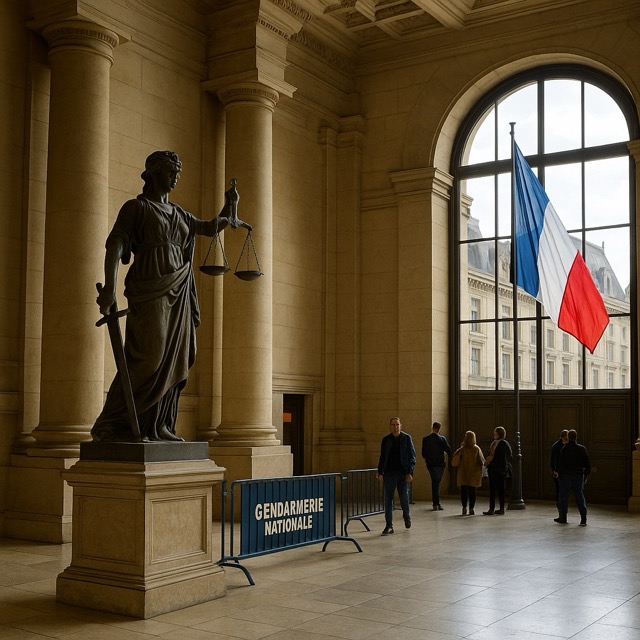
In 2011, Nathalie Gavarino helped lead France’s magistrates in revolt against President Nicolas Sarkozy. Fourteen years later, she presided over the ruling that sent him to prison—igniting praise, fury, and questions about the long memory of French justice.
PARIS — On September 25, 2025, a Paris criminal court sentenced former president Nicolas Sarkozy to five years in prison for criminal conspiracy in the long-running investigation into suspected Libyan financing of his 2007 campaign. The verdict, the most consequential of the ex-head of state’s legal saga, immediately triggered a political and cultural aftershock. Supporters thundered about judicial zeal. Lawyers’ associations urged calm. And within hours, the presiding judge, Nathalie Gavarino, became the focus of a new controversy: her past as a union activist and her role in the historic 2011 protests by magistrates against then‑President Sarkozy.
French justice is built to resist winds of politics, and judges are not required to be tabula rasa. Yet the collision of history and jurisprudence is hard to ignore. In 2011, amid a nationwide outcry over Sarkozy’s rhetoric during the so‑called “Laetitia affair,” thousands of magistrates and court staff staged walkouts and rallies to protest what they saw as executive meddling and attacks on judicial independence. Among the organizers and visible figures in that movement was Gavarino, then a magistrate and union representative. Fourteen years later, the same jurist led a three-judge panel that found Sarkozy guilty of criminal association, even as it acquitted him of several related charges. The symmetry was irresistible for commentators—and combustible for the political right.
Within days of the verdict, Paris prosecutors opened investigations into death threats sent to Gavarino, while the main magistrates’ unions condemned intimidation and called for the protection of judicial officers. The climate was tense enough that bar associations and political leaders across the spectrum urged restraint. Sarkozy’s defense team vowed to appeal and to seek measures reducing any time behind bars, underscoring that he denies wrongdoing and insists the proceedings were tainted by political animus.
The decision itself was stark. While the court said prosecutors had not proved that Libyan cash ultimately reached the campaign, it concluded that Sarkozy knowingly allowed close associates to court Libyan officials for illicit support and that the resulting conspiracy grievously damaged public trust. Two of his longtime allies were also sentenced, and a web of intermediaries—financiers, fixers, and former Libyan officials—received varying terms. For the first time in modern French history, a former president now faces serving an actual custodial sentence stemming from conduct tied to his ascent to power.
That context makes the resurfacing of Gavarino’s past all the more sensitive. In 2011, the magistrates’ movement united rival unions and flooded court steps from Paris to Marseille. The trigger was Sarkozy’s repeated broadsides at judges after the killing of a young woman, suggesting judicial laxity had let a repeat offender roam free. Magistrates responded that they were overburdened, under-resourced, and being scapegoated to serve a security-first agenda. The protests were, at the time, one of the rare moments when the ordinarily discreet corps shed its reserve to defend institutional independence in the public square.
Gavarino’s role then, colleagues say, was that of a syndicaliste—an elected union figure who argued that the executive branch had crossed a line. Her defenders now stress that such advocacy is not only legal but part of the living architecture of French justice: magistrates may belong to professional unions and speak on systemic questions, provided they remain impartial in the courtroom. What matters in law is not whether a judge once carried a banner but whether her decisions, read line by line, rest on facts and statutes.
Sarkozy’s supporters see it differently. To them, the 2011 banners and the 2025 bench form a continuous thread of hostility. Conservative commentators frame the verdict as the apotheosis of a “government of judges,” echoing grievances first aired when Sarkozy was sentenced in earlier cases and ordered to wear an electronic tag. This week, social media amplified the most extreme claims, some of which spilled over into threats that prosecutors are now probing. The intensity underscored how the former president still polarizes France—and how judicial authority is increasingly assailed in the age of virality.
The legal stakes remain high. Sarkozy’s lawyers will appeal, likely arguing that the court overreached in stitching together inferences to construct a conspiracy, and they will revisit the credibility of key witnesses and intermediaries. The prosecution, for its part, will seek to defend a case built over more than a decade, involving international letters rogatory, Swiss banking trails, and a mosaic of testimonies that have shifted over time. The death of Franco-Lebanese fixer Ziad Takieddine in 2024, after years of contradictory statements about suitcases of cash, has only deepened the evidentiary thicket.
Beyond the courtroom, the episode reframes an old French debate: who guards the guardians? Since the 1958 Constitution, France has grappled with balancing executive energy and judicial independence. The 2011 showdown was, in part, a reaction against a presidency that many jurists felt blurred those lines. The 2025 verdict is a different chapter, but the same separation-of-powers nervous system is twitching. That a judge who once opposed a president from a union platform later ruled against him in a criminal case may look, from a distance, like a closed circle. Up close, it is a stress test of institutions designed to withstand precisely that kind of pressure.
For Gavarino, the personal consequences are immediate—and fraught. Threats against magistrates are prosecuted in France, but they also take a psychic toll. For her peers, the episode is a reminder that public trust in justice is not built only on black-letter law but on the perception of fairness. That perception must be earned, case after case, with reasoning that is transparent and reviewable on appeal. In the end, appellate judges, not hashtags, will determine whether last Thursday’s reasoning holds.
As the appeals process unfolds, two truths coexist. First, Sarkozy remains one of the most significant figures on the French right, and his legal fate will have ripples in a political family already struggling to define itself. Second, the judiciary’s credibility—its ability to decide cases without fear or favor—depends on both protecting judges from intimidation and enforcing the discipline of impartiality. The 2011 protests and the 2025 verdict can be read not as proof of bias but as evidence of a judiciary that argues about its place in the Republic, and then returns to the bench to decide difficult cases in public, with reasons that can be contested and reviewed.
History rarely offers clean lines. It offers echoes. The echo in this case is unmistakable: a judge who once marched to shield her profession from presidential pressure later signs a judgment that confines that same president. Whether French society hears in that echo a vindication of independence or the drumbeat of vengeance will shape the next chapter—not just of Nicolas Sarkozy’s legal odyssey, but of the public’s faith in justice itself.




 The Tower Post