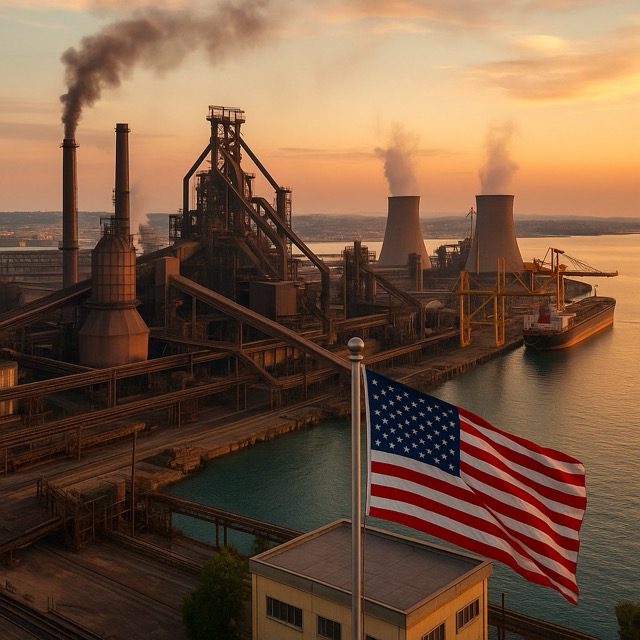
Ten bids land on the commissioners’ desk; only two aim to buy the whole group—Bedrock Industries and a Flacks Group consortium with Steel Business Europe—setting up an all-American showdown.
ROME—Italy’s long-saga sale of the former Ilva steel empire reached a decisive new act this weekend. Extraordinary commissioners overseeing Acciaierie d’Italia (AdI) and Ilva in extraordinary administration confirmed that ten bids arrived by the latest deadline. But only two proposals seek to acquire the entire business—an audacious, high-stakes play that thrusts two U.S.-linked investors into the foreground: Miami-based industrial turnaround specialist Bedrock Industries and a consortium led by the U.S. Flacks Group alongside Slovak trader Steel Business Europe. If either prevails, the smokestacks of Taranto—the sprawling heart of Europe’s once-largest steelworks—could soon fly the Stars and Stripes by proxy.
The field thinned dramatically in the final hours. Two previously touted contenders—Azerbaijan’s Baku Steel (teamed with the Azerbaijan Investment Company) and India’s Jindal Steel International—did not file binding offers for the full perimeter. According to officials and company statements, Baku Steel’s plan collided with local resistance tied to energy and environmental logistics around its decarbonization scheme, while Jindal’s focus appears to have shifted to opportunities in Germany. That left the American funds—neither a classical European steel operator—squaring up for control of a system that still employs roughly ten thousand people, most of them in Taranto.
Eight additional offers reportedly target individual assets rather than the entire network. Names circulating include renewables and infrastructure player Renexia (part of the Toto Group), metallurgy operator Industrie Metalli Cardinale, and Italian steel group Marcegaglia, among others. Their bids map onto a potential “spezzatino”—a carve-up of assets—that unions have long warned could undermine industrial coherence, jobs, and environmental commitments. UILM, one of Italy’s main metalworkers’ unions, branded the outcome a “total failure” of policy and repeated its call for nationalization to avert what it called an environmental and employment disaster.
For the Meloni government, the numbers cut both ways: ten offers look like competitive interest; only two for the full perimeter underscore the risk that Italy’s most sensitive industrial dossier fractures into pieces. Industry Minister Adolfo Urso struck a cautious tone, acknowledging the complexity of the situation and stressing that the commissioners will need adequate time to examine the proposals. Those evaluations—officials say—will weigh not just price, but also investment timelines, decarbonization commitments, and job guarantees, the trio of criteria that has governed the state’s approach since the plant’s judicial and environmental crises first detonated more than a decade ago.
The big strategic question now: can either U.S.-anchored bidder credibly fund and execute a multi-year transformation of Taranto from a blast-furnace behemoth into a cleaner, competitive producer—without repeating the stop-start cycle that has bedeviled Ilva’s many would-be saviors? Bedrock, known in North America for acquiring and restructuring industrial assets, has pitched itself as a hands-on operator with turnaround chops. The Flacks Group consortium, by contrast, would blend private-equity discipline with trading muscle via Steel Business Europe. Both teams would still face the same hard math: high energy costs, heavy capex for direct reduced iron (DRI) and electric arc furnace (EAF) transitions, and a local community that demands measurable environmental remediation after years of public-health alarms.
Decarbonization remains the fulcrum. Any path forward hinges on converting Taranto away from coal-based blast furnaces and toward DRI-EAF routes powered by natural gas now and low-carbon hydrogen later. That implies complex energy logistics—pipeline capacity, potential LNG backstops, and regional grid upgrades—plus a phased technical plan to keep some output flowing during construction. Europe’s Carbon Border Adjustment Mechanism (CBAM) and tougher ETS trajectories add urgency: if Taranto lags on emissions intensity, its coils and plates risk becoming uncompetitive in a carbon-priced market.
Financing the shift will be as political as it is industrial. Rome has repeatedly injected lifelines on national-strategic grounds and will almost certainly be asked to co-finance the green transition through guarantees, contracts-for-difference, or dedicated funds from REPowerEU and Italy’s national plans. Brussels, meanwhile, will scrutinize any package for state-aid compliance. The bidders’ ability to present bankable project phases—with clear milestones for dismantling obsolete units, installing DRI modules, and commissioning EAFs—could determine whether lenders and the EU sign on.
Employment is the other hard edge. With roughly 8,000 workers in Taranto alone and thousands more in supplier ecosystems, any downsizing would trigger immediate political heat. Unions are pressing for ironclad job protections and reskilling guarantees tied to the decarbonization timeline. The commissioners’ selection grid is expected to give heavy weight to job retention, training for new process technologies, and environmental-health safeguards for nearby neighborhoods such as Tamburi, which has carried the brunt of past contamination.
A carve-up remains the fallback scenario. If the commissioners deem the two whole-of-company offers insufficient, they could pursue a controlled sale of individual assets—rolling mills, logistics terminals, energy units—to multiple buyers. That might unlock targeted investments and reduce execution risk but would also raise vexing questions about integrated supply chains, shared utilities, and who bears responsibility for remediation legacies. For Italy’s downstream manufacturers—from shipyards to white goods—losing a domestic, integrated flat-steel champion would deepen dependence on imports, especially during market spikes.
Market timing is another wild card. European steel demand has softened through 2024–2025 amid high rates and weak construction, but the medium-term picture brightens with rearmament cycles, grid expansion, and renewable buildouts—all steel-intensive trends. Taranto’s value is not just in current output, which has withered; it is in acreage, port access, deep-water logistics, and a workforce that knows steel. If a disciplined owner can stage capex, lock in energy, and rebuild customer trust, Italian steel could reclaim a strategic anchor without the environmental liabilities that once made Ilva a byword for industrial catastrophe.
What happens next? In the coming weeks, commissioners will open data rooms, cross-examine financing plans, and test decarbonization roadmaps against regulatory and local constraints. Government interlocutors will, in parallel, probe European state-aid boundaries and sketch support instruments that can survive Brussels’ scrutiny. Expect tight-lipped deliberations—and louder street politics—as unions mobilize and Taranto watches for tangible cleanup milestones. One fact is no longer in doubt: the endgame will be made in America, or not at all. Between Bedrock’s industrial pragmatism and the Flacks consortium’s financial-engineering drive, Italy must decide which path offers the clearest, cleanest route to a steel future that finally breaks with Ilva’s past.


 The Tower Post