A year-long operation, a hidden hydraulic hatch, and 300 tonnes seized: how Italy’s Guardia di Finanza uncovered an industrial-scale underground production hub near Cassino with an estimated €1 billion turnover
CASSINO, Italy —
From the street, the warehouse looked like the hundreds that line the industrial belt near Cassino: anonymous façades, shuttered bays, a few forklifts asleep behind fencing. What it concealed, investigators say, was anything but ordinary: a hydraulically sealed underground bunker housing the largest illegal cigarette factory ever discovered in Italy — and, by production capacity, among the biggest in Europe.
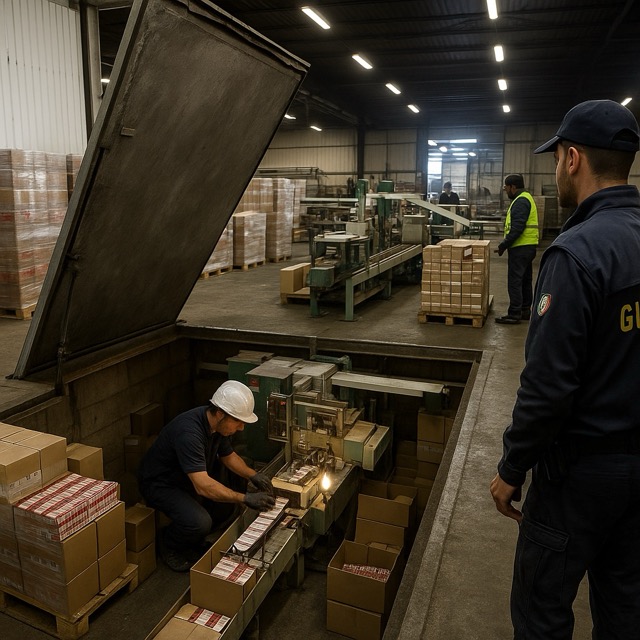
The Guardia di Finanza’s financial police, working with prosecutors in Cassino and a unit based in Ancona, moved in after months of technical surveillance and commercial-paper sleuthing. What they found was an industrial plant meticulously engineered to be invisible: three tobacco-processing and packing lines, an advanced ventilation system to suppress odors, and a concealed lift descending to a 1,600-square-meter maze of corridors and workrooms beneath a seemingly empty logistics depot.
A hatch that lifted ‘an office’ off the floor
The entry point, according to officials, was hidden in plain sight. Investigators describe an innocuous aluminum-framed office unit on the warehouse floor that, when a specific button sequence on a remote control was pressed, rose slowly on hydraulic pistons. Beneath it, a service platform and freight elevator led to the heart of the operation. The layout — lit, ventilated and arranged like a legitimate production line — was designed to let workers spend entire shifts below ground without drawing attention above.
Production by the minute, profits by the billion
Technical assessments cited by authorities estimate the factory’s output at roughly 5,000 cigarettes per minute — about 7.2 million per day, equivalent to some 2.7 billion a year. Police say more than 300 tonnes of counterfeit and contraband cigarettes were seized on site and in associated storage, alongside equipment valued at nearly €1.8 million. Based on pricing and tax models used by investigators, the operation’s annual turnover could approach €900 million to €1 billion, with approximately €600 million in taxes allegedly evaded.
How the bunker stayed hidden
The engineering was as much about concealment as it was about throughput. The bunker sat under reinforced concrete, with air exchanged through a baffled system that vented laterally and scrubbed emissions. Delivery patterns mimicked a low-activity warehouse: infrequent, off-peak movements; pallets arriving as ‘machine parts’ or ‘packaging supplies’; outward flows labeled as recycled materials. Inside, modular lines could be reconfigured within hours to switch brands and packaging, investigators say, a hallmark of the European illicit tobacco trade’s flexibility.
A supply chain built for shadows
While the precise corporate architecture behind the plant remains under investigation, the outlines are familiar to specialists: tobacco leaf sourced through shell intermediaries; flavorings and paper reels procured from legitimate suppliers; packaging that copied popular EU brands down to duty stamps and health warnings. The production room included granulators and humidification units typical of legal factories, as well as carton formers and cellophane overwrappers used to create retail-ready packs. Officials believe the output was destined for multiple EU markets, shuttled by road in short, overlapping legs to confound customs profiles.
One arrest — and a wider map of suspects
Police detained one person at the site and filed multiple aggravated smuggling complaints against others believed to have rotated through the facility. Forensic work is now focused on serial numbers etched into machinery, diesel generator cycles logged by the control panels, and mobile-device beacons that pierced the bunker’s shielding at regular intervals. Those digital breadcrumbs could tie the Cassino plant to parallel production cells and storage depots across central and southern Italy.
Why Cassino — and why now
The choice of location was strategic. Cassino sits at a logistical crossroads between Rome and Naples, with quick access to A1 motorway links that can move goods north to the Po Valley or south toward the ferry routes of the lower Tyrrhenian. The surrounding industrial parks also offer what illicit manufacturers crave: anonymity, acoustic cover from legitimate machinery, and a labor market that can be tapped through informal networks.
The market that feeds the mills
Italy has long been a high-demand destination for ‘bionde’ — the colloquial term for blond tobacco cigarettes — both counterfeit versions of major brands and so‑called ‘illicit whites’ manufactured solely for smuggling. Rising excise duties and cost-of-living pressures have expanded the customer base for cheaper packs, experts note, while enforcement has squeezed traditional smuggling routes, pushing criminal groups toward domestic production that reduces border risk and transport costs.
What 300 tonnes means on the street
A seizure of this scale is rare. Three hundred tonnes equate to roughly 15 million standard packs, depending on brand and moisture content — enough to feed several regional markets for weeks. Yet veterans of tobacco investigations caution that supply chains are resilient. When one ‘node’ is dismantled, capacity is often redistributed to smaller lines, ready to surge again once attention shifts.
A cat-and-mouse game of machines
The Cassino bunker underlines how the economics of smuggling have converged with the economics of manufacturing. Industrial cigarette machinery is durable, modular and increasingly available on secondary markets worldwide. Criminal groups with capital can assemble legal-grade lines with relative ease; the differentiator is concealment — not capability. Hydraulic lifts, acoustic baffling, and air-scrubbing technology are now as central to illicit production as paper reels and filter tips.
What comes next
Prosecutors will spend months tracing the money: who purchased the machines and consumables, who rented the warehouse, who arranged the logistics fleets, who laundered payments. Assets worth about €53 million have already been frozen, authorities say — a down payment on what could become a much larger asset-recovery effort if the factory’s profits and procurement trails are mapped successfully. Meanwhile, cross-border intelligence units are comparing packaging lots and ink batches seized in Italy, Malta, and other EU entry points to identify common suppliers.
The signal to Europe
For European enforcement, Cassino is both a victory and a warning. The victory is obvious: an extraordinary plant neutralized, with immediate supply disruption and rich forensic leads. The warning is that the model works — a subterranean factory hidden beneath an ordinary warehouse, scaled for continental distribution, and sustained by the price gap between legal and illicit cigarettes. Unless that gap narrows or detection improves, investigators say, the next ‘invisible’ factory may already be humming somewhere else, waiting for the right sequence on a remote to lift the floor.
As the aluminum ‘office’ descended back into place during a reconstruction for the search teams, the warehouse returned to its practiced blankness — a façade designed to deceive, and for a year, it did. This time, the machinery is silent. But the blueprint it revealed will not be easily forgotten.



 The Tower Post