
Doctors Without Borders suspends medical work in Gaza City, citing an unacceptable risk to staff and patients, while Israeli strikes continue to pound the enclave.
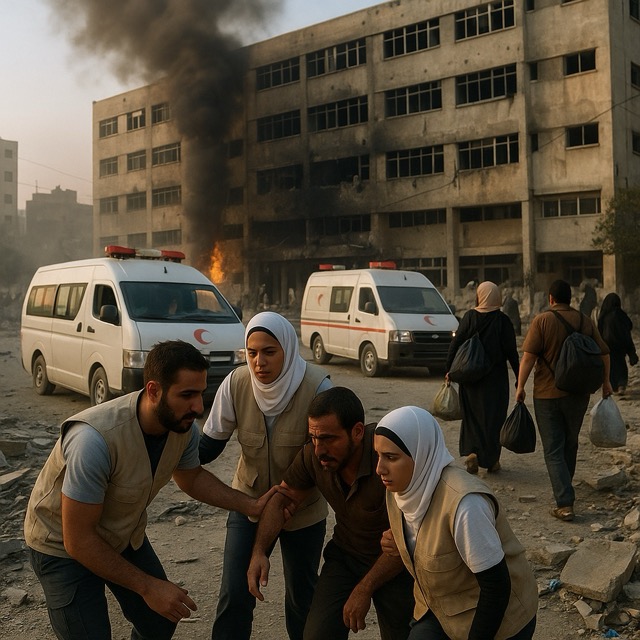
GAZA CITY/ROME — Médecins Sans Frontières (MSF) has suspended its medical activities in Gaza City after what it called an “unacceptable level of risk” to staff and patients amid an intensified Israeli offensive that has pushed tanks and gunfire to the doorsteps of aid-run clinics. The decision, announced late Friday, marks the latest retreat by a major humanitarian group from the north of the besieged strip, where shelling and street battles have surged in recent days.
The organisation — known in Italian as Medici senza frontiere — said armoured units were advancing from multiple directions and that at least two of its clinics had been effectively encircled. “We had no choice,” an MSF manager said in a statement. “Continuing to operate would have placed our people and the patients we treat directly in harm’s way.”
‘No safe option’
MSF officials stressed the suspension is limited to Gaza City and does not amount to a full withdrawal from Gaza, where the group continues to support hospitals and mobile clinics farther south when access is possible. But they acknowledged that the contraction removes yet another lifeline for civilians trapped in the north, where supplies have dwindled and medical facilities have been damaged, evacuated or shuttered.
“It’s a devastating call for our teams, but there is no safe option left in Gaza City,” said one MSF coordinator, pointing to repeated aerial bombardments and close-quarters fighting. Aid workers describe streets emptied by fear, operating rooms lit by generators running on fumes, and improvised triage points moving from building to building as front lines shift.
A deadlier weekend
The pullback came as Israeli forces broadened operations in and around Gaza City. Over the weekend, health officials in the enclave reported dozens of people killed in strikes across the strip, with some of the heaviest bombardment again in the north. Smoke billowed over the shattered skyline as families fled on foot along coastal roads, carrying what belongings they could salvage.
Israel’s military said it struck command centres, tunnel shafts and combat units it accused of operating within dense civilian areas. Prime Minister Benjamin Netanyahu reiterated in a speech to the U.N. General Assembly that Israel would continue its campaign “until the mission is completed,” a signal that the fighting is set to grind on despite mounting international pressure for a ceasefire and a hostage deal.
Hospitals under siege
Northern Gaza’s health system is faltering under the pressure. Local and international monitors say two clinics have been destroyed by recent airstrikes, at least two hospitals have shut after sustaining damage, and those that remain open are barely functioning for lack of fuel, medicines and staff. Doctors describe performing amputations without adequate anaesthesia and rationing antibiotics for the most critical cases.
MSF said that in recent days tanks were less than a kilometre — in some accounts less than a mile — from its facilities in Gaza City, with exchanges of fire audible inside triage rooms. The group reported that repeated requests for safe access to resupply or rotate staff were denied or rendered impossible by the fighting. “The conditions Israeli authorities require for humanitarian access and staff security are clearly not in place today,” MSF said.
Civilians on the move
The Israeli military says hundreds of thousands of people have evacuated Gaza City since the latest push began, urged southward by text alerts and leaflets. Humanitarian groups counter that many civilians remain in the north — because they are caring for relatives, fear the journey, or lack money and transport — and that those who flee face bombardment and acute shortages farther south.
Witnesses described families streaming out with white flags, while others sheltered in school courtyards and the rubble of apartment blocks. Aid agencies warn that food, clean water and sanitation are running out in neighbourhoods cut off for weeks, raising the risk of disease outbreaks ahead of winter.
The numbers behind the headlines
Casualty figures are difficult to verify in real time, but Gaza’s health authorities said more than 50 people were killed in Friday’s strikes and at least 59 more on Saturday, while dozens were treated for shrapnel wounds, burns and crush injuries. Since the war erupted in October 2023 after Hamas’s attack on southern Israel, more than 65,000 people in Gaza have been killed and over 160,000 injured, according to the Hamas-run Ministry of Health. Israel disputes the numbers and says it targets militants embedded in civilian areas, an assertion rights groups have challenged for lacking sufficient transparency and independent verification.
Israeli officials say the current operations in Gaza City are aimed at dismantling remaining Hamas combat units and infrastructure, including an underground tunnel network. The army has published videos of airstrikes and raids it says hit rocket squads and weapons depots; it accuses Hamas of using hospitals and schools for cover, allegations Hamas rejects.
A humanitarian red line
MSF has repeatedly accused Israel of failing to ensure the minimum conditions required for aid groups to operate safely in the north, warning that medical workers and patients have been killed in and around health facilities. In an open letter earlier this month, MSF joined more than 20 aid organisations urging world leaders to intervene to protect civilians and health infrastructure after a U.N. commission concluded that genocide is being committed in Gaza — a finding Israel rejects as biased and unfounded.
For residents, the semantics matter less than survival. “We cannot keep moving,” said one father sheltering near the ruins of his apartment block in Gaza City, who asked that his name be withheld for security reasons. “My children are hungry. My wife is sick. The clinic we used to go to is closed. Where should we go?”
What MSF’s exit means
The suspension of MSF’s clinics in Gaza City will likely ripple across an already threadbare health ecosystem. The organisation has been a cornerstone of trauma care and post-operative follow-up in the north, supporting emergency rooms, providing wound dressing, mental health support and mobile teams that reach people unable to travel. Without those services, medics warn, treatable injuries could turn fatal, and chronic illnesses — diabetes, hypertension, kidney failure — will go unmanaged.
Other aid groups are trying to fill the gap, but access constraints remain severe. Deliveries of fuel and medical supplies are sporadic and subject to inspection delays; telecommunications blackouts make coordination hazardous; and routes that are open one day can be under fire the next. Humanitarian convoys have been struck in recent months despite advance coordination, according to aid agencies, chilling efforts to scale up.
Calls for accountability and access
Diplomatic efforts are again intensifying. European and Arab officials have urged an immediate halt to hostilities around hospitals and a humanitarian pause to allow evacuations, while the United States has pressed Israel and Hamas to finalise a ceasefire-and-hostage package. Families of Israeli hostages staged new protests this weekend, demanding a deal after nearly two years of captivity for some.
Rights groups are also calling for independent investigations into strikes that hit medical facilities and clearly marked ambulances. Israel says it reviews incidents and disciplines troops when warranted; Palestinians and aid workers say those processes are opaque and rarely lead to accountability.
The road ahead
For now, MSF says it will reassess its posture daily but will not restart in Gaza City until safe access is guaranteed. Its teams continue to work in parts of central and southern Gaza when possible, offering support to hospitals and running mobile clinics for displaced families. “Our commitment to Gaza has not changed,” the group said. “But we cannot ask our staff to operate where the basic guarantees for their safety do not exist.”
As the fighting pushes deeper into Gaza City’s devastated districts, the cost of that absence will be measured not only in the operating theatres that fall silent, but in the quieter emergencies that never reach a hospital door: infected wounds that turn septic, diabetic crises without insulin, trauma left to fester in children who have known nothing but war.
—
Sidebar: What MSF Does in Gaza City
• Emergency and trauma care, including wound dressing and surgical aftercare.
• Support to hospital emergency rooms and inpatient wards when access allows.
• Mobile clinics delivering primary care and mental health support to displaced families.
• Training and donations for local health staff on infection control and mass-casualty triage.
Sources: MSF statements and briefings; reports by international and local media; Gaza health authorities; Israeli government and military communiqués.




 The Tower Post