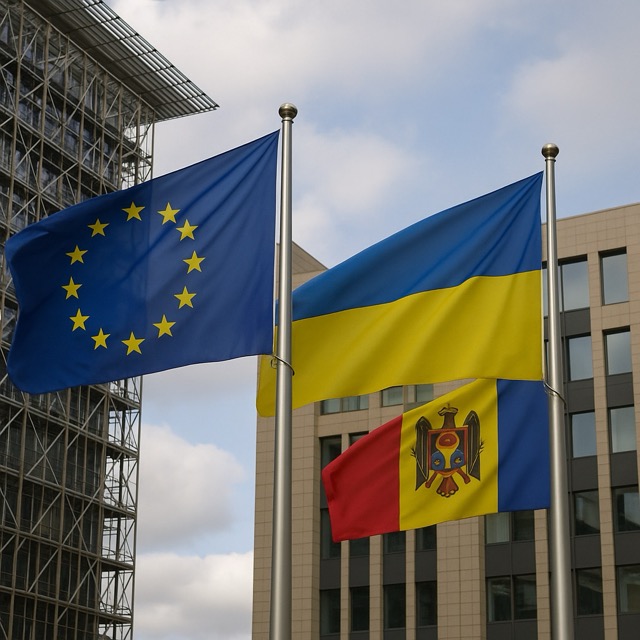
Brussels leans on “technical work” and procedural tweaks to keep enlargement momentum alive as officials map paths around Budapest’s block
Brussels
The European Union is moving to advance Ukraine and Moldova’s accession efforts even as Hungary signals it will continue to block formal steps, according to officials briefed on internal planning. In recent days, senior EU figures have discussed a combination of “technical work” inside the accession machinery and procedural adjustments that would allow Kyiv and Chișinău to keep aligning with EU law—without requiring unanimous approval at every phase.
The push comes amid renewed political momentum for enlargement. Moldova’s pro‑European Action and Solidarity Party (PAS) secured a parliamentary majority in elections on September 28, reinforcing President Maia Sandu’s pledge to anchor the country in the EU. In Kyiv, officials say they have an understanding with Brussels to sustain progress even if Budapest refuses to sign off on opening the first negotiating chapters. “The crucial point is to avoid interruptions,” one Ukrainian official said this month, describing the plan as a “unique approach” to keep work streams alive while the politics catch up.
At the heart of the effort is a technocratic set of measures that sound arcane but could be consequential. Under the EU’s methodology, accession talks are organized into clusters and chapters that cover everything from the rule of law to the energy market. Hungary’s veto has held up the formal opening of these files for Ukraine—and, by extension, slowed Moldova, which is informally paired with its neighbor in the Council’s political calendar. The workaround under discussion would let the European Commission and the candidates proceed with detailed “screening,” drafting of action plans, and alignment exercises inside specific clusters—essentially doing the homework—so that, when the political green light finally comes, the chapters can be opened and closed more quickly.
Officials frame this as staying within the letter of the treaties while maximizing what can be done without a unanimous Council decision. European Council President António Costa has also floated a narrower rule‑change for certain interim steps, testing whether qualified‑majority voting could be used to open clusters rather than requiring all 27 member states to agree. Diplomats caution such a move would itself need unanimous consent or creative legal interpretation. But even airing the option signals the pressure building on Budapest—and the growing conviction across EU capitals that enlargement has become a strategic necessity since Russia’s full‑scale invasion of Ukraine.
Hungary, led by Prime Minister Viktor Orbán, remains publicly unpersuaded. Budapest argues that Ukraine still falls short on key conditions, from minority‑rights guarantees to anti‑corruption enforcement, and has threatened to block the process until its concerns are addressed. Hungarian Foreign Minister Péter Szijjártó reiterated this hard line in recent days, accusing Kyiv of pursuing “anti‑Hungarian” policies and questioning its readiness for accession. Budapest’s stance has already forced a series of high‑wire political maneuvers: last year EU leaders resorted to shuttle‑diplomacy and a carefully choreographed “constructive abstention” to launch talks in principle, only to see the practical opening of chapters stall.
For Brussels, the latest gambit is meant to avoid another lost year. Commission officials say the technical track can meaningfully narrow gaps with the acquis communautaire—the body of EU law—even absent formal decisions. In energy and the internal market, for example, Ukraine has already mapped significant alignment with EU rules under wartime emergency arrangements. Moldova, whose economy is deeply intertwined with EU trade, has made fast progress in customs and public‑procurement reforms. If the Commission can keep issuing benchmarks, running peer‑review missions, and validating draft legislation, both candidates can show measurable progress to their publics and markets—and be better placed to close chapters at speed once the veto is lifted.
There are risks. Without the milestone of formally opening and closing chapters, the political incentives that normally power accession could fade. Candidate‑country parliaments often move fastest when a tangible chapter decision is on the Council’s agenda; absent that pressure, reform coalitions can fray. EU insiders also warn that any perceived “accession by stealth” could backfire, hardening resistance in some member states or inviting legal challenges. That is one reason the evolving plan emphasizes transparency: the Commission would continue to publish roadmaps, interim assessments, and cluster‑level scorecards, while member states would be kept in the loop through regular briefings in Brussels.
The politics around the table are shifting too. The recent Moldovan election result—hailed in Brussels as a mandate for continued reforms—has stiffened arguments that the EU should shield enlargement from single‑capital vetoes. In parallel, think‑tanks and legal scholars have circulated proposals to limit unanimity for certain intermediate steps in accession, invoking the treaties’ values clause and existing “passerelle” mechanisms that allow, with the right safeguards, a switch to qualified‑majority voting. None of these proposals is a silver bullet; all run head‑first into the EU’s deeply ingrained deference to national vetoes on enlargement. But the fact they are being debated at the highest levels reflects a recalibration since 2022: keeping Europe’s eastern neighborhood anchored to the EU is now treated as part of the Union’s security posture.
For Ukraine and Moldova, the calculus is straightforward. Every month of visible motion—new screening tables completed, new directives transposed, new audits passed—helps sustain domestic support for a journey that will still take years and heavy political lifting. Kyiv’s negotiators, juggling a war and reform, argue that the EU can “bank” progress on clusters like energy, transport and digital, where Ukraine already participates in EU frameworks, and focus political capital on the toughest chapters, notably rule of law and judiciary. Chișinău’s team, emboldened by its electoral mandate, is seeking to synchronize reforms with EU funding windows and invest in administrative capacity, so that when formal chapter‑opening happens the government can move at pace.
The immediate test will come in the weeks ahead. EU leaders are due to gather in early October with Ukraine’s President Volodymyr Zelenskyy and Moldova’s leadership joining parts of the discussion. Diplomats expect a carefully worded set of conclusions that both acknowledges Hungary’s continued reservation and instructs the Commission to “maximize technical progress” in the clusters, along with further exploration of procedural options to prevent single‑state hold‑ups. Whether this amounts to a real bypass or simply a well‑publicized holding pattern will depend on how quickly the Commission translates the political nod into concrete checklists and missions on the ground.
Markets and security planners are watching closely. For investors—particularly in energy transit, logistics, and digital services—clearer timetables and benchmarks can de‑risk projects tied to EU integration. For defense and resilience planners, closer regulatory integration eases cooperation on dual‑use supply chains and critical infrastructure protection. Both candidates remain exposed to Russian pressure campaigns, from disinformation to trade disruption; locking in EU‑aligned standards and oversight, even before full membership, is seen in Brussels as a way to raise the political and economic costs of destabilization.
None of this changes the basic arithmetic: full accession still requires unanimous agreement by the member states and the European Parliament’s consent. But it does change the tempo. By doing the technical heavy lifting now—and by exploring limited shifts away from unanimity for non‑final steps—the EU hopes to ensure that when the political window opens, Ukraine and Moldova can step through it without delay. In a union tested by war at its borders and polarization within, that blend of legal caution and political urgency may be the only path to keep enlargement moving.


 The Tower Post