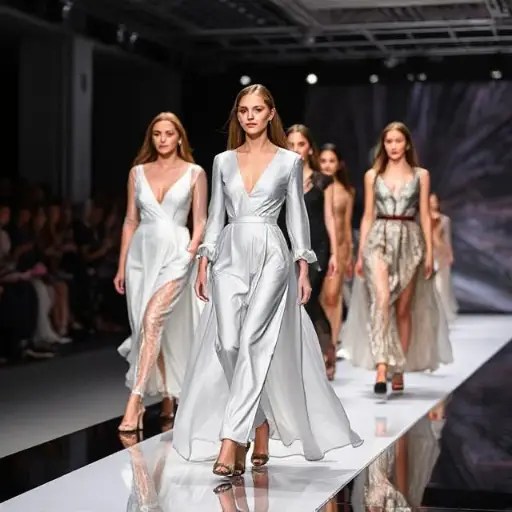
The British designer’s debut collection for the Italian luxury brand highlights artisanal roots and a shift toward soft functionality and subtle elegance.
Louise Trotter’s first collection for Bottega Veneta, presented during Milan Fashion Week, marked a significant shift for the Italian luxury brand. The show, held in the Piazzale Lodi area, featured a minimalist set with only gummy-colored Murano glass stools for guests, allowing the focus to remain on the clothing. This approach contrasted sharply with the more elaborate sets used by the brand’s former designer, Matthieu Blazy, who is now at Chanel.
Trotter, who joined Bottega Veneta in January 2025, has sought to highlight the brand’s deep artisanal heritage, emphasizing its origins as a Venetian artisanal shop. Founded in 1966 by Michele Taddei and Renzo Zengiaro in the northeastern town of Vincenza, Bottega Veneta has long been known for its high-quality, discreet, and elegant products. Today, craftsmanship remains at the heart of the brand, with products still made by artisans in Italian ateliers. This focus on craftsmanship was also central to the brand’s 2025 ad campaign — the first under Trotter — which featured the hands of its artisans and brand ambassadors, including Tyler the Creator, Jack Antonoff, and Zadie Smith.
Trotter’s designs centered on the concept of “soft functionality,” emphasizing the idea of wearing a bag without a logo and the confidence that such a choice requires. The collection featured a range of shoes, including heels, loafers, and clogs, as well as bags made with the brand’s signature “intrecciato” leather weave — all without obvious branding. The clothes themselves were tactile and engaging, with pieces like jacquard and leather outerwear, smart trousers, and experimental designs in vibrant colors and textures. The show’s soundtrack, composed by the British artist Steve McQueen, added an artistic dimension to the overall experience.
Trotter’s approach to design is rooted in her belief that the body should be treated as a canvas. Her designs neither cling nor hang off the body but instead act like sculptures, maintaining a graceful and flattering distance from the wearer. This philosophy was evident in the collection, which included pieces that appeared simple at first glance but had intricate details, such as a dress that came in two colorways (black and white) with one strap designed to fall off the shoulder.
Despite challenges faced by many global luxury brands in recent years, Bottega Veneta — which shares the same parent company as Gucci, Saint Laurent, and McQueen — has seen a slight sales increase in the first half of 2025. While Trotter’s impact on the brand’s performance remains to be seen, her ability to create desire for her designs is essential in an environment with such high price points and where people are increasingly preoccupied with more than just clothing. Her influence is already being felt, with many stylish individuals — both women and men, including Jacob Elordi — eager to wear her creations.
Trotter drew inspiration from Laura Braggion, Bottega Veneta’s first female creative lead, who was also part of Andy Warhol’s legendary art studio, The Factory, in New York. She explained: “I was imagining her journey, her freedom of being an archetypal Italian woman, moving to New York and that experience. It was a liberation for her, and that’s what I wanted to say.” This theme of liberation and transformation was woven throughout the collection, reflecting both Trotter’s vision and the brand’s evolving identity.




 The Tower Post