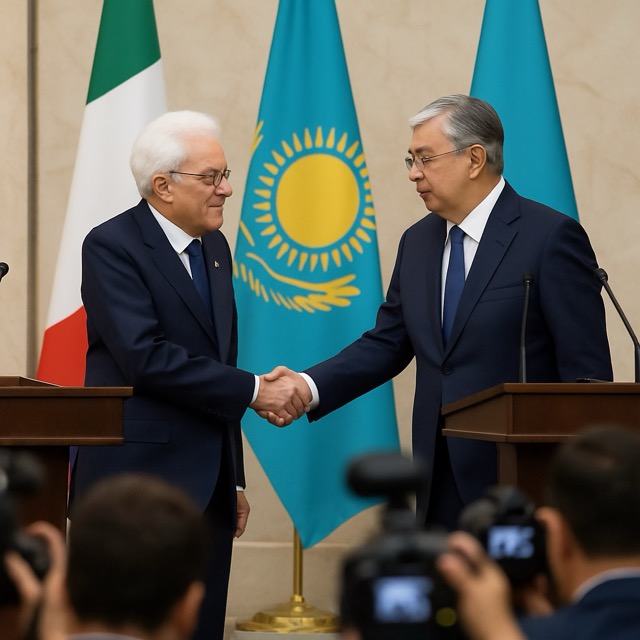
On a state visit to Kazakhstan, Italy’s president urges a return to multilateralism: “We thought recourse to force had been banished.”
ASTANA — Italian President Sergio Mattarella used a state visit to Kazakhstan to deliver one of his clearest appeals yet for de‑escalation and renewed multilateral cooperation, arguing that the world cannot afford a return to power politics. “It is important to refer to all possible efforts to bring peace to the world,” he said after talks with Kazakh President Kassym‑Jomart Tokayev in Astana, stressing “the equal dignity of every state.” He went further, warning of “the resurgence of unilateral behaviour and the use of military force—phenomena we hoped had been banished and were receding into world history,” remarks that resonated far beyond Central Asia.
Mattarella’s language—firm but measured—was calibrated for an international moment marked by overlapping crises and a growing fatigue with diplomacy. His call for “no more military interventions” and for a recommitment to rules‑based dialogue underscored Rome’s posture: support for international law and humanitarian principles, and skepticism toward coercive solutions that risk widening conflicts. The appeal also fit the setting. Kazakhstan, which has positioned itself as a convening power between East and West, provided a platform for the Italian head of state to link bilateral cooperation with a wider plea for restraint and institution‑building.
The visit, spread over two days in Astana, mixed state ceremony with a policy‑heavy agenda. The two leaders reviewed energy ties and industrial partnerships and discussed digital innovation, with Mattarella scheduled to tour the Astana Hub to see Kazakhstan’s expanding IT ecosystem. Symbolism threaded through the choreography: the president conferred Italy’s highest honor—the Order of Merit of the Italian Republic—on Tokayev, a gesture that both celebrated a long economic relationship and acknowledged Astana’s role as a pragmatic interlocutor in an unsettled neighborhood.
In public remarks, Mattarella returned repeatedly to multilateralism as both a norm and a tool. The equal standing of states, he argued, is not rhetorical flourish but a prerequisite for solving problems that no power can shoulder alone, from energy security and climate to artificial intelligence and disinformation. “Equal dignity,” he said, is the antidote to zero‑sum tactics that corrode trust and stall negotiations. The message tracked with Italy’s broader diplomatic messaging in recent months—support for international organizations, respect for sovereignty, and the defense of humanitarian law—while carefully avoiding any single frontline as a foil.
Context lent the words weight. Central Asia has become a corridor for trade, logistics and ideas as routes are redrawn by war and sanctions. Kazakhstan has sought to balance relationships with major powers while keeping open channels to Europe. Italy, for its part, is among the country’s top European economic partners, with energy firms, manufacturers and service companies present across the vast steppe. Although the visit emphasized economic continuity—accelerating cooperation in innovative sectors from renewables to advanced manufacturing—the subtext was stability: predictable rules, reliable corridors and dispute resolution through diplomacy rather than force.
At the joint appearance, the Italian president’s caution about the reappearance of military solutions touched a nerve. The language mirrored a sentiment increasingly voiced in European capitals: that the avalanche of crises risks distracting governments from “epochal” challenges—climate transition, demographic shifts, and the governance of emerging technologies. Mattarella’s formulation linked the moral case for peace with a practical one: societies cannot modernize, nor can supply chains be rerouted responsibly, under the shadow of escalation.
Diplomats traveling with the delegation framed the stop in Astana as a bridge to the wider region. From Kazakhstan, Mattarella is due to continue to Baku, Azerbaijan, where talks are expected to focus on energy networks and regional security. The sequencing—Astana followed by Baku—reads as a map of Italy’s calculus: engaging partners that sit at the crossroads of Eurasia while encouraging dialogue rather than confrontation. The itinerary also reflects a bet that medium‑sized powers, if networked through forums and institutions, can mitigate the centrifugal forces pulling at the international order.
Beneath the headlines, the visit also sketched a practical agenda. Italian and Kazakh interlocutors highlighted opportunities in AI and digitalization, green energy, agri‑food value chains and university exchanges. Astana’s innovation ecosystem, showcased at the Astana Hub, has become a calling card for the country’s diversification efforts; Italian companies are exploring complementary roles in software, industrial automation and clean‑tech components. Both sides signaled interest in making existing ties more resilient to shocks—through joint research, standardized procedures and deeper financial links—so that projects are not hostage to geopolitics.
Mattarella’s appeal for a cease to “military interventions” did not translate into neutrality. Italy remains aligned with international partners on sanctions and collective defense commitments. But the president’s emphasis pointed to a strategic preference: prevention over punishment, negotiation over coercion, and the patient work of alliance‑building over spectacular shows of force. The choice of words—invoking practices the world had hoped were “banished”—suggested a historical memory stretching from the Balkan wars to the Middle East and the post‑Cold War illusions that economic interdependence alone would deter conflict.
For Kazakhstan, the visit offered validation and leverage. Hosting a European head of state who speaks fluently about multilateralism amplifies Astana’s brand as a facilitator. For Italy, it reaffirmed a presence in a region where European diplomacy is often overshadowed by larger players. For both, it was a reminder that the language of peace is not a luxury add‑on to trade missions but a foundational element of prosperity.
In a region of shifting alignments, Mattarella’s voice carried the gravitas of a constitutional president: above day‑to‑day politicking, rooted in the legal and ethical architecture of the Republic, and cautious about commentary that could be mistaken for partisanship. That positioning allows him to speak credibly about principles without foreclosing the space for governments to negotiate specifics. By tethering his remarks to the vocabulary of the UN Charter—sovereign equality, peaceful dispute settlement—he turned a bilateral pageantry into a plea for systemic repair.
Whether the message lands will depend on follow‑through. The coming months will test whether the bilateral road map—a mesh of energy, tech and higher‑education initiatives—advances beyond communiqués; whether forums in Europe and Eurasia can absorb the shock of worsening conflicts; and whether mid‑sized powers can set positive precedents when great‑power dialogue falters. In Astana, at least, the case for restraint and rules was made with clarity. The applause, polite but steady, suggested an audience ready to listen. The harder task—turning listening into policy—begins now.
 The Tower Post