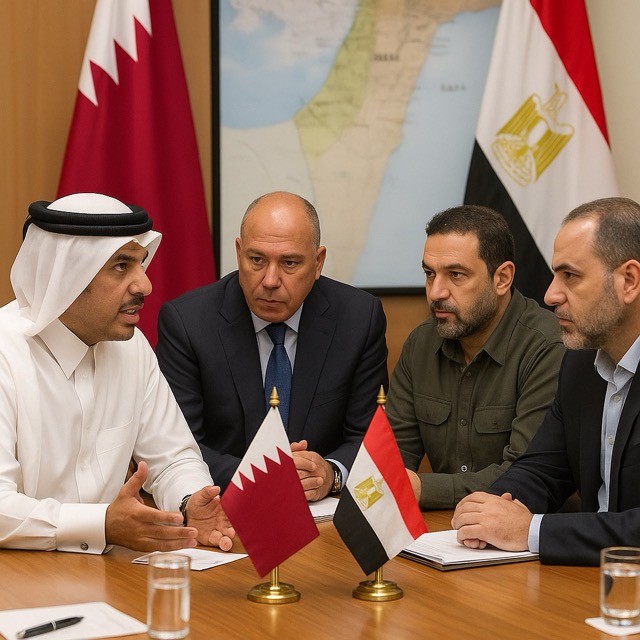
Qatar and Egypt brief Hamas on a U.S.-backed proposal as Washington signals “full backing” for Israel if the deal is rejected
Doha/Cairo/Washington — A new diplomatic push to end the Gaza war moved into a decisive phase this week after Qatar’s prime minister and Egypt’s intelligence chief presented a detailed proposal to Hamas negotiators, according to an official briefed on the talks. The militant group has indicated it will study the terms and respond, even as U.S. President Donald Trump publicly warned that Washington will give Israel its “full backing” to eliminate Hamas if the group refuses to accept the plan.
The outlines of the proposal, described by multiple officials and publicly promoted in Washington, point to a cease-fire framework paired with hostage-prisoner exchanges, staged Israeli withdrawals and strict benchmarks for demilitarization inside Gaza. It would install a transitional administrative arrangement with international oversight while laying groundwork for reconstruction and a longer-term political horizon for Palestinians. The pitch was relayed to Hamas in recent hours by Qatari Prime Minister Sheikh Mohammed bin Abdulrahman Al Thani and Egypt’s intelligence chief Abbas Kamel, who have served for nearly two years as the principal intermediaries between the parties.
In an appearance alongside Israeli Prime Minister Benjamin Netanyahu in Washington on Monday, Trump cast the moment as a binary choice for Hamas: accept the plan or face harsher consequences. “If Hamas won’t take this deal, Israel will have our full support to finish the job,” he said, framing the initiative as the most credible route to both an end to active hostilities and to preventing Hamas’s return to power. Netanyahu welcomed the approach, saying it met Israel’s core aims of dismantling Hamas’s military capacity and curbing the group’s political influence.
The language of ultimatum—and the choreography around it—are designed to compress the negotiating clock. A senior regional diplomat involved in the mediation said that while Hamas has been wary of provisions requiring disarmament and exile options for some cadres, the group’s political bureau also recognizes growing regional impatience and war-weariness in Gaza. “The message from the mediators is that this is the most generous security and reconstruction package on the table; a rejection will carry costs,” the diplomat said.
For Qatar and Egypt, the latest sprint reprises roles honed over successive rounds of crisis diplomacy since 2023. Doha maintains open channels to Hamas’s leadership while absorbing sustained criticism from Israeli officials; Cairo controls Gaza’s southern gate and has marshaled Arab consensus around cease-fire sequences that pair humanitarian relief with security guarantees. Together—often with the CIA director and Israel’s Mossad chief in the room—the mediators have walked the parties through granular disputes over the pace of Israeli drawdowns, the sequencing of hostage and prisoner releases, and the mechanics of enforcing demilitarization in a densely populated strip of land.
This week’s proposal attempts to bridge those gaps with a 20-point matrix, according to people familiar with its contents. It sets an immediate, time-bound cease-fire; front-loads the release of the most vulnerable hostages; and staggers IDF pullbacks against a ladder of verifiable steps from Hamas, including the handover of heavy weapons and the mapping of tunnel networks. To address Israeli domestic politics, the plan underscores that security oversight will remain robust during the transition. To address Palestinian concerns, it couples reconstruction funds with a technocratic, corruption-resistant administrative body and reiterates that Gaza’s governance will be Palestinian-led—not Israeli.
Trump has added personal branding to the diplomatic architecture, proposing an international board to supervise reconstruction and security, with the U.S. chairing and key allies—including some Arab states—participating. The White House argues that such imprimatur can accelerate donor commitments and discipline implementation. Skeptics worry the arrangement might muddy lines of authority or saddle Gaza’s civil institutions with outside veto players. If the deal survives first contact with the parties, mediators expect the most fraught arguments to center on who polices violations and how to unwind emergency measures, including buffer zones along the border.
Hamas’s calculus remains the wild card. The group has historically used deadlines to extract last-minute concessions and to test the resilience of political coalitions on the other side. But after months of intense fighting and a humanitarian catastrophe that has deepened international isolation, officials say Hamas’s leadership is weighing costs differently. “They know the battlefield trend is against them; the question is whether they accept demobilization in exchange for survival of their cadres and a path to relief for civilians,” said a Western official briefed on the exchanges.
For Netanyahu, the incentives and risks are symmetrical. The plan offers a feasible glide path out of an open-ended campaign that has strained Israel’s military, economy, and international standing. Yet he must manage a coalition where far-right ministers oppose concessions and reject any arrangement perceived as empowering Palestinian governance, even in technocratic form. Failure to secure Hamas’s buy-in would give hardliners leverage to press for expanded operations; success could trigger a fresh round of domestic political upheaval.
Arab capitals have responded cautiously but constructively. Several have signaled support for a deal that credibly ends major combat, returns hostages, and creates enforceable guardrails against Hamas’s rearmament. Qatar, bruised by months of public sparring with Jerusalem, has nevertheless doubled down on mediation, while Egypt frames the process as essential to stabilizing Sinai and halting further regional spillover. European governments, facing refugee pressures and political polarization at home, have urged Hamas to accept a deal and have pressed Israel to commit to verifiable steps that allow humanitarian access to scale.
On the ground, the correlation between words and reality remains tenuous. Israeli operations have continued even as diplomacy gathers speed, and aid groups warn that any cease-fire window must be long enough to reconstitute basic services—water, electricity, sanitation—and to secure the logistics corridors needed for reconstruction. Economists estimate that rebuilding Gaza’s housing, hospitals, and public infrastructure will cost tens of billions of dollars over several years, contingent on security conditions and administrative competence.
What happens next will hinge on Hamas’s formal response and the mediators’ ability to keep both timelines and expectations in sync. If Hamas signals acceptance in principle, negotiators are prepared to move quickly into textual drafting and operational planning, officials say. If the group hedges or rejects the package, Trump’s warning of “full backing” for intensified Israeli operations will be tested—along with the political tolerance of Israel’s partners and the humanitarian capacity of Gaza’s aid ecosystem.
For now, the diplomatic center of gravity sits in Doha and Cairo, where envoys are gaming contingencies hour by hour. The plan’s authors insist that, imperfect as it is, the proposal aligns carrots and sticks more tightly than previous rounds: meaningful reconstruction in exchange for irreversible demobilization; international guarantees in exchange for enforceable security benchmarks. In the coming days, the choice facing Hamas may be stark. But for millions of civilians for whom the word “deal” translates into food on shelves, medicine in clinics, and nights without explosions, the measure of success will be simpler still: a sustainable quiet—and the beginnings of recovery.
No single agreement can resolve every underlying grievance or erase the trauma of the past two years. But the mediators’ message—that this is the best window in months to trade guns for guarantees—has rarely been clearer. Whether that message is heeded will determine not only the fate of this proposal, but the political trajectories of the leaders who have staked their capital on it.


 The Tower Post