
As Russia escalates Shahed and decoy swarms, Ukraine bets on thousands of low‑cost, AI‑assisted ‘drone catchers’ to plug the short‑range air‑defense gap
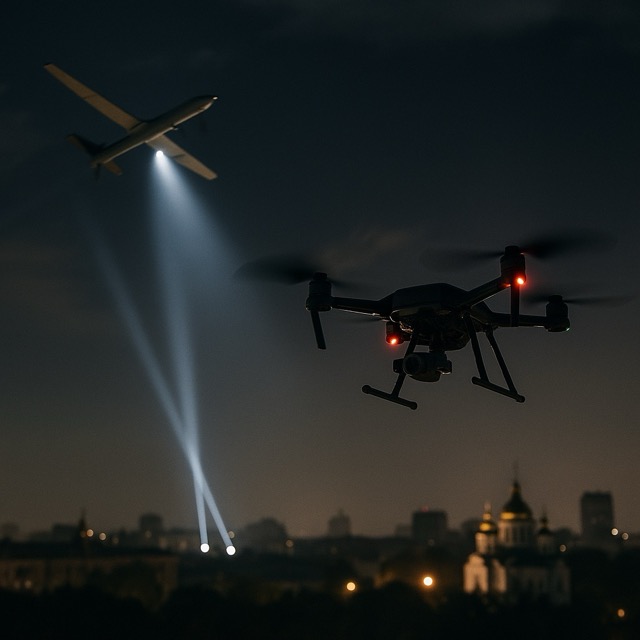
KYIV — The night sky over Ukraine’s capital no longer belongs solely to incoming threats. Increasingly, it is also populated by Ukrainian-made interceptors—stubby, high‑thrust quadcopters and fixed‑wing hybrids that climb into the darkness to hunt Russian Shahed‑type drones. For Kyiv, this drone‑versus‑drone fight has become the most urgent front in air defense: a race to field thousands of semi‑automated interceptors that can be launched in minutes, fly pre‑planned intercept geometries, lock onto targets with onboard vision, and then ram, net, or detonate against them. The aim is brutally pragmatic: replace million‑dollar missiles with thousands of agile robots priced in the low thousands.
The pressure is intensifying. Russia’s nightly salvoes—mixing one‑way attack drones with decoys and cruise missiles—are designed to saturate Ukrainian defenses. Newer Shahed variants fly higher, vary their profiles, and sometimes arrive in waves from multiple directions to exploit radar gaps. Ukrainian officials warn that the coming winter will bring even heavier drone barrages designed to target energy infrastructure. In this context, every inexpensive interceptor that can take a Shahed out of the sky frees up scarce surface‑to‑air missiles for higher‑end threats.
Ukraine’s answer is industrial as much as tactical. A rapidly growing ecosystem of domestic firms—coordinated through defense‑tech initiatives—has pushed out a family of low‑cost interceptors built around commercial components, heat‑ and electro‑optical sensors, and software that can track distinctive drone signatures. Some makers tout bullet‑shaped frames that trade endurance for raw acceleration; others use larger propeller disks for efficiency and stability in crosswinds. Several models can fly a semi‑autonomous intercept once cued by radar or acoustic pickets, reducing operator workload in the crucial seconds before collision. Unit prices, depending on payload and sensor fit, range roughly from two to five thousand dollars—orders of magnitude cheaper than a short‑range missile.
The cost logic is compelling. During mass strikes, Ukraine has sometimes fired surface‑to‑air missiles costing hundreds of thousands of dollars at drones assembled for a fraction of that. Interceptor drones flip that equation. If a $2,000–$5,000 autonomous quadcopter can destroy a $30,000–$50,000 Shahed—or force it to maneuver into guns or electronic traps—the defenders regain the initiative. Ukrainian developers claim hundreds of successful kills in recent months as these systems have moved from prototype into serial production and field use. European militaries are now taking notice, spurred by incidents of Russian drones probing NATO airspace and prompting debate over a ‘drone wall’ on the EU’s eastern flank.
For operators, the workflow is becoming standardized. A layered sensing network—short‑range radar, thermal cameras, passive RF and acoustic arrays—detects and classifies an inbound target. A tactical tablet recommends launch points and headings, and a pre‑programmed intercept profile sends the interceptor arcing into the Shahed’s flight path. Computer vision models trained on prop disc patterns, exhaust plumes, and navigation lights guide the final approach. Depending on the variant, the kill mechanism might be a reinforced nose for ‘air‑ramming,’ a net with drag parachute, or a small directional charge designed to shatter composite wings without spreading debris over a wide area. Because the last seconds are violent and GPS‑denied, onboard autonomy matters more than long‑range data link quality.
The electronics war is equally fierce. Russian jamming tries to blind sensors and corrupt navigation; Ukrainian interceptors respond with inertial dead‑reckoning, multi‑band receivers, and vision‑only terminal guidance. Developers have shaved milliseconds from control loops, added prop guards and sacrificial frames for survivability, and designed quick‑swap power modules so ground crews can turn birds around between sorties. On the back end, machine learning routines digest combat logs to refine intercept geometries and target‑recognition thresholds. The goal is not just more drones, but smarter ones that can be launched by lightly trained teams after a short familiarization.
Scale is the strategic variable. Ukrainian officials talk openly about producing interceptors by the thousands per week, arguing that nightly attacks require stockpiles measured in the tens of thousands over a winter campaign. The production model borrows from civilian quadcopter supply chains—standard motors, commodity flight controllers, 3D‑printed airframes where feasible—and reserves custom engineering for seeker heads and fuzes. Quality control is the bottleneck: a poorly balanced prop or under‑tested firmware can turn a $3,000 interceptor into a lawn dart. To mitigate risk, producers have introduced modularity and instituted rolling software updates synchronized with unit training.
Kyiv is also formalizing the mission set. This month, the Air Force moved to stand up a dedicated drone air‑defense branch to consolidate procurement, training, and tactics for interceptors and counter‑UAS sensors. Commanders describe a layered doctrine: guns and mobile fire teams for the low and slow; interceptor drones for the mid‑altitudes where Shaheds loiter; and missiles or fighters for the rare high‑altitude intruders. As ranges and speeds increase—Russia has teased a jet‑powered Shahed—the doctrine is evolving, with Ukrainian officials saying they already field interceptor types capable of engaging faster targets. The emphasis is on interoperability: plug‑and‑fight systems that can accept cues from NATO sensors while remaining resilient when links drop.
For allies, there is a lesson in tempo. Stockpiling exquisite munitions is useful, but salvo warfare rewards agility and adaptation. A procurement pipeline that can add or swap components within weeks, not years, may matter more than any single ‘silver bullet’ system. That mindset is spreading. European governments are evaluating Ukrainian interceptor designs for domestic production, and several have expanded funding for drone detection, mobile gun units, and training exchanges. Ukraine has proposed a joint aerial shield—shared sensors, shared doctrine, shared lessons—so that the know‑how accumulated over three grinding years can harden the rest of the continent against the next wave.
Risks remain. Automation raises thorny questions about rules of engagement in cluttered airspace; vision models can misclassify birds or civilian quadcopters; and debris falls somewhere. Developers are adding positive‑ID checks, geofencing, and abort‑on‑uncertainty logic to keep human vetoes in the loop. Meanwhile, Russia is iterating too, experimenting with decoys that mimic Shahed acoustics and radar signatures, and sequencing strikes so that drones arrive just as interceptors must cycle batteries or swap rotors. It is a chess match measured in watts, grams, and milliseconds.
Still, the contours of the near future are clear. As winter approaches, Kyiv’s factories and field workshops are working around the clock to fill shipping crates with semi‑automated interceptors. Every marginal improvement—a faster climb, a sturdier nose cone, a smarter seeker—translates directly into saved transformers, warmer apartments, and fewer funerals. The city’s defenders now listen for a different sound in the night: the rising note of their own drones, angling into the dark to meet the threat head‑on.



 The Tower Post