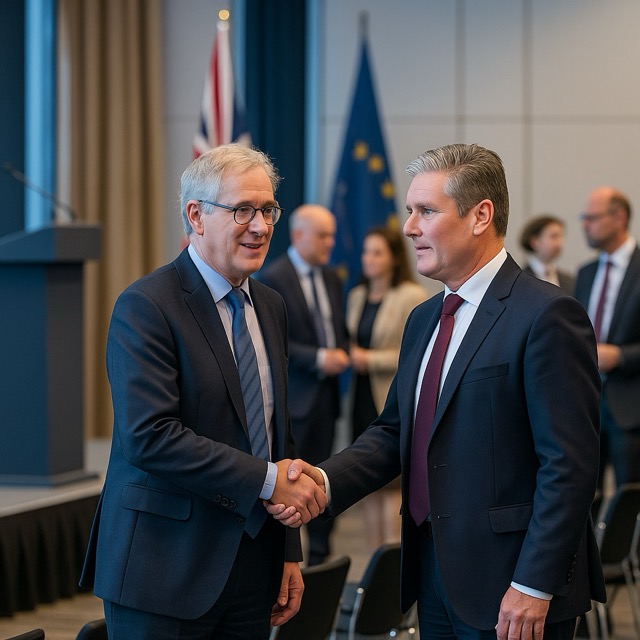
After a tricky first year in power, the prime minister’s bid to ‘get companies back on side’ left many executives asking what, exactly, has changed.

LIVERPOOL — Keir Starmer arrived at Labour’s annual conference this week promising a reset with corporate Britain. After a first year in government marked by tight money, fraying patience and a stop‑start reform agenda, the prime minister told business chiefs he wanted to ‘get companies back on side.’ Yet as the confetti settled, many of those leaders left more puzzled than persuaded.
It is not that access is a problem. Since the election, senior executives say Downing Street and the Treasury have opened more doors than any administration in recent memory. Roundtables multiply; ministers are on speed dial. What’s missing is the same commodity that business argued was missing under the last government: clarity. Executives describe a muscular rhetoric about partnership that collides with fiscal caution, shifting tax signals and a reform programme that is either undercooked or underfunded.
The mood music has grown louder as the fiscal backdrop has grown darker. With a sizeable shortfall pencilled in by official forecasters and pressure mounting across the NHS, local government and welfare, ministers have tiptoed away from their no‑new‑tax mantras. Hints of targeted levies to plug gaps—on betting firms, potential reversals of National Insurance cuts, and a longer, slower timetable for expensive commitments—have landed awkwardly in a corporate audience that had banked on stability above all.
At conference, Starmer framed the choice as ‘renewal or decline’. To win business back, he promised a ‘serious, practical partnership’ across planning, skills and investment. But much of the detail still sits on the runway. The flagship industrial strategy has progressed from green paper to white paper drafting but continues to rely on cross‑Whitehall coordination that historically proves elusive. The Planning and Infrastructure Bill is designed to speed approvals for housing and energy projects, yet secondary legislation and guidance—where the real delays fester—remain months away.
That gap between intent and implementation is where frustration grows. ‘We can’t calibrate five‑year capex on slogans,’ says the UK head of a European manufacturer. ‘Tell us the rulebook; we’ll play by it. But the rulebook keeps being promised for next quarter.’
Consider taxation. The chancellor’s Mansion House pitch to make the UK the world’s leading hub for financial services won applause—and a welcome focus on unlocking pensions capital for growth. But investors are still scanning for the fine print on capital allowances, the future path of corporation tax, and whether windfall logic could metastasise into a semi‑permanent surtax culture. Even a whisper of re‑opening the main tax levers is enough to chill boardrooms planning multi‑year investments.
On regulation, officials trail a 25% cut in red tape—an eye‑catching figure that begs a dull but vital question: 25% of what? Companies are not allergic to standards; they are allergic to uncertainty. A retail boss put it plainly: ‘Give me a clear compliance map and I’ll cost it. What I can’t cost is ambiguity.’
There are bright spots. Business rates reform has finally moved from conference fringes into genuine policy work; the apprenticeships system is being reshaped to address shortages from engineering to care; and the government’s courtship of foreign direct investment has produced a handful of marquee pledges in clean energy and advanced manufacturing. The prime minister’s message to visiting CEOs—Britain is open, predictable and pragmatic—lands well, especially set against turbulence in other major markets.
But the test that matters remains domestic investment—and here the signals compete. Starmer’s team talks about a decade‑long rebuild of the state’s capacity to deliver: planning officers, grid connections, digital procurement, predictable funding settlements. Business agrees with that long game, but wants near‑term certainty to justify moving projects off the shelf. That is why the absence of line‑of‑sight on tax and the timetable slippage on key bills has grated.
Politics, inevitably, intrudes. The government’s fixation on Nigel Farage’s Reform UK shapes conference set‑pieces and, some fear, policy sequencing. Pro‑growth bits that antagonise the party’s activist wing are tiptoed out; measures that poll well against Reform are accelerated. Business hears the argument for pragmatism but sees risk: if the centre‑ground economic program is constantly refracted through a partisan lens, predictability suffers.
So what would a ‘clearer’ Starmer offer sound like to the City and beyond? Three things, according to executives across finance, energy and manufacturing. First, a binding fiscal framework that outlives a single Budget—one that sets a credible debt path while ring‑fencing multi‑year investment allowances. Second, a transparent regulatory pipeline: publish a calendar that sequences consultations, draft rules and go‑live dates across planning, energy and data so companies can staff and spend accordingly. Third, a prioritised, costed industrial strategy that names a handful of missions—grid upgrade, housing density near stations, NHS digitisation—and funds the delivery muscle to execute them.
There is, to be fair, more continuity than rupture in Labour’s courtship of business. Whitehall is again speaking the language of ‘crowding in’ private capital; state venture funds are being tweaked to de‑risk first‑of‑a‑kind projects; and the pitch to unlock pensions into UK growth funds is finally moving from think‑tank fodder to term sheets. Taken together, this is a respectable supply‑side plan—if ministers can resist the temptation to keep rewriting it.
But conferences are about signals as much as spreadsheets, and those signals were mixed. The most repeated line in Liverpool—that tough decisions are coming—was honest, even overdue. It was not, on its own, a business plan. With the Autumn fiscal event looming and departmental pressures multiplying, the government must decide whether fiscal realism means targeted tax rises now or a slower, visible march to growth‑friendly consolidation. Either path can be explained. Neither can be muddled.
There is a paradox at the heart of Starmerism that executives have learned to live with but not yet to love: a lawyerly caution wrapped in the promise of technocratic delivery. It is steady and, after recent drama, maybe that is the point. But steady can shade into static if decisions are perpetually deferred. Business does not need fireworks; it needs firm ground.
The government still has assets to play. International partners see a serious interlocutor in London again. The civil service, under new leadership in key departments, is building delivery capacity. And there is cross‑party recognition that the UK’s growth puzzle—weak investment, thin productivity, over‑stretched infrastructure—cannot be solved without the private sector.
Yet the case that Starmer sought to make—‘we are on your side’—will only land when firms can read, in hard policy, what being ‘on side’ means: stable tax baselines, faster permits, and programmes that survive a headline cycle. Until then, the boardroom verdict on year one is measured rather than euphoric. ‘We’re still in—but we’re still guessing,’ says the CFO of a mid‑cap manufacturer. ‘Give us the rules of the game, then hold us to them.’
Business is not asking for special treatment; it is asking for consistent treatment. Starmer’s challenge in year two is to trade uplift speeches for unmissable signals—turning mission language into milestones. Do that, and the partnership he invokes will look less like courtship and more like a contract. Fail, and the confusion that trailed the conference will calcify into caution. For a government elected to ‘end the chaos,’ that would be the wrong kind of continuity.



 The Tower Post