As electricity becomes the new oil, the developing world may be a forerunner in co‑operating with Beijing
BEIJING/NAIROBI/SÃO PAULO — In the scramble to electrify everything—cars, factories, data centers and homes—power has become geopolitics. Not the oil-soaked kind that shaped the 20th century, but the quiet, relentless currency of the 21st: electrons. And no country has built more of the machinery that makes and moves them than China.
From photovoltaic cells and inverters to ultra‑high‑voltage (UHV) transmission lines, Chinese firms sit at the chokepoints of the clean‑energy economy. A decade ago, this might have been a story about export dominance alone. Today it is also a story about finance, standards and influence—especially across the Global South, where governments need megawatts now and can seldom afford to wait for Western supply chains or multiyear grant cycles.
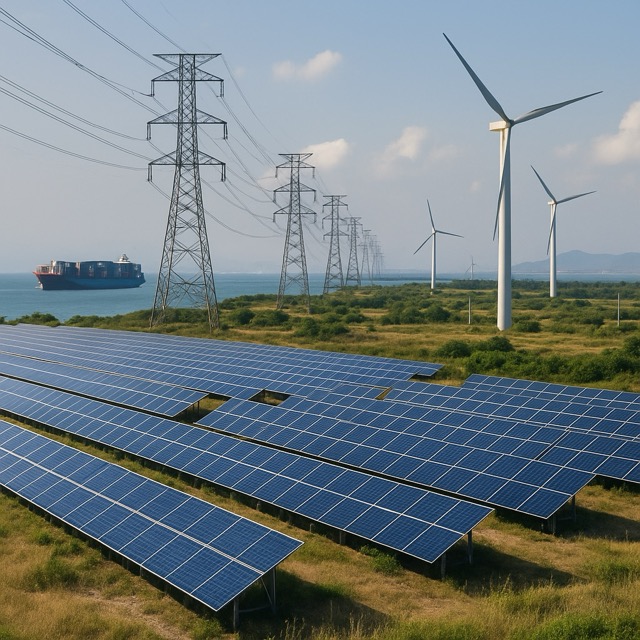
The numbers are stark. China was responsible for well over half of global demand for solar inverters last year, while homegrown champions Huawei and Sungrow together controlled a majority share of the worldwide market. Chinese factories also account for the lion’s share of the world’s solar manufacturing capacity from polysilicon to modules, which has driven panel prices to historic lows. For countries from Pakistan to Brazil, the result is that a solar plant sourced largely from China can be designed, financed and delivered in months rather than years.
Grid steel is the other half of Beijing’s strategy. As gigantic wind and solar bases bloom across China’s interior, State Grid and its suppliers have raced to stitch the country together with UHV lines that shuttle renewable power thousands of kilometers to coastal cities. That engineering playbook now travels abroad in pieces—from hardware to software, from grid‑forming inverters to dispatch algorithms—packing a promise many developing capitals find irresistible: rapid electrification with fewer blackouts.
The Belt and Road Initiative (BRI), once synonymous with highways and ports, is quietly tilting green. In the first half of 2025, overall BRI engagement hit record levels, and energy deals surged—with wind, solar and hydropower among the biggest winners. The shift is pragmatic as much as political: Chinese manufacturers face fierce competition and thin margins at home, and the Global South offers both demand and diplomatic leverage.
For policymakers in Nairobi, La Paz or Jakarta, the calculus is straightforward. Electricity demand is rising faster than public budgets. U.S. and European suppliers can offer quality and safeguards, but often at higher prices and with tighter export controls. Chinese offers typically arrive with concessional finance, bundled EPC contracts and a well‑oiled logistics chain. When the alternative is diesel generation and rolling blackouts, Beijing’s package looks less like dependency and more like a lifeline.
That appeal is sharpening as electricity becomes the new oil. In transport, the center of gravity has already shifted. Chinese carmakers dominate the world’s electric vehicle value chain; their batteries, motors and software are spreading across Southeast Asia, the Middle East and Latin America. In heavy industry, low‑cost solar modules and ever‑cheaper inverters are turning sun‑belt nations into potential hubs for green hydrogen and direct‑reduced iron. For mineral‑rich countries, joint ventures with Chinese firms promise more than raw‑ore exports: cathode plants, anode lines and battery assembly close to the mine gate.
Still, the arrangement is not painless. Trade defenses in the West—from tariffs on Chinese EVs to probes into subsidized solar gear—are splintering markets. Developing countries risk finding themselves caught in the middle, locked into standards from one bloc and barred from selling to another. Leaders in Brasília and Pretoria insist they want open markets and diversified supply; their procurement plans increasingly read like hedge strategies, mixing Chinese balance‑of‑plant with Western controls and local content rules.
The grid bottleneck is another hazard. As renewables surge, many countries lack dispatchable backup, reactive power support and modern control rooms. Chinese vendors are pushing grid‑forming inverters and digital substations as fixes, but successful integration requires regulatory reforms that outlast political cycles. Without them, solar parks become stranded assets and public opinion turns against the transition.
Finance is the pivot. Western public lenders have begun to wind down overseas fossil support, yet clean‑energy funding has not risen fast enough to fill the gap. China’s policy banks and commercial lenders have stepped in selectively—especially where projects can be collateralized with mineral offtake or sovereign guarantees. For small states with thin credit files, Beijing’s willingness to underwrite risk remains a decisive advantage.
Consider Africa. In Kenya, grid‑scale battery tenders now routinely include Chinese integrators, while Ethiopia’s industrial parks court Chinese panel makers to anchor export zones. In North Africa, developers weigh Chinese turbines and inverters against European supply to hit aggressive timelines for hydrogen pilots tied to EU demand. Across the continent, the race is on to electrify mines, refineries and ports—an ecosystem where Chinese firms already know the customers and can mobilize quickly.
Latin America tells a parallel story. Brazil’s utility‑scale solar boom was propelled by cheap Chinese modules and inverters; now the frontier is transmission. If Brasília can unlock right‑of‑way and permitting reform, consortia with Chinese equipment could link far‑inland sun and wind to industrial southeast load centers. Meanwhile, in the lithium triangle, provincial governors are pushing for midstream value—refining and cell assembly—that keeps more jobs onshore, even as they court Chinese capital.
Southeast Asia is betting on manufacturing. Vietnam and Thailand are courting Chinese EV and battery suppliers to build export plants; Indonesia is doubling down on nickel chemistries with Chinese partners while testing local content rules to ensure capability transfer. The more the region becomes a workshop for electrification hardware, the more its utilities will favor grid standards and service contracts compatible with that kit—a subtle but powerful form of alignment.
Critics warn of over‑reliance, pointing to debt concerns and the potential for political pressure. Proponents counter that the greater risk is delay: each year of under‑build locks in costlier fuel imports and missed industrial opportunities. The practical compromise now emerging is a kind of non‑aligned electrification—take Chinese speed and scale, pair it with stricter tendering, better disclosure and regional interconnectors that reduce any single‑supplier stranglehold.
Those interconnectors may be the most consequential arena of all. In a decarbonized economy, power flows will define trade in ways oil tankers once did. China’s UHV engineering edge, married to local financing and multilateral support, could help build the backbone for cross‑border electricity trade from the Andes to the Sahel to the Mekong. Where such lines go—and whose standards they follow—will shape who captures the value of cheap electrons.
In that sense, the green race is less a sprint than a build‑out. Beijing’s advantage is plain: its companies operate across the stack, from upstream minerals to grid software, and can underwrite projects at speed. For the developing world, the choice is not whether to work with China, but how—what to demand in transparency and jobs, what to standardize regionally, and how to keep options open as politics shift.
The lesson from oil’s century is that infrastructure begets influence. The lesson from today’s electricity age may be that influence accrues fastest to those who can turn policy into concrete, copper and code. On that measure, China is ahead. The question for everyone else is whether they can harness that momentum without surrendering their own.
© 2025. All rights reserved.


 The Tower Post