A reported fiction on how Finland faced the Bear in 1939 — and why the echoes matter now
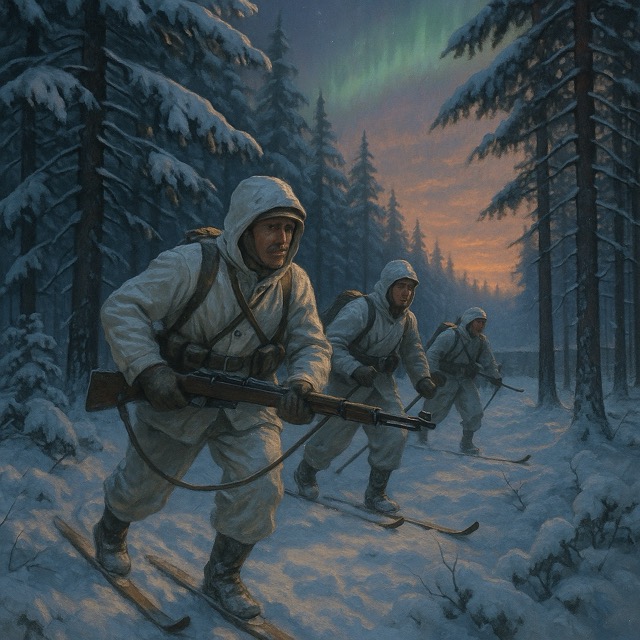
The first thing you hear is the cold. It crackles in the pines and bites at the rifle bolts; it squeaks under skis as a column of men ghosts through a corridor of blue snow. In this fictionalised reconstruction of a very real war, Lieutenant Aarne Korhonen—twenty-three, a postman from Oulu before mobilisation—raises a gloved hand. The line stops in perfect stillness. Somewhere beyond the timberline, engines growl. He glances at his sergeant, who mouths the same word that carried across the White Isthmus in the winter of 1939: ‘Halt.’
Finland’s Winter War with the Soviet Union has been told often, with maps and casualty tables and the tidy inevitability of hindsight. But read in the shadow of today’s anxieties, it feels less like history and more like a rehearsal. The questions that animated those months—the balance between small-state grit and great-power appetite, the geometry of deterrence, the stubborn arithmetic of logistics—have returned to Europe’s northern forests. This is a story told in the cadence of reportage and stitched with the thread of imagination: what it may have felt like to stand on skis at forty below, to be a citizen-soldier inside a geopolitics we recognize too well.
The day begins with the quiet industry of improvisation. Korhonen checks the white bedsheets that make a uniform out of laundry; he pats the pocket where a packet of sugar waits to sweeten melted snow. The men are not professionals but they are practiced: foresters, clerks, students, the sons of fishermen. Their rifles are cleaned, their toes are wrapped in newspaper. They carry the oddest secret weapon of the war—mobility. While tanks choked on the narrow forest roads, these amateurs learned to move like weather, arriving where maps insisted they could not.
Back at headquarters in Viipuri, a colonel runs his pencil along a line of pins. He knows the numbers are wrong. He does not have enough artillery, enough planes, enough sleep. But the geography is right: lakes and swamps and stands of spruce that carve the north into corridors. ‘We do not have to be strong everywhere,’ he tells a visiting minister, ‘only stronger where it matters.’ The phrase presents like doctrine; it is really a prayer.
By noon, Korhonen’s platoon melts into what modern commanders would call a kill box: a narrow road, a drifted bend, a rustle of spruce that conceals a half-dozen bottles of gasoline—homebrew and hope—stoppered with rags. The Soviet column arrives in iron syllables: clank, snort, clank. The first tank plows into the bend at a confident angle, muzzle sweeping the timber. A match flares like a firefly. Someone shouts ‘Now.’ There is a rushing roar, then light, then the strange silence that follows an explosion in deep snow. In the official histories, that tableau becomes a tactic with a handsome name—’motti,’ a woodcutter’s term for a log sectioned and isolated. In this retelling it is simply survival with a plan.
The platoon does not hold ground; it edits it. If the road is a sentence, the men remove verbs: bridges, culverts, fuel. The night returns with familiar stars and an aurora that feels like a weather report from another world. The men thread away, snow dusting their shoulders, the fatiguing grace of ski travel binding them into one long, breathing animal. A runner clicks into the command tent, shaking ice from his eyelashes, and whispers a conclusion brave armies have reached throughout time: ‘They stopped.’
What turned that pause into a reputation was not magic but management. It was the logistics of the small: a stove that fits inside a bread tin; a squad that can disappear behind one drift; a language of hand signals refined to the point of poetry. Our lieutenant keeps a notebook not for philosophy but for lists—how many rounds, how many feet of fuse, how long until the frost cracks rifle bolts again. He writes a letter to his mother and folds it so that the words do not touch the margins; he hopes the censor’s scissors will spare the meat of it.
In Helsinki, there are debates and denials, negotiations that cast long shadows across short afternoons. Newspapers print maps that look like puzzles missing crucial pieces. Somewhere in the middle of it, a child asks, ‘Why do the men wear sheets?’ The answer is as prosaic as it is profound: because camouflage is cheaper than armor, because autonomy is dearer than cloth. The city is tense but functioning—pinched cheeks, brisk steps, a sense that history has become a civic project executed on skis and in coal cellars.
Not every page of this winter is clean. Our story has blood in it and hunger and the hard premise of conscription. A firefight leaves a trench full of splinters and spent brass; a supply sled overturns and is not found until spring. A nurse stitches a cheek where shrapnel has written its own punctuation. There are errors—always there are errors. A unit turns left when the plan said right; a courier misses a rendezvous; frostbite remaps a future. The war, even when told as a fable of cunning, is still a grindstone.
On the Isthmus, the colonel’s pins advance and retreat like tides. He sends a telegram to a general that is both a report and an allegory: ‘Small fires can hold a great forest if the wind is ours.’ It is a lesson that travels easily into the present. In the era of satellites and swarming drones, the math has become more complex but the variables rhyme—terrain, timing, tempo, morale. The value of a citizenry trained to move and shoot and repair. The folly of underestimating a neighbor who has winter for an ally.
Toward the end of our reconstructed winter, Korhonen’s squad is assigned the kind of mission that knots a stomach: stay behind, watch the road, slow the inevitable. They select a thicket that appears designed by Providence: a shallow saddle, spruce so dense it feels like a curtain, a drainage that will carry the breath and sound away from the kill zone. The men eat their last hard candy and talk quietly about raspberries in July. When the enemy appears, it is not as a faceless horde but as tired men riding atop cold metal, stamping their feet. War reduces everyone to physiology in the end—warmth, calories, sleep.
The ambush they spring is not perfect. The first bottle wobbles in flight and bursts short; the second takes; the third refuses to ignite; the fourth crowns a turret and pours fire into an open hatch. The road becomes a theater of sickly light, shadows lurching like actors missing cues. The squad withdraws in pairs, as trained, pausing to listen and to count. In the trees, a private kneels to adjust his binding and finds his fingers have turned wooden. He rubs them until the nerves return with the brutal fizz of reentry. He does not believe in destiny, only in the next ridge and the next hour.
Afterwards, the platoon’s report is slim and apologetic. They estimate damage, note losses, and add footnotes about ammunition and temperature. The colonel will clip the report to a file heavy with similar papers—one more snowflake in a storm that, taken together, buried an invading timetable. He knows that strategy never arrives as an epiphany; it accretes from small competencies, from thousands of decisions made correctly enough.
In this fiction, Korhonen survives. He returns to his post route and finds the streets longer than they were, the doors thinner. He carries mail to widows and to boys who will soon be men. He keeps a pair of skis in his shed as if they were a spare set of lungs. Sometimes, when the lake freezes black and clean, he skates in a trench coat and cap, and the cold sings that familiar note.
The parallels to the present do not require stretch or sermon. Today, northern Europe is again a hinge where geography meets will. New alliances redraw deterrence across forests and fjords. Satellites float where watchtowers once stood; glide bombs replace mortars; but the old truths persist. A small country’s best defense begins long before the shooting: in roads arranged to confuse, in citizens who can repair radio masts and read a map, in leadership that trusts sergeants as much as speeches. Preparedness is not an act of paranoia but of citizenship.
There is also a lesson about stories. The Winter War endures in part because it offers a usable past: a tale in which improvisation defeats overconfidence, in which weather is an ally, in which humor survives in foxholes. But the danger of myth is complacency. No one is invincible in the long arithmetic of history. The real men and women of 1939 won neither a Hollywood victory nor a nihilist defeat; they negotiated time with courage and suffered for every hour they bought. The modern echo is not triumphalism but sobriety: security is a practice, not a posture.
Our lieutenant, older now and invented from fragments, steps out of this narrative the way he stepped into it—on skis, into weather. He leaves us a ledger of cold facts and warm gestures: the mittens shared, the stove coaxed into life, the bottle filled and lit, the compass checked twice, the retreat conducted without panic. These are homely assets, and in northern latitudes they are as valuable in 2025 as they were in 1939.
On the last night of our composite winter, the sky opens with pale curtains of light. The men are quiet, not because they are poetic but because breath is precious. Somewhere far off, an engine coughs and the noise drifts—directionless, diminished. The sergeant taps Korhonen’s sleeve and points to a gap in the spruce. ‘There,’ he says. It might be an enemy. It might be a fox. It might be, as so often in history, a test. The squad lifts their poles and slides forward into the whiteness, balanced between fear and competence, a posture that feels, even now, like a nation’s best defense.
 The Tower Post