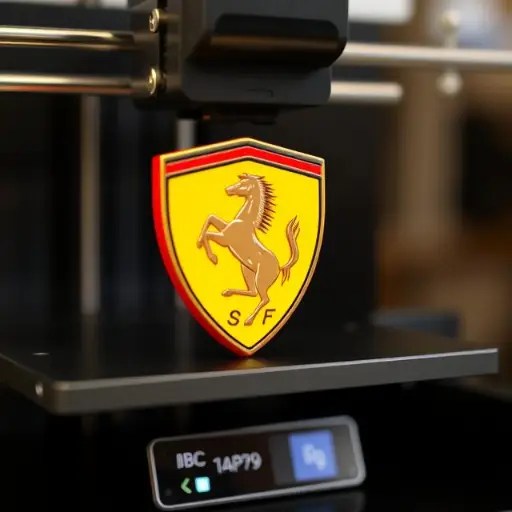
Additive manufacturing is pushing the boundaries of automotive design and performance, starting with high-end models like the Ferrari F80.
The automotive industry is undergoing a transformative shift with the integration of 3D printing for structural components in road cars. Ferrari’s F80, the brand’s first road vehicle to feature 3D-printed upper suspension triangles, exemplifies this leap forward. This innovation not only enhances design flexibility but also significantly reduces weight, potentially redefining performance benchmarks for luxury sports cars.
Traditional manufacturing methods, such as casting and machining, often impose limitations on the shape and structure of mechanical components. However, 3D printing, or additive manufacturing, allows designers to create complex, optimized structures that use material only where necessary. Ferrari’s F80 benefits from a process known as “topological optimization,” enabling the creation of intricate shapes like hollow structures with thin walls or honeycomb patterns. These designs can reduce component weight by up to 50 percent, offering substantial performance advantages.
The additive manufacturing process typically involves “laser powder bed fusion,” where a thin layer of metal powder—often an aluminum-titanium alloy—is melted by a laser according to a predetermined pattern. This layer-by-layer construction continues until the entire component is formed. While the process can be time-consuming, especially for larger parts, it is highly material-efficient and eliminates the need for initial mold investments, making it ideal for limited-series production.
Ferrari’s F80 is part of a limited run of 799 units, a production volume that aligns well with the high costs associated with 3D printing. The exclusivity of such models allows manufacturers to justify the investment in cutting-edge technologies, even if they are not yet economically viable for mass-market vehicles. For now, 3D printing remains a hallmark of high-performance engineering and innovation.
In addition to Ferrari, other high-end manufacturers like McLaren and Bugatti are also exploring the potential of 3D printing in their supercar designs. The technology is particularly appealing for reducing unsprung mass, which can significantly improve handling and performance in ultra-high-performance vehicles. As the technology matures, it is expected to become more accessible and cost-effective, potentially expanding its use to more mainstream automotive applications.
Despite the high costs and time involved, the exclusivity of supercars justifies the use of such cutting-edge technologies. Ferrari’s F80 is a prime example, where the pursuit of maximum weight reduction aligns perfectly with high-performance goals. As the technology advances and becomes more cost-effective, it may eventually extend beyond high-end models, though for now, it remains a hallmark of exclusivity and innovation.
As other high-end manufacturers like McLaren and Bugatti explore similar applications, the future of automotive engineering is being reshaped by the possibilities of 3D printing. Whether this technology will become the norm across the industry remains to be seen, but one thing is certain: it is already redefining what is possible in automotive design and performance.




 The Tower Post