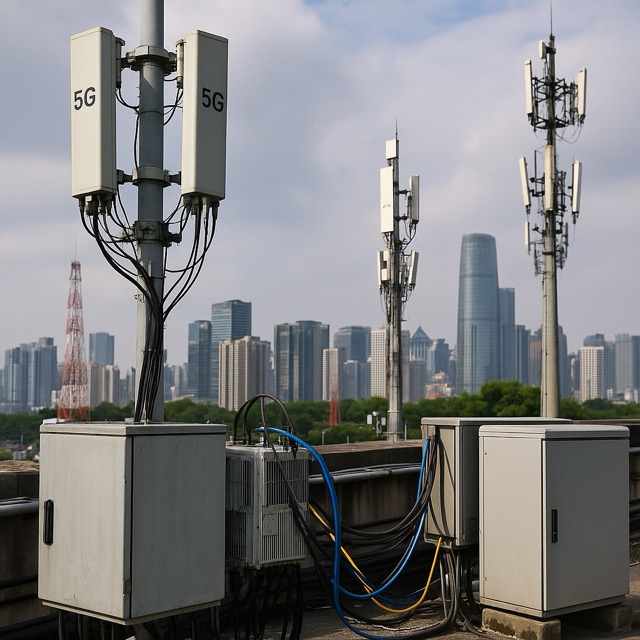
As Xi Jinping intensifies a drive for technological self-reliance, foreign telecom bids face opaque national-security vetting that slows approvals and shifts market share to domestic rivals

BEIJING/BRUSSELS — China is tightening the screws on European telecom gear makers Nokia and Ericsson, requiring their bids for network contracts to undergo lengthy “black box” national-security reviews as President Xi Jinping pushes to reduce reliance on Western technology in critical infrastructure. The move, which industry executives say has accelerated this year, adds new friction to an already shrinking corner of the world’s largest telecom market still open to non-Chinese suppliers.
Under the stepped-up regime, state-backed buyers — including China’s big mobile operators and utilities — must submit procurement involving the two European vendors for security checks by the Cyberspace Administration of China (CAC). Companies are not told how their equipment is assessed, what data points are weighted, or how to remedy concerns, according to people familiar with recent tenders. In parallel, public purchasers have been instructed to demand exhaustive documentation, down to component-level bills of materials and the percentage of local content, people involved in the process say.
While foreign suppliers have long faced headwinds in the mainland, executives and analysts describe the reviews as a potent new bottleneck. Even when projects are technically approved, the extra steps can introduce months of delay, giving an edge to domestic rivals exempt from equivalent scrutiny. “Time kills deals,” said one industry consultant who advises on China bids. “If you’re waiting for a green light that may or may not come, operators will default to vendors they know will pass on day one.”
The shift lands at a sensitive moment in the geopolitics of 5G and its successor technologies. In Europe and the United States, policymakers have spent years curbing Chinese champions Huawei and ZTE over security concerns, with some countries funding “rip-and-replace” programs to strip Chinese gear from networks. In Beijing, officials have invoked the same national-security rationale to argue for tighter control over foreign inputs — and, increasingly, for eliminating them altogether in core networks and strategic sectors.
Beijing’s legal scaffolding has thickened since 2021, culminating in updates that widened the scope of cybersecurity reviews and codified the concept of “critical information infrastructure.” Procurement tied to such systems can be pulled into CAC-led vetting that is opaque by design, people familiar with the procedures say. The result, industry figures contend, is a de facto localization drive that rewards Chinese suppliers and sidelines outsiders even when bid prices and technical scores are competitive.
The market impact has been stark. According to estimates cited by industry researchers, Nokia and Ericsson’s combined share in China’s mobile network equipment market has dwindled from the low double digits five years ago to the low single digits last year as operators leaned into domestic ecosystems. Ericsson and Nokia still derive small portions of their global revenue from China — mid-single digits, by some analyst tallies — but executives now speak of the mainland as a constrained, unpredictable market rather than a growth engine.
For Beijing, the calculus is broader than telecoms. Xi’s slogan of “self-reliance and self-strengthening” in science and technology has been elevated in party documents and echoed across provincial plans. The emphasis dovetails with industrial policies that prioritize indigenous innovation, higher local content, and greater control over data flows. Telecom networks — the circulatory system for the digital economy — sit near the center of that agenda.
At the same time, Chinese operators are pressing ahead with upgrades such as “5G-Advanced,” a mid-cycle leap billed to deliver higher speeds and industrial features like network slicing. Domestic vendors have dominated recent rounds of base-station tenders, and state media has burnished those wins as evidence that homegrown solutions can meet national needs without foreign risk. That narrative, executives say, reinforces procurement preferences that are already shifting due to policy.
For European policymakers and corporate leaders, China’s posture poses a thorny reciprocity problem. Many EU states have restricted Chinese telecom vendors — though implementation has been uneven — while simultaneously pushing for market access in China. Business groups warn that tightening “black box” reviews will further narrow that access. Several Europe-based executives said they now treat China bids as optional, focusing instead on North America, India, and parts of Southeast Asia where policy and financing conditions are clearer.
Nokia and Ericsson declined to comment on specific tender processes but have previously said they comply with local laws and work to safeguard customers’ networks. Privately, executives say they are calibrating China exposure to reflect the risk that orders, even when initially awarded, can be derailed late in the review phase or reshaped to favor domestic content. The companies have also emphasized growth in private wireless and enterprise networks outside China to offset carrier spending slowdowns.
Within China, the security reviews ripple beyond mobile operators. Grid operators, municipal authorities, and state-owned enterprises running ports, railways, and energy facilities are increasingly classified as stewards of critical infrastructure. Their purchases of routers, switches, optical transport and timing systems can also be swept into vetting regimes, further constraining opportunities for foreign vendors across the stack.
The regulatory uncertainty is reshaping supply chains, too. Foreign bidders report more requests to localize manufacturing, software support, and testing; to disclose source code under escrow; and to commit to onshore data handling. Several note a growing expectation that production of sensitive modules takes place in-country with verifiable audit trails. Those terms raise costs and, for some products, are incompatible with global platforms designed to be uniform across markets.
There are risks for Beijing. Overly rigid procurement could limit exposure to diverse technologies and increase single-vendor dependence, a vulnerability that European and U.S. authorities have cited in their own critiques of China’s tech model. Some Chinese academics and industry veterans warn that insulating domestic players may slow innovation over time if international competition is squeezed out of tenders. So far, however, the political momentum favors security-first policymaking, even at the expense of openness.
Foreign governments are taking note. Brussels has tested new tools to press China for reciprocal access in public procurement and has encouraged member states to implement 5G security guidance more consistently at home. Washington, for its part, continues to tighten export controls on advanced chips and certain telecom technologies while funding the removal of restricted Chinese equipment from U.S. networks.
For now, executives expect the gap to widen. As China lays out plans for next-generation network upgrades and industrial connectivity, the combination of opaque reviews, local-content obligations and geopolitical tension suggests limited room for a rebound by European kit makers. The result, analysts say, is a world in which telecom supply chains — once touted as global and interoperable — are splitting into blocs aligned to national security priorities.
In the near term, that fragmentation will raise costs for operators who must design, test and maintain networks around incompatible equipment bases while ensuring security compliance. Over the longer horizon, it may shape standards-setting bodies and fragment ecosystems for applications from autonomous logistics to telemedicine. For many in the industry, the question is no longer whether decoupling is happening, but how far and how fast it goes — and whether a cycle of reciprocal restriction leaves everyone with less choice and slower innovation.
As one veteran of China bids put it: “We used to talk about speed, coverage and price. Now the first line on every slide is compliance.”




 The Tower Post