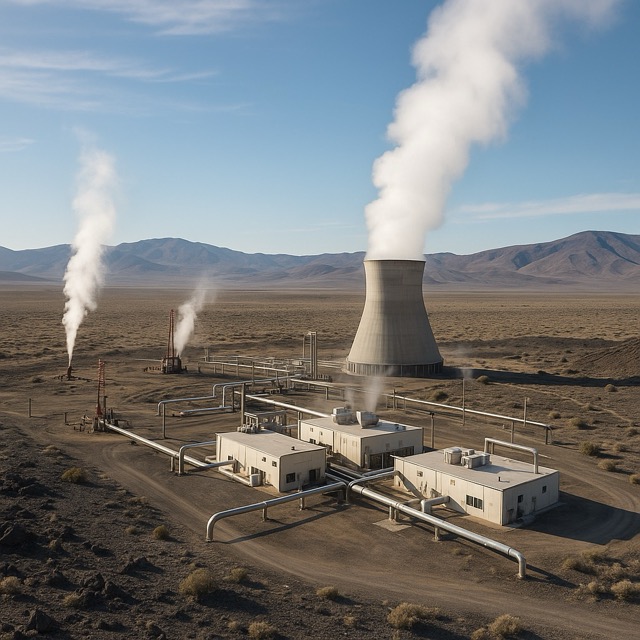
Once confined to volcanic regions and district heating, a new wave of ‘enhanced’ techniques aims to make clean, always‑on geothermal available almost anywhere
Geothermal energy today supplies less than half a percent of global energy demand. Most of that contribution comes from district heating and industrial heat rather than electricity, and it is concentrated in places where the planet’s heat is easiest to tap — volcanic islands, tectonic rifts, and sedimentary basins with natural hot fluids. Yet an old idea with new tools is gaining momentum: using high‑precision drilling, stimulation and reservoir management techniques adapted from oil and gas to unlock heat almost anywhere.
The pitch is simple but radical. Instead of searching for rare, naturally permeable rocks that send hot water gushing to the surface, engineers propose to make their own underground radiators. By drilling two or more deep wells and carefully creating a network of tiny fractures between them, water can be circulated through hot, tight rock, picking up heat before returning to the surface to spin a turbine or feed a district heating loop. This approach, known as Enhanced Geothermal Systems (EGS), borrows liberally from horizontal drilling, hydraulic fracturing, microseismic monitoring and flow control perfected in shale plays over the past two decades.
For investors and policymakers hunting for clean, dependable power, the allure is ‘always‑on’ energy that behaves like a conventional generator. Unlike wind or solar, geothermal output is not tied to the weather or daylight. That makes it a valuable partner for grids balancing growing shares of variable renewables. The challenge has been cost and risk: drilling several kilometres down is expensive, and until very recently there were few proof points that engineered reservoirs could deliver commercial‑scale flows without triggering unacceptable seismicity.
Those proof points are beginning to arrive. In the United States, a consortium anchored by Fervo Energy has demonstrated engineered geothermal in the high desert of Nevada and advanced development plans in Utah, while signing a 115‑megawatt supply arrangement with Google and NV Energy to deliver round‑the‑clock clean electricity to data centres. These projects adapt oilfield‑grade tools — multistage stimulation, fiber‑optic sensing, and real‑time microseismic monitoring — to build predictable subsurface heat exchangers. Early operating data have shown sustained flow rates and temperature profiles consistent with multi‑year baseload generation, addressing a key bankability hurdle.
Beyond EGS, several companies are racing to reach the superhot rock regime, where temperatures exceed 400°C and water becomes a highly efficient ‘supercritical’ working fluid. At those conditions, a single well pair could, in theory, produce several times the power of conventional geothermal. Start‑ups such as Quaise Energy are testing millimetre‑wave drilling systems designed to vaporise rock and open boreholes far deeper and hotter than conventional drill bits can manage, with field demonstrations on repurposed oil rigs in Texas. If successful, superhot geothermal could compress the footprint needed for a gigawatt‑scale development and slash levelised costs.
Europe, jolted by the gas crisis and determined to decarbonise heat, is moving quickly on the policy front. Germany has proposed legislation to speed permitting for geothermal heat networks and grant them ‘overriding public interest’ status, aligning approvals with wind and solar. The Netherlands, France and the Nordic countries are scaling up deep‑heat projects for cities and industry, while Iceland remains a laboratory for cutting‑edge drilling and reinjection practices. In parallel, the U.S. Department of Energy’s Enhanced Geothermal Shot aims to cut EGS power costs by as much as 90 percent by the mid‑2030s, funding the Utah FORGE field laboratory that is steadily ticking off technical milestones such as precise inter‑well connectivity and faster, cheaper drilling.
Still, engineering the subsurface is as much art as science. The risk envelope for induced seismicity remains tightly watched, particularly in regions with a history of tremors linked to wastewater disposal or geothermal stimulation. Developers emphasise they are not ‘fracking for hydrocarbons’: pressures, fluid volumes and treatment chemistries differ, and projects are designed to create controlled, self‑limiting fracture networks rather than long‑distance pathways. Continuous microseismic imaging and traffic‑light systems — again borrowed from the oil patch — can throttle operations if activity rises above regulatory thresholds. Ultimately, social licence will hinge on transparent monitoring and collaboration with local authorities.
The business model is also evolving. Because geothermal plants can run flat‑out for decades, offtake contracts increasingly focus on ‘24/7’ clean power — matching supply with demand hour‑by‑hour rather than as annual totals — a metric prized by data‑centre operators and heavy industry. Utilities are experimenting with clean‑firm tariffs that blend multiple resources to meet that round‑the‑clock standard. Oilfield service giants see a pathway to redeploy crews and rigs as drilling programmes scale; their supply chains, subsurface software and well construction experience could compress timelines and lower risk for early movers.
Closed‑loop systems, another branch of the innovation tree, avoid rock stimulation altogether. Instead they circulate fluid through sealed, engineered wellbores that snake through hot rock, transferring heat by conduction. While power densities may be lower, the approach could open markets where stimulation is politically or geologically constrained, and it offers a modular, repeatable template akin to manufacturing rather than bespoke field development.
What would success look like? Analysts point to a sequence familiar from shale: Step one is a handful of compelling pilots that prove thermal output and reservoir longevity. Step two is a factory model to repeat wells economically, with learning curves driving costs down each campaign. Step three is an ecosystem of financiers, insurers and grid offtakers comfortable with the risk profile. If that happens, geothermal’s share could climb from today’s sliver to a meaningful slice of electricity in the 2030s, while delivering vast quantities of clean heat for cities, greenhouses and industrial process steam.
None of this will be easy. Subsurface surprises can derail schedules, and each basin poses unique geomechanical puzzles. Early projects will need thoughtful regulation and public engagement, particularly where drilling intersects with scarce water or sensitive aquifers. Workforce development is another constraint, though here the oil and gas connection is an advantage: many of the same geoscientists, drilling engineers and completions crews can pivot to geothermal with modest retraining. And unlike wind and solar, where hardware is dominated by global manufacturing, geothermal creates local jobs in the communities where it is built.
The broader energy system will benefit if geothermal fulfils even part of its promise. Firm renewables shrink the need for long‑duration storage and can defer expensive grid reinforcements designed to shuttle variable power across great distances. In heating, district systems anchored by geothermal can decarbonise dense urban neighbourhoods more efficiently than building‑by‑building retrofits. For countries without hydro resources or constrained by land and wildlife impacts, deep heat offers a small surface footprint and minimal visual intrusion once drilling is complete.
After a decade in which geothermal felt like the perennial ‘next big thing,’ 2025 finds the sector at an inflection point. The enabling technologies — sensing, drilling, stimulation and subsurface modelling — are proven in adjacent industries and are now being adapted to harvest heat instead of hydrocarbons. Early commercial contracts are stacking up, public funders are underwriting first‑of‑a‑kind risks, and regulatory frameworks are loosening in response to energy‑security and climate goals. The earth’s heat is effectively inexhaustible on human timescales. The question is whether we can learn to tap it with the same repeatability and pace that unlocked shale — and do so with the care and transparency that communities deserve.
If the industry can thread that needle, the next time we talk about geothermal it won’t be as a niche resource from exotic volcanic locales, but as a backbone of clean power and heat — engineered almost anywhere, humming quietly under our feet.


 The Tower Post