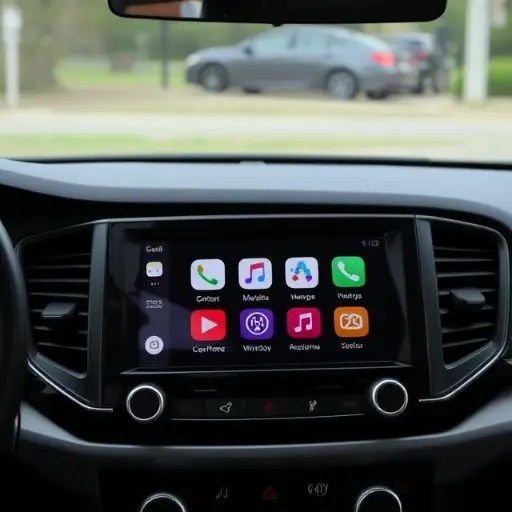
As Apple expands its CarPlay Ultra reach, Ford’s Jim Farley emphasizes the need for clarity and balance in vehicle-software integration.
Ford’s CEO Jim Farley has expressed cautious optimism regarding Apple’s latest CarPlay Ultra, acknowledging that while the company is committed to Apple, it is not fully impressed with the first iteration of the upgraded phone mirroring system. In an interview on Decoder, Farley said Ford is taking a wait-and-see approach before authorizing CarPlay Ultra in its vehicles. Apple launched the system earlier this year in models from Aston Martin, with Porsche expected to follow. The upgraded system aims to offer deeper integration with vehicle functions, allowing users to control features like climate settings and drive modes directly from the CarPlay interface.
However, Apple has yet to announce any additional automakers beyond Aston Martin and Porsche, a delay that may be due to concerns from other manufacturers who are pursuing their own software modernizations. Farley noted that Ford is still committed to consumer choice and has no plans to limit access to CarPlay or Android Auto. He emphasized that Ford wants to avoid creating unnecessary barriers between customers and their preferred digital experience, stating, “We don’t think we should restrict that to make money off the customers.”
In contrast, General Motors recently blocked phone projection services in its electric vehicles, a move that has drawn criticism from customers who prefer the digital experience on their phones. Farley said Ford aims to avoid such barriers, ensuring a seamless digital experience for its customers. He also highlighted that Ford is working on enhancements to the digital experience of Google and CarPlay, aiming to add features that improve upon the existing systems.
Farley also raised concerns about the extent of Apple’s integration with vehicle functions, asking, “How far do you want the Apple brand to go?” He questioned whether Apple would want to control functions such as starting the car, limiting speed, or restricting access. “If Apple wants to do that, I think we’re going to have a tough time with that, because then the digital experience gets really messy,” he said.
Ford’s new Digital Experience platform was designed to enhance the phone mirroring experience by allowing customers to maximize CarPlay to fit the entire screen. The company is also exploring ways to add features on top of the existing digital experience of Google and CarPlay, aiming to provide a more comprehensive and user-friendly interface.
This cautious stance from Ford reflects a broader industry conversation about the balance between third-party integration and maintaining the core functionality and control of the vehicle itself. Other automakers, such as Mercedes-Benz, have also expressed concerns about Apple’s ambitions, with CEO Ola Källenius previously warning about the risks of ceding too much control to third-party platforms.
Apple’s CarPlay Ultra represents a significant evolution in in-car infotainment systems, but its adoption by major automakers remains uncertain. While Ford remains open to the technology, it is seeking clarity on how Apple intends to integrate with the vehicle’s core systems. Farley’s comments suggest that Ford is not ready to fully embrace the system until Apple provides more transparency and reassurance about the boundaries of its integration.
As the automotive and tech industries continue to converge, the relationship between automakers and software providers like Apple will likely remain a key point of discussion, shaping the future of in-car technology and user experience.



 The Tower Post