Inside the civilian armada testing the world’s red lines off Gaza
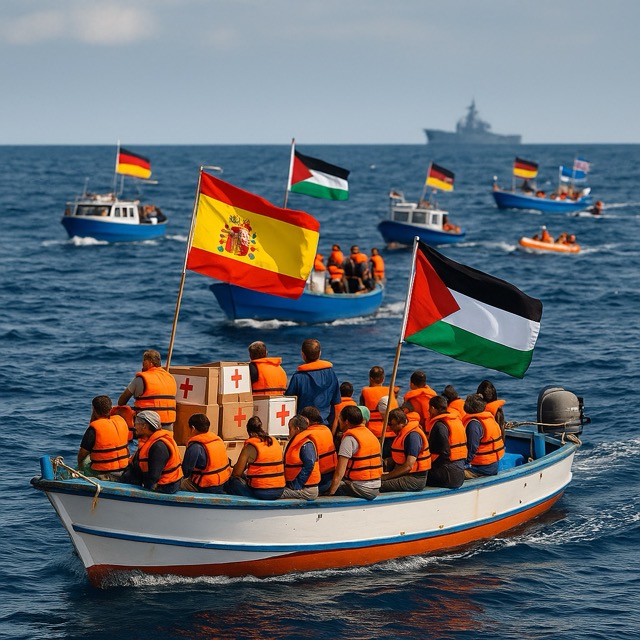
CATANIA, Sicily — On a warm late-September morning, a ragged procession of yachts, fishing vessels and refitted ferries slipped out of a lava-stone harbor at San Giovanni Li Cuti and pointed their bows southeast. Together they formed the latest and largest civilian attempt in years to breach Israel’s maritime blockade of the Gaza Strip — a sprawling, loosely coordinated effort that organizers have dubbed the Global Sumud Flotilla, or simply, the “Global Flotilla.”
By week’s end, organizers said, more than forty boats carrying some five hundred people from over forty countries were sailing in staggered groups across the Ionian and into the eastern Mediterranean. On their manifests: crates of antibiotics and insulin, baby formula, water filters, and spare parts for hospital generators. On their decks: a bruising mix of activists, lawyers, parliamentarians, clergy, shipwrights, medics and media fixers. Swedish climate campaigner Greta Thunberg had boarded one of the vessels; so had lawmakers from Italy, Greece and France. The coalition behind the voyage — the Freedom Flotilla Coalition and partner groups — framed the mission as both a delivery of aid and a public test of international law.
The voyage was never simply nautical. It was political theater on open water, with governments and publics as the audience. Italy’s government tagged the convoy as a potential diplomatic liability even as it initially shadowed the boats with a naval vessel, then signaled it would pull back the escort as the fleet moved deeper into contested waters. Spain sent a ship to the eastern Mediterranean to render assistance “if necessary.” Turkey watched with drones. Israel, which deems the area off Gaza an active combat zone and enforces a naval cordon it says is vital to prevent weapons smuggling to Hamas, warned repeatedly that no vessel would be allowed to approach.
The flotilla’s organizers insist the cargo is purely humanitarian and the mission transparent. They publish routes and positions on a public tracker, invite international observers aboard and demand inspection by neutral authorities rather than the Israeli navy. Supporters cast the voyage as civil disobedience on a maritime canvas: if land crossings are throttled by politics and war, they argue, then the sea is the last unarmed corridor left to test.
Numbers, in this case, are strategy. Earlier flotillas relied on a handful of boats; this time, the coalition attempted something closer to a civilian swarm. When one lead vessel suffered an engine failure off Greece, others kept moving. The fleet’s spread added resilience but also friction. Boats sailed at different speeds, radio discipline varied, and the legal status of each hull — flagged here, leased there, insured elsewhere — created a patchwork of exposure. The coalition’s chosen name, “Sumud,” Arabic for steadfastness, doubled as instruction: keep going.
Yet being many did not make them immune. As September gave way to October, the boats entered what activists called the “orange zone,” roughly 150 nautical miles off Gaza, a belt of sea where maritime lawyers say contact with Israeli forces becomes more likely and more complicated. Even in international waters, navies can hail, question and, in extraordinary circumstances, board ships. Israel argues the blockade — in force since 2007 and periodically affirmed by its allies as a security measure — authorizes interdictions far from shore. Critics counter that a blockade maintained during a protracted humanitarian crisis pushes the limits of what the law of the sea and the laws of war were meant to allow.
The law, for any flotilla, is both compass and cudgel. Organizers cite the duty to allow humanitarian relief and the right to free navigation; Israel cites self-defense and the San Remo Manual’s rules on blockades. In practice, law is adjudicated through power: who can get close, who can stop whom, who can document what happens along the way. The flotilla’s bet is that many ships, many cameras and many nationalities raise the political cost of force — and perhaps prod third countries to broker inspections by a neutral port.
Onshore, the convoy’s wake roiled parliaments and timelines. In Italy, participation by opposition lawmakers drew fire from the right and a flurry of claim-and-counterclaim about who was safeguarding citizens at sea. In South Africa, veterans of anti-apartheid struggle amplified the mission as an echo of boycott-era boat lifts and sanctions campaigns. Across Europe, city squares flickered with vigils and impromptu supply drives as organizers posted daily dispatches: engine repairs completed; medical kits inventoried; volunteers trained on how to sit, film and remain calm during a boarding.
The flotilla’s critics — and there are many — say the mission is reckless symbolism. Even if the boats slipped through, they argue, the quantities of aid would be a drop in a desert. Worse, they say, the spectacle risks legitimizing Hamas or giving false hope to civilians in Gaza. Israeli officials, for their part, have offered to transfer any aid via established channels after security inspection, insisting that no ship will be permitted to approach an active war theater. The activists reply that those “channels” are the problem — slow, politicized, and too narrow to meet need.
At sea, the tactical choreography grew tense as the convoy neared the zone where warships and frisks begin to feel inevitable. Some captains lashed extra fenders to their rails and rehearsed distress calls. Others consolidated into tighter packs to keep cameras trained on each other should encounters turn rough. Deck briefings ran through rules familiar to civil disobedience on land — no sudden moves, hands visible, no grabbing back — updated for saltwater realities: lines can coil, decks can pitch, and a boarding ladder materializes out of nowhere.
For the activists, the point is impact, not tonnage. A handful of pallets cannot power a hospital, but a headline can power a debate, and a debate can shift a vote that unblocks an aid corridor or compels an ally to lean on another ally. That is the theory. The counter-theory is that every maritime confrontation hardens positions and makes compromise on land more elusive. Between those views lies a question without neat answers: when institutions stall, how far should citizens go to force the question?
Beyond the daily tracking dots, the flotilla is a referendum on the tools civil society uses when governments deadlock: convoys and caravans, marches and sit-ins, sanctions and boycotts. Each carries its own risks and theater. A truck convoy can be towed; a march can be kettled; a boat can be boarded. The flotilla’s uniqueness is its stage — international waters — where accountability is a haze of flags and jurisdictions, and where a single grainy video can dominate a week of diplomacy.
The fleet’s very heterogeneity is a story. A Maltese-flagged catamaran ferries Spanish firefighters; a Greek-registered trawler carries pediatric nurses from Marseille; a borrowed ketch that once shuttled tourists between islands now bristles with satellite antennas and solar mats. On one deck, a former naval officer teaches a crash course in maritime law to people who have never slept offshore. On another, a rabbi and an imam take turns leading prayers over the soft metronome of a diesel engine.
No one aboard is naïve about risks. Previous flotillas have ended with arrests, detentions and, in a notorious 2010 raid, lethal violence. Since then, organizers have worked to reduce the chance of escalation, embedding legal advisers and de-escalation trainers and broadcasting intentions openly. Israeli officials say those precautions do not alter the basic calculus: as long as Hamas fights, the sea will be closed.
And so the Global Flotilla moves — sometimes in sight of one another, sometimes strung out over hundreds of miles — toward a line that is as much political as geographic. The boats’ GPS data trail across screens in apartments from Dublin to Durban. Every course correction becomes a metaphor: persistence, solidarity, stubbornness, provocation. In the end, the flotilla’s success or failure will not be measured only in nautical miles or pallets delivered, but in what follows on land: whether more aid moves by any route, whether new monitors are accepted at checkpoints, whether a war-weary public reconsiders what is necessary and what is merely normal.
For now, the Mediterranean is the stage. The wind is light. The radios crackle. On a makeshift bridge framed by plastic tarps, a young captain lays a finger on a chart and reminds her crew of the plan should gray hulls appear on the horizon: keep cameras rolling, keep hands visible, keep your nerve. The next minutes, they know, could redraw a line the world has argued over for nearly two decades.
—
Sources: Organizers and live updates from the Freedom Flotilla Coalition and Global Sumud Flotilla tracking pages; backgrounders and explainer reporting from PBS NewsHour (late September 2025) and the Associated Press; on-the-ground and at-sea dispatches and photography from Novara Media; regional political context from the Guardian and the Times of Israel.



 The Tower Post