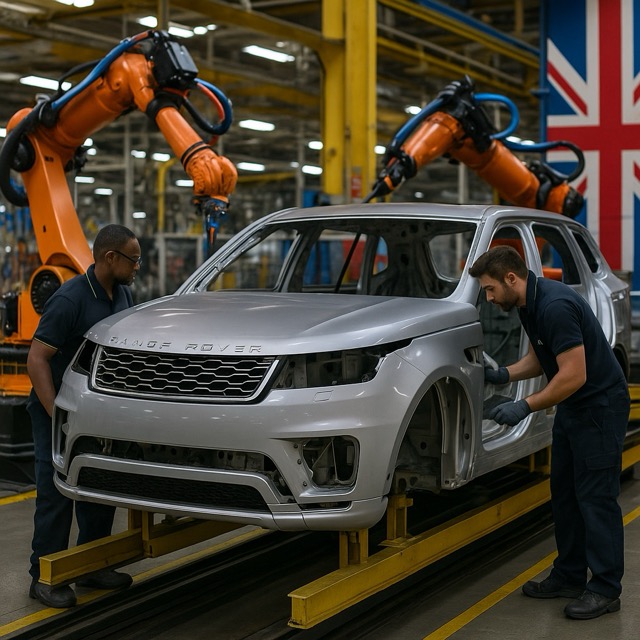
Inside Peter Kyle’s rare ministerial direction, the cyberattack that forced the issue, and what the guarantee really means for Britain’s auto supply chain
LONDON — Business and Trade Secretary Peter Kyle approved a government guarantee expected to unlock up to £1.5 billion in commercial lending to Jaguar Land Rover (JLR). The decision — taken via a rare ministerial direction that overrode a senior civil servant’s reservations — followed one of the most disruptive cyberattacks to hit a British manufacturer in years and aimed to stabilise a fragile ecosystem of suppliers that had begun to buckle.
The backing comes through the Export Development Guarantee (EDG), a UK Export Finance instrument that allows government to underwrite a large share of the risk on a private loan. In this case, officials have signalled coverage of up to 80 percent, allowing banks to advance liquidity more cheaply and more quickly than the carmaker might otherwise secure in the immediate aftermath of the attack. The government argues the move will protect jobs and preserve export capacity. Critics counter that it props up a profitable, well‑capitalised company while doing too little for the small firms that have borne the brunt of the shutdown.
Kyle framed the intervention in stark terms. A late‑August breach forced JLR to halt production and rebuild core IT systems, with knock‑on effects rippling throughout the Midlands and Merseyside. For dozens of tier‑two and tier‑three suppliers — businesses that often run on thin margins and tight cash cycles — the stoppage meant delayed purchase orders, idled lines, and an urgent hunt for working capital. “This was not only an attack on an iconic British brand, but on our world‑leading automotive sector and the livelihoods that depend on it,” he said in announcing the support.
Yet the manner of the decision has drawn as much attention as the money itself. A ministerial direction is Whitehall’s constitutional pressure valve: when a department’s accounting officer believes a programme may fall short on one of four tests — value for money, regularity, feasibility or propriety — the minister can order it to proceed regardless, placing personal responsibility on the political office‑holder. Such directions are uncommon, and their very rarity telegraphs the tension between economic urgency and stewardship of public risk.
Officials familiar with the process say the accounting officer’s concerns focused on risk and precedent. JLR, majority‑owned by Tata Motors, has returned to profitability and had secured significant private financing lines before the hack. Why, then, should the state stand behind new borrowing for a prime corporate borrower — particularly when the frontline distress is in the second‑ and third‑tier supplier base? The fear, according to one senior figure, is moral hazard: once the government backstops an industry champion at the first sign of stress, other companies may expect similar treatment.
For ministers, the counter‑case is straightforward: systemic risk. JLR is one of the UK’s largest manufacturers and exporters, an anchor for regional clusters of engineering, tooling and logistics firms. If its payment cycle stalls, the liquidity shock propagates to smaller firms with less bargaining power at their banks. In recent days, suppliers described being asked for personal guarantees — even their homes — as collateral for emergency loans. Against that backdrop, the guarantee buys time: it shores up the OEM’s ability to restart lines and push cash faster through the chain.
The attack itself has become a case study in operational fragility. Although JLR has brought core systems back online and begun phased restarts, the episode exposed how interdependent modern auto manufacturing has become. Production lines are synchronised to the minute; software integrates everything from procurement to paint‑shop robotics; even modest IT disruptions cascade into missed takt times and costly rework. In the weeks after the breach, some plants sat quiet while teams rebuilt servers, validated data integrity and re‑established supplier interfaces.
What, precisely, does the £1.5 billion do? Structurally, the EDG means commercial banks can extend a multi‑year loan at terms reflecting sovereign support for most of the risk. People close to the deal say a syndicate of UK and international lenders is prepared to participate, with the government’s contingent liability capped at its guarantee percentage. JLR is expected to deploy the funds to bolster working capital, accelerate payments to critical suppliers and cushion the restart curve as production ramps back from weeks of interruption.
On paper, the arrangement is fiscally cautious: the state does not hand over cash unless the borrower defaults. But directions exist because the accounting officer must imagine worst‑case scenarios. If cyber disruptions recur or market conditions sour, the guarantee could crystallise into a real cost. Set against that are the costs of inaction — plant closures, permanent supplier exits and lost export share to European rivals — which are harder to quantify but all too plausible in a just‑in‑time industry.
JLR’s parent, Tata, has reasons to welcome the show of confidence. The group is in the midst of a capital‑intensive transition, electrifying model lines and retooling for software‑defined vehicles. It is also tied to a major UK battery manufacturing project — a pillar of the country’s attempt to retain high‑value automotive jobs as combustion engines phase out. A disorderly episode now could bleed talent and gum up investment schedules. The guarantee, modest against the group’s balance sheet, is intended as a circuit‑breaker rather than a blank cheque.
Still, critics note that none of this directly pays a parts maker’s wage bill this Friday. Trade bodies for small and medium‑sized engineering firms have called for targeted relief: quicker invoice settlement, temporary tax deferrals, easier access to British Business Bank schemes and government‑brokered standstills with lenders. Without such measures, they argue, a guarantee at the top of the pyramid may take too long to filter down. Cash flow — not credit ratings — is the existential threat for the long tail of suppliers.
The politics are as intricate as the accounting. A new government eager to project competence cannot be seen dithering in the face of a high‑profile industrial incident. Nor can it afford the charge that it socialises risk for corporate giants while leaving the “foundation economy” exposed. By issuing a direction, Kyle has accepted personal accountability if the bet goes wrong — a boldness his allies cast as leadership and his opponents as imprudence. The Treasury will watch closely how quickly the guarantee translates into supplier payments and rising throughput.
There is also a broader policy test: how should states respond to cyber shocks that threaten critical economic nodes? After a decade of urging firms to harden defences through regulation and insurance, governments are confronting the reality that some risks are too interconnected to leave to private balance sheets. Loan guarantees are one tool in a limited kit. Public‑private cyber response frameworks, minimum resilience standards for just‑in‑time production and pre‑agreed supplier support mechanisms may all be needed for the next crisis.
Inside JLR, the practical questions now dominate. Which lines start first? Which suppliers are paid on accelerated terms, and which must wait? How quickly can the company chew through the repair backlog without compounding quality risk? Managers say the company has resumed some manufacturing and reopened key payment systems, focusing on stabilising parts flow and giving smaller vendors the predictability they need to keep staff on the shop floor. Success will be measured less by headline loan sizes than by lead times, fill rates and overtime rosters.
Two truths can be held at once. First, the ministerial direction signals an extraordinary moment — proof that cyber risk has leapt from the server room to the Cabinet table, with taxpayers implicitly on the hook. Second, the UK’s automotive heartlands will judge the decision by outcomes they can touch: machines running, deliveries going out and overtime returning. The government has bought time at a price. What it does with that time — to support the long tail of suppliers and strengthen resilience — will determine whether this episode is remembered as decisive stewardship or a missed opportunity.
For now, the industry watches the dashboards: production schedules inching up, arrears ticking down and bank credit committees softening. If those indicators improve by late October, the gamble will look wise. If not, expect louder calls for a second‑order response aimed squarely at the small firms for whom a week’s delay is the difference between survival and closure.



 The Tower Post