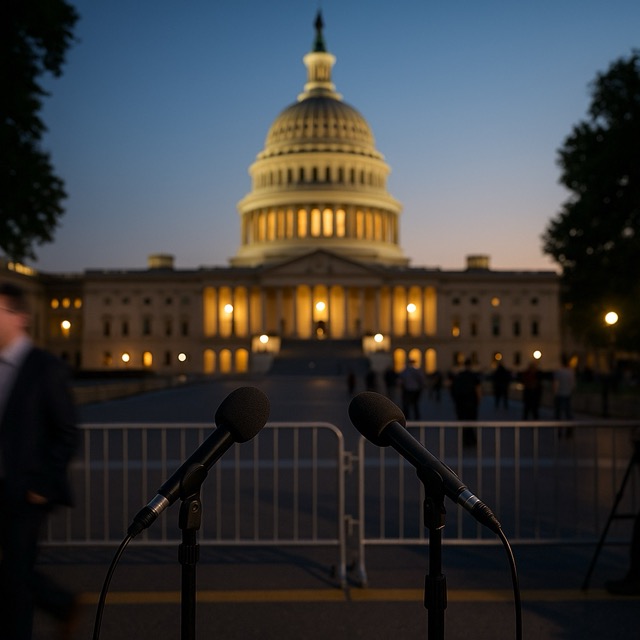
With Washington dark, Trump and Democrats escalate blame to sway a weary electorate
WASHINGTON — The second U.S. federal shutdown in nearly seven years has opened a new front in America’s permanent campaign: a messaging battle designed as much for November’s voters as for negotiators at the Capitol. President Donald Trump and Democratic leaders are trading hourly accusations about who turned off the lights, seeking to define the terms of the standoff before its economic and political costs harden into public memory.
At the center of the impasse is a dispute over whether to bundle an extension of enhanced Affordable Care Act premium tax credits into a stopgap funding bill. Democrats call the credits—expanded during the pandemic and now set to expire—non‑negotiable, arguing that letting them lapse would spike premiums and could push older and rural Americans out of coverage just as open enrollment begins on November 1. Republicans say Democrats are holding the government hostage over a long‑term policy fight that can be negotiated later, insisting on a short‑term funding measure first.
The shutdown arrived at 12:01 a.m. on October 1 after the Senate failed to advance rival plans, locking hundreds of thousands of federal employees out of work and requiring hundreds of thousands more to report without pay. Essential services continue—airports remain open, Social Security checks go out—but the ripples are real: from stalled research at the National Institutes of Health to uncertainty for the Women, Infants and Children nutrition program and delayed inspections and permits that businesses rely on.
Both sides entered the crisis with ready‑made narratives. The White House has cast the closure as the product of Republican obstruction and an unwillingness to protect families’ health costs. Republicans counter that Democrats engineered the showdown by jamming a policy wish list into a must‑pass bill. Within minutes of the lights going dark, party committees blasted fundraising emails, and leaders flooded television hits and social feeds with slickly edited clips tailored to their base.
Polling in the first 48 hours offers an early snapshot of the blame game’s trajectory. A Washington Post survey found a plurality of Americans more likely to fault Trump and congressional Republicans than Democrats, though partisanship remains the strongest predictor of whom respondents blame. That split mirrors the post‑2018 pattern: independents tend to punish the party seen as forcing a crisis, though their views can shift quickly if the economic fallout becomes more visible.
Economists warn that visibility is coming fast. An internal White House analysis estimates the economy could forfeit roughly $15 billion in output for each week the shutdown drags on, with consumer spending softening and as many as tens of thousands more Americans out of work if the closure lasts a month. A Europe‑based credit rater, Scope, cautioned that prolonged dysfunction could pressure the U.S. rating and reinforce perceptions of a polarized, less predictable policy environment—particularly given already large deficits and rising debt burdens.
The political incentives are murkier. For Trump, the showdown is a chance to re‑rally the coalition that delivered the White House—particularly voters skeptical of federal spending and hostile to anything branded as an Obamacare expansion. For Democrats, it is an opportunity to defend a tangible kitchen‑table benefit that touches millions of households while painting Republicans as cavalier about health care costs. Both calculations point toward sharper rhetoric, not compromise.
Inside the Capitol, the mechanics are as important as the messages. Senate Republicans argue that a ‘clean’ continuing resolution—free of the ACA subsidy extension—could pass quickly and reopen the government while talks continue. Democrats, backed by committee chairs who oversee health programs, say that approach would sow confusion during the open‑enrollment run‑up and risk premium spikes if negotiations stall. Each side says the other is gambling with real lives to gain leverage.
Beyond Washington, the impacts slice across constituencies both parties court. Contractors face unpaid invoices that some small firms can’t float for long. Tourism‑dependent communities—think national parks and nearby gateway towns—brace for cancellations. Scientific agencies weigh pausing grant cycles, jeopardizing graduate students’ stipends and lab timelines. Air travel remains largely functional, but hiring and training pipelines for air traffic controllers slow, reviving memories of stress and delays from past shutdowns.
Strategists in both camps privately concede that the longer the shutdown lasts, the higher the risk of collateral damage. The Trump campaign wants to keep the story on Democratic ‘hostage‑taking’ and rising prices; Democrats want to talk about family premiums and broken promises. But a month of halted paychecks, clogged services and social media videos of frustrated federal workers would swamp talking points. That is where independents live—and where elections are decided.
History offers cross‑pressures, not a blueprint. The 2013 shutdown over the Affordable Care Act initially harmed Republicans’ standing, but issue salience faded as other crises dominated. The 2018–19 closure, the longest on record, dented the party in power more clearly. Today’s scenario is different: the fight is explicitly about health subsidies during a period of elevated prices and economic anxiety, and it unfolds with a president who embraces confrontation as a governing style.
Still, the arithmetic of compromise has not changed. A deal will require giving the other side a headline: Republicans need a path to claim they didn’t sign off on a ‘blank check’ for Obamacare; Democrats need certainty that families won’t see premium shocks mid‑enrollment. That could mean a short extension of the credits paired with targeted cuts or oversight sweeteners. Or it could mean a brief stopgap to reopen the government with a hard deadline for a health‑care vote. The more public the feud grows, the higher the political price for whichever side moves first.
For now, leaders are content to test‑market blame. House and Senate Republicans amplify clips accusing Democrats of ‘manufacturing a crisis’ and rejecting a straightforward bill to keep the lights on. Democrats, for their part, spotlight families whose budgets hinge on the subsidies and point to projections of higher premiums without congressional action. Each side believes the other will blink first; neither wants to be seen blinking at all.
The truth is simpler, and grimmer. Government shutdowns are failures by definition. They don’t settle ideological disputes so much as delay them, while extracting economic and human costs with little to show beyond hardened feelings. As one veteran appropriator put it this week, ‘There are no winners here—only the bill.’ Whether voters agree may depend less on whose ad is better than on who feels the pain first—and for how long.
Sources
– Washington Post, Oct. 2, 2025: ACA premium tax credits at center of shutdown; early polling on blame.
– Reuters, Oct. 1–2, 2025: Live updates on shutdown; Scope Ratings warns of credit impact.
– POLITICO, Oct. 1, 2025: White House memo estimates ~$15B weekly GDP hit, 43k additional unemployed if month‑long shutdown.
– CBS News, Oct. 1–2, 2025: Live coverage as shutdown begins and enters second day; impacts on travel and services.
– The Guardian, Oct. 1–2, 2025: Both parties trade blame as government closes.



 The Tower Post