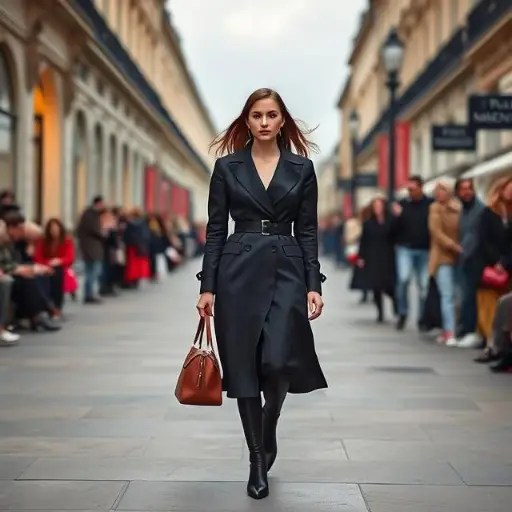
How a 16-Year-Old Brit’s Time in Paris Set the Stage for a Fashion Legacy
Jane Birkin’s journey from a directionless teenager to a French style icon began in 1963 when her family sent her to Paris for a few months. Initially unenthusiastic about the move, Birkin found herself immersed in a cultural environment that would shape her future. Living with a group of young women in the home of Madame P., also known as Countess Puget, she received private lessons on the French lifestyle, including cooking, art, and language. Despite her struggles with the French language, her heavy English accent and “franglais” would become a source of endearment, amusement, and even derision for the rest of her life.
Her time in Paris was marked by encounters with famous figures like Edith Piaf, who had recently passed away, and Françoise Hardy, a popular French singer of the era. Birkin, with her long bangs and brownish-blond hair, bore a resemblance to Hardy, and the experience left an impression on her. She even recorded the moment in her diary, expressing both disbelief and flattery at being mistaken for the singer. Hardy, who was only three years older than her, had already established herself as a cultural icon, and Birkin felt both inspired and humbled by the encounter.
Upon returning to London in 1964, Birkin found herself transformed. The grey buildings and towering brick of London felt foreign after her time in Paris. She began to embrace the Youthquake, a cultural shift that redefined fashion and social norms in the UK. This era, marked by the rise of miniskirts, bold makeup, and a new sense of freedom, allowed Birkin to experiment with her style. She cut her own hair, wore tight jeans, and embraced the theatrical energy of the times.
Her fashion sense, influenced by the bold trends of the 1960s, would go on to inspire generations of fashion enthusiasts. Birkin’s eclectic style, marked by her signature Portuguese basket, bangs, and eyeliner, became instantly recognizable. She was not just a style icon but a symbol of the changing times, embodying the carefree energy of a new generation.
In the 1960s, the female ideal in fashion shifted dramatically. Models like Twiggy and Jean Shrimpton, who were coltish and far removed from the patrician figures of the 1950s, became the new standard. Birkin, who had previously been bullied for her body, found a new sense of confidence in this era of liberation. She was also influenced by the actress Julie Christie, whom she admired for her unpretentious and eclectic style.
Birkin’s journey from a teenage girl sent to Paris to become a proper young lady to a cultural phenomenon is a testament to the power of self-expression and reinvention. Her time in Paris was the catalyst for a transformation that would not only redefine her own identity but also leave an indelible mark on the world of fashion.
In 1967, Birkin met French filmmaker and designer Jean-Claude Birkin, and the couple soon became one of the most iconic and romantic pairs in the world of fashion and entertainment. Their relationship, though ultimately tumultuous, would lead to the creation of the iconic Birkin bag, a symbol of luxury and elegance that is still produced by Hermès today.
As the world remembers her for the iconic Birkin bag, it’s worth noting that her journey began with a teenage girl sent to Paris to become a proper young lady. Instead, she became a cultural phenomenon, forever altering the landscape of fashion and style.




 The Tower Post